





A collage of Dwayne “The Rock” Johnson, Jason Momoa, H.E.R., Kamala Harris, Bruno Mars, Keanu Reeves, Naomi Osaka, and Juju Smith-Schuster.
Module 1: Overview: Multiracial Pacific Islanders and Asian Americans
Does learning about the experiences of multiracial Pacific Islanders and Asian Americans reveal ways to combat racism?
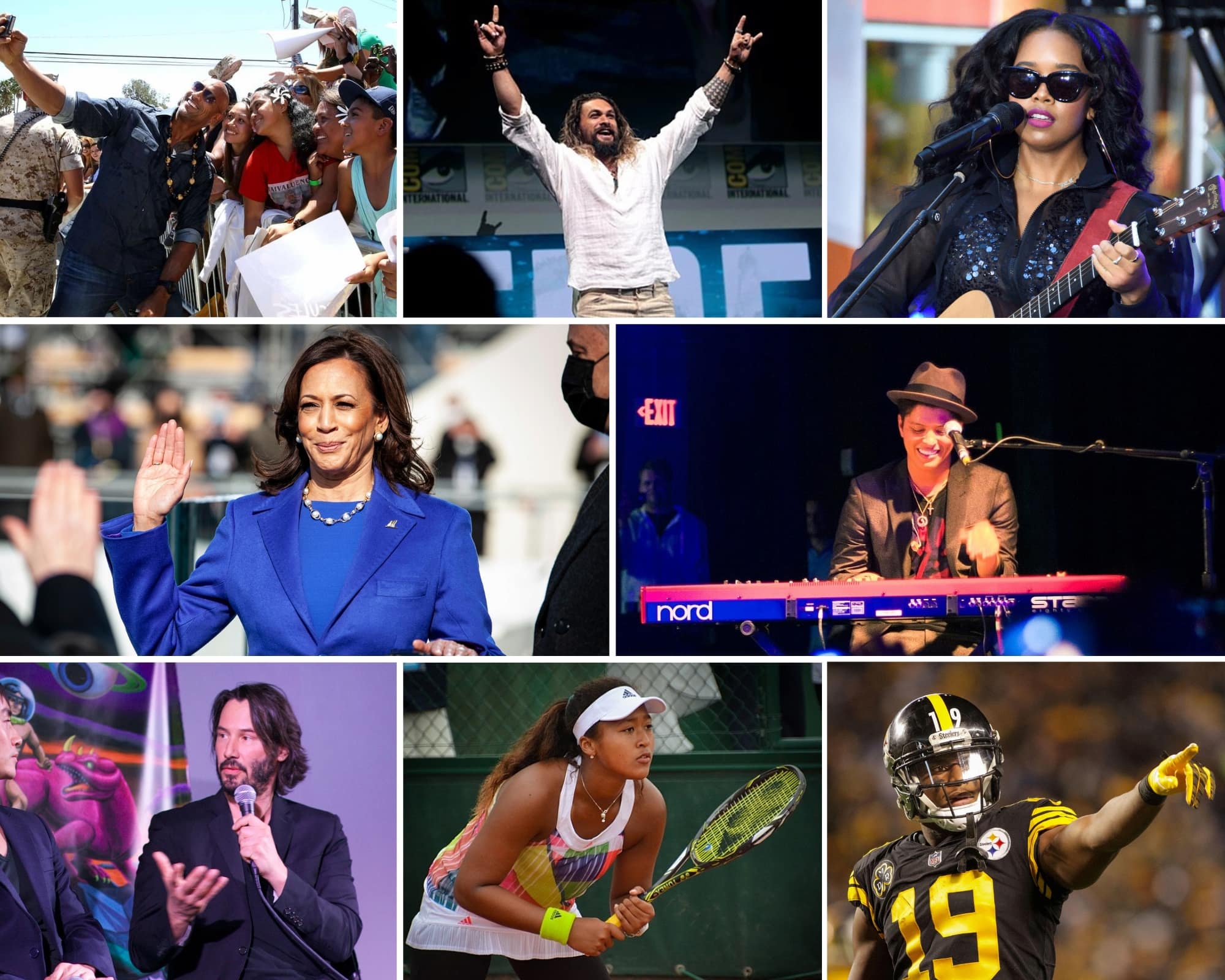
Image 34.01.01 — Dwayne “The Rock” Johnson, Jason Momoa, H.E.R., Kamala Harris, Bruno Mars, Keanu Reeves, Naomi Osaka, and Juju Smith-Schuster are among the most famous multiracial Pacific Islanders and Asian Americans in the US.
Dwayne “The Rock” Johnson. H.E.R. Juju Smith-Schuster. Keanu Reeves. Kamala Harris. Bruno Mars. Naomi Osaka. Jason Momoa. These names represent some of the most famous multiracial Pacific Islanders and Asian Americans in the United States. In this chapter, we discuss the history and experiences of multiracial people, focusing on Pacific Islanders and Asian Americans who identify with more than one racial category.
This chapter looks at who multiracial Pacific Islanders and Asian Americans are, how they create their racial identities, and how they shape our ideas about race. We also examine media representations of these groups, including mainstream films and mixed race memoirs.
This first module gives an overview of anti-miscegenation laws that once prohibited interracial marriage in the United States. It also offers a snapshot of the various backgrounds of multiracial Pacific Islanders and Asian Americans and where they live. By connecting these historic laws to current demographics, we can understand changes in this population over time and their impacts on our ideas of race.
What are the key concepts that help us understand multiracial people?
Who are multiracial Pacific Islanders and Asian Americans, what are their population numbers, and where do they live?
How do laws inform the history of multiracial people in the US?
Key Concepts
We learn about the increasing number of multiracial people from the US Census, a survey the government conducts every ten years. People fill out the census by providing information about, among other things, their incomes, education, and racial self-identification. Whereas the vast majority of Americans select only one racial category, those who select two or more categories are now the fastest-growing population in the United States.
The term “biracial” is used to describe people whose parents come from two different racial backgrounds, such as “Asian and Latina,” or “Black and white.” Multiracial people may identify with more than two backgrounds, including “Black, Filipino, and Chinese,” or “Cherokee, African, and white.”
Multiracial people challenge the idea of monoracialism, or the expectation that individuals have only one racial identity, and that it matches their parents. Multiracialism disrupts the idea that people in the United States fit neatly into one racial category. Like cross-racial adoptees (for example, a Korean child adopted by a white family), multiracial children may identify differently than either parent.
Since multiracial people challenge our expectations about race, others often question their identities. One of the most common questions faced by multiracial people, especially those who are difficult to categorize, is: “What are you?” People with multiple ancestries are often asked which community they belong to and may feel pressured to “choose one,” making it difficult to feel fully accepted in any group.
Monoracism and Multiracial Backgrounds
Some multiracial people may have certain privileges, such as lighter skin complexions or connections through white family members. However, they may also face monoracism, a form of oppression against people who do not fit into one racial category. This can include the idea that they are disloyal and untrustworthy, being racially misidentified, or being accused of using their racial backgrounds only for strategic gain.
Because of the country’s history with slavery and white-dominated institutions, the US has long used a Black-and-white system to classify people. This explains why many Americans think of biracial people only as Black and white, such as former president Barack Obama, rapper J. Cole, and actress Halle Berry. Most multiracial Americans have one white parent and one non-white parent. For example, Barack Obama’s mother was a white woman from Kansas and his father was a Black immigrant from Kenya. According to the US Census, the most common multiracial background is “White and Some Other Race,” followed by “White and American Indian and Alaska Native.”
However, many people now identify with more than one race and do not have a white parent. For example, actor Dwayne Johnson is Black and Samoan, and musician Saweetie is Black, Chinese, and Filipino. When former vice president Kamala Harris, whose mother is Indian and father is Black Jamaican, ran for US president in 2024, many Americans questioned her racial identity. Many Americans are confused about multiracial people, especially dual-minority biracials, or mixed people who do not have a white parent.
The US Census
Multiracials are the fastest-growing population in the US, as one in ten Americans identify with more than one race. This shift reflects changing ideas about race. Americans once thought there were three main races: “Mongolian,” “Negroid,” and “Caucasoid.” Today, we tend to refer to five main racial categories: white, Black, Native or Indigenous, Asian, and Latina/o. While the US Census does not include “Latino” among its racial categories, in this chapter we do. Beginning in the 2030 Census, a new racial category of “Middle Eastern or North African” (MENA), previously subsumed as an identity under the “White” category, will be added. Although the census does not always capture on-the-ground realities, changing census categories reveal the social nature of race, which is dynamic rather than fixed.
Instead of only an “Asian” category, the census allows people to choose from a list of over twenty Asian ethnicities, such as Asian Indian (formerly categorized as “White”), Korean, or Filipino. The large racial category of “Asian” lumps together numerous national and ethnic groups under one label. Pacific Islanders—who are distinct from Asian Americans—are people Indigenous to societies in Oceania (the Pacific). The census lists over thirty groups under the label “Native Hawaiian and Other Pacific Islander,” including Tongans, Māori, Kānaka Maoli (also referred to as Native Hawaiians or Kānaka ʻŌiwi), Marshallese, and Papua New Guinean. The populations of Pacific Islanders and Asians in the United States have increased substantially over time, as have the numbers of their multiracial children.
Why has the multiracial population risen so quickly in the past fifteen years, from almost 3 percent of the US population to over 10 percent? Why do some multiracial people, including former president Barack Obama, choose only one racial category on the census, but often code-switch, or change identifications, based on the context? Is it because more people are marrying across racial lines? The answers lie in the long history of the United States. This history includes laws regulating marriage, the mainstream media’s portrayal of multiracial people, and multiracial identity formation and self-representation.
Anti-Miscegenation Laws
A central concern of American colonists was regulating interracial marriages. In 1661, over a hundred years before we formally became “the United States,” the colony of Virginia enforced an anti-miscegenation law prohibiting interracial marriage between a white person and non-white person. The law’s clear intention was to ban the union of Black men with white women. Monitoring interracial unions was tied to the system of slavery. That same year, Virginia passed its first law formally allowing the ongoing practice of slavery. Over time, thirty states enacted anti-miscegenation laws, later expanding to include other categories beyond Black and white.
The regulation of Black/white marriage was tied to slavery, and the regulation of Asian/white marriage was tied to restricting citizenship and immigration. Both restrictions helped maintain white privilege. On the West Coast, anti-miscegenation laws prohibited marriages between white people and Native Americans, “Malays” (Filipinos), “Mongolians” (Chinese), and “Hindus” or “Asiatic Indians” (Indians).
States in the West and Southwest added these categories because their populations included immigrants from Asia and large Native American populations. California’s 1880 law prohibiting marriage between “Mongolian” (Chinese) men and white women was quickly followed by the exclusion of Chinese laborers through the Chinese Exclusion Act of 1882. It was not until 1967, with the US Supreme Court case Loving v. Virginia, that anti-miscegenation laws were finally deemed unconstitutional across the nation.
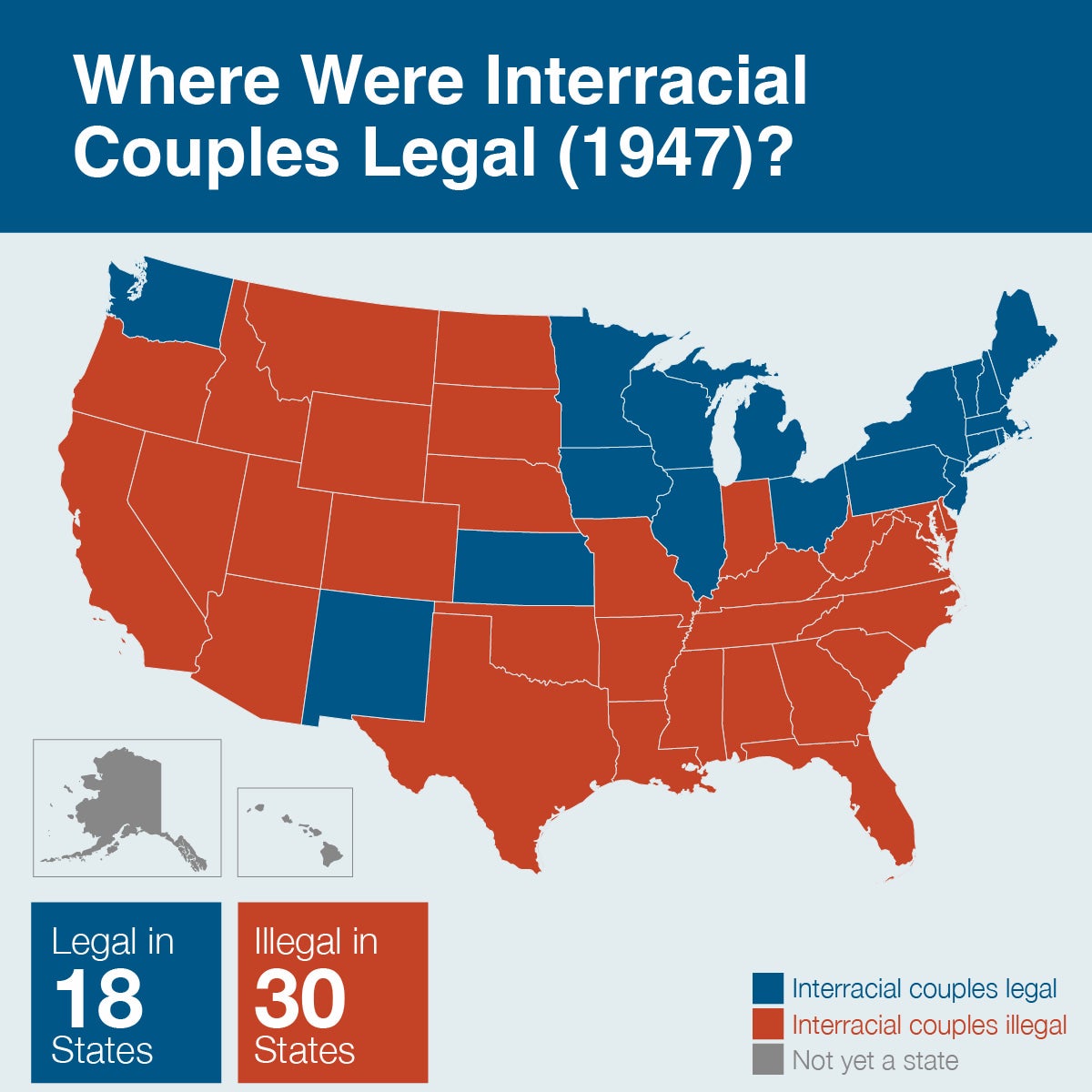
Image 34.01.03a — This map depicts which states restricted interracial marriage and relationships in 1947, two decades before the US Supreme Court case Loving v. Virginia. (Source: Loving Day)
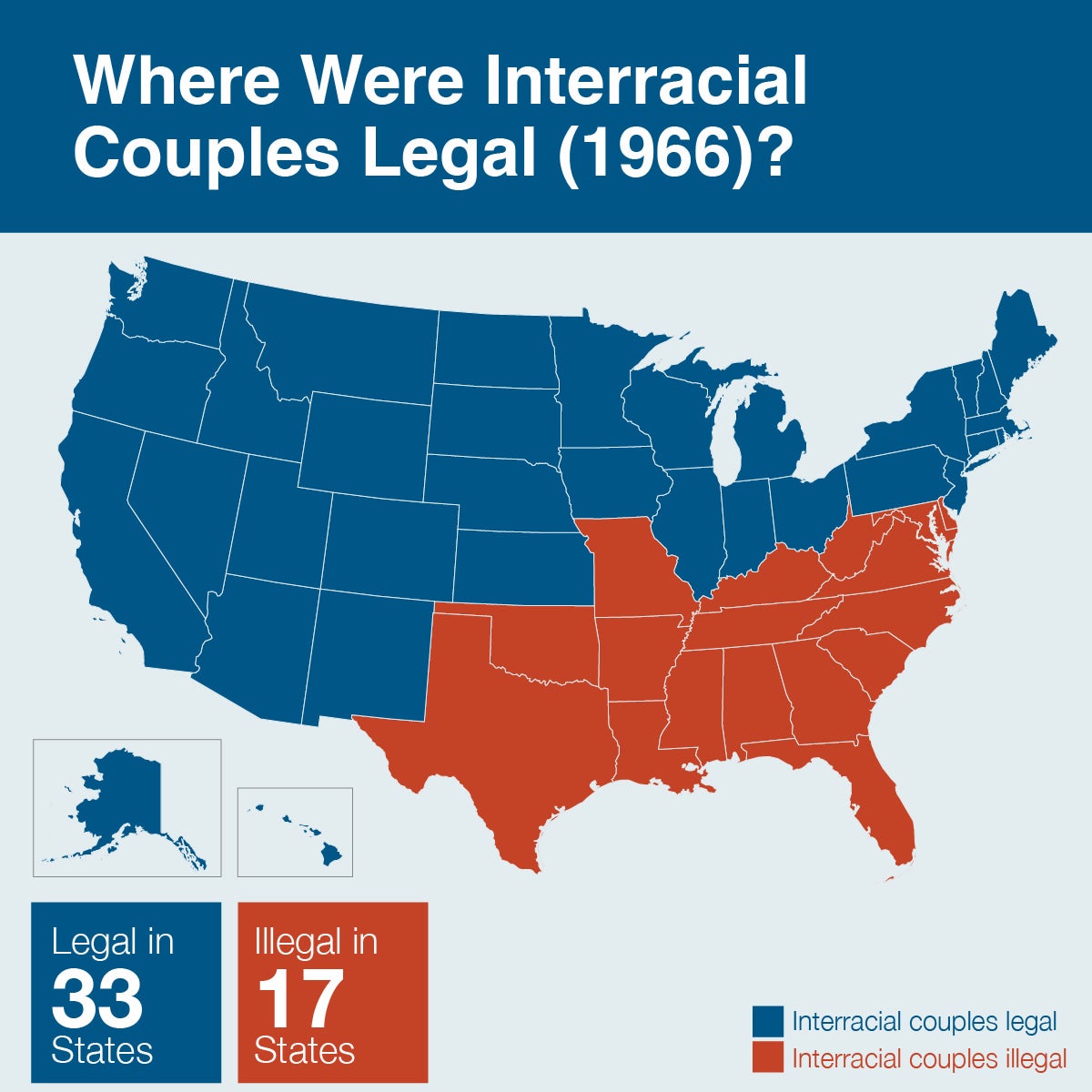
Image 34.01.03b — This map depicts which states restricted interracial marriage and relationships in 1966, the year before the US Supreme Court case Loving v. Virginia. (Source: Loving Day)
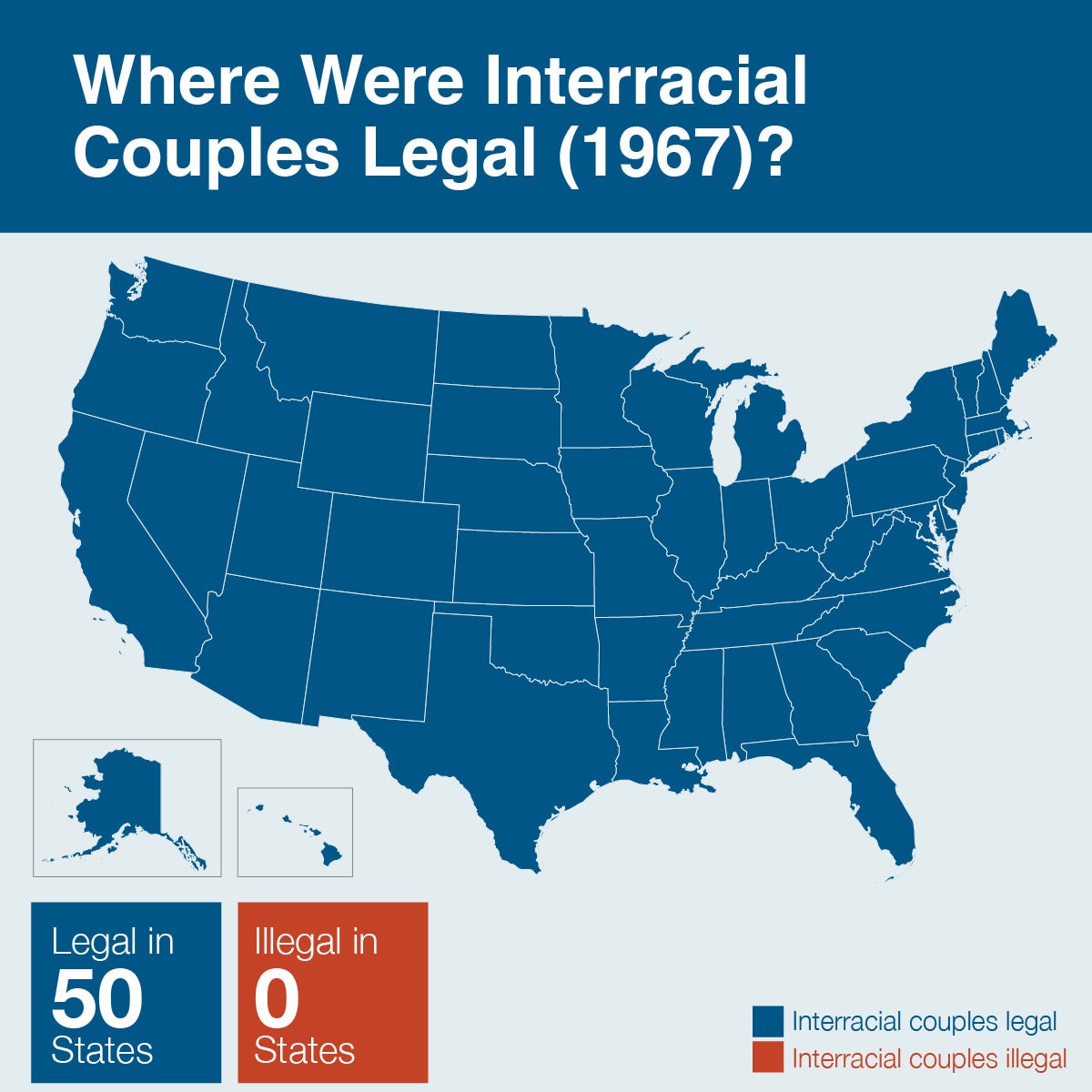
Image 34.01.03c — This map depicts which states restricted interracial marriage and relationships in 1967 following the US Supreme Court case Loving v. Virginia. (Source: Loving Day)



The national obsession with preventing interracial marriages was primarily about preserving the idea of “white purity,” or the idea that whiteness was not to be “diluted.” This notion was key to maintaining power and privilege in the hands of powerful white landowning men. Therefore, anti-miscegenation laws were as much about keeping races separate as they were a tool used to define race through the law, and thus keep money, land, and political power in the hands of those deemed superior.
People considered a marriage between a nonwhite man and a white woman threatening because it could create mixed children. Such unions and their children would disrupt the functioning of systems, such as slavery, and efforts to create a mostly white nation by restricting citizenship. These laws were based on the idea that there are distinct, separate races of humans that should remain so.
Drawing upon their ability to make decisions about their own lives, people throughout history have resisted such oppressive and restrictive treatment. In the context of these laws, for instance, some Pacific Islanders and Asians in the United States and the Pacific created new communities that evaded these laws.
For example, Mexican Filipino communities of Mexipinos formed in the early twentieth century in the San Diego region. Farther north in the Imperial Valley of California, there are generations of Punjabi Mexican descendants of Indian migrant men who married Mexican women. In Hawaiʻi, the term hapa haole arose from the Hawaiian word hapa, meaning “of mixed blood.” It now refers to people who are Native Hawaiian and haole (white). In Samoan, afakasi means “half caste,” referring to those who are Samoan and palagi (white). In the New York neighborhood of Harlem, South Asian male migrants married Black and Puerto Rican women in the early 1900s, developing “Bengali Harlem.”
“Being mixed” is not a new phenomenon, and multiracial people have existed since the notion of race was invented. However, American colonists were concerned with regulating interracial marriages because these unions and their children challenged systems built on the idea of separate races, including slavery and US citizenship.
Who Are Multiracial Pacific Islanders and Asian Americans and Where Do They Live?
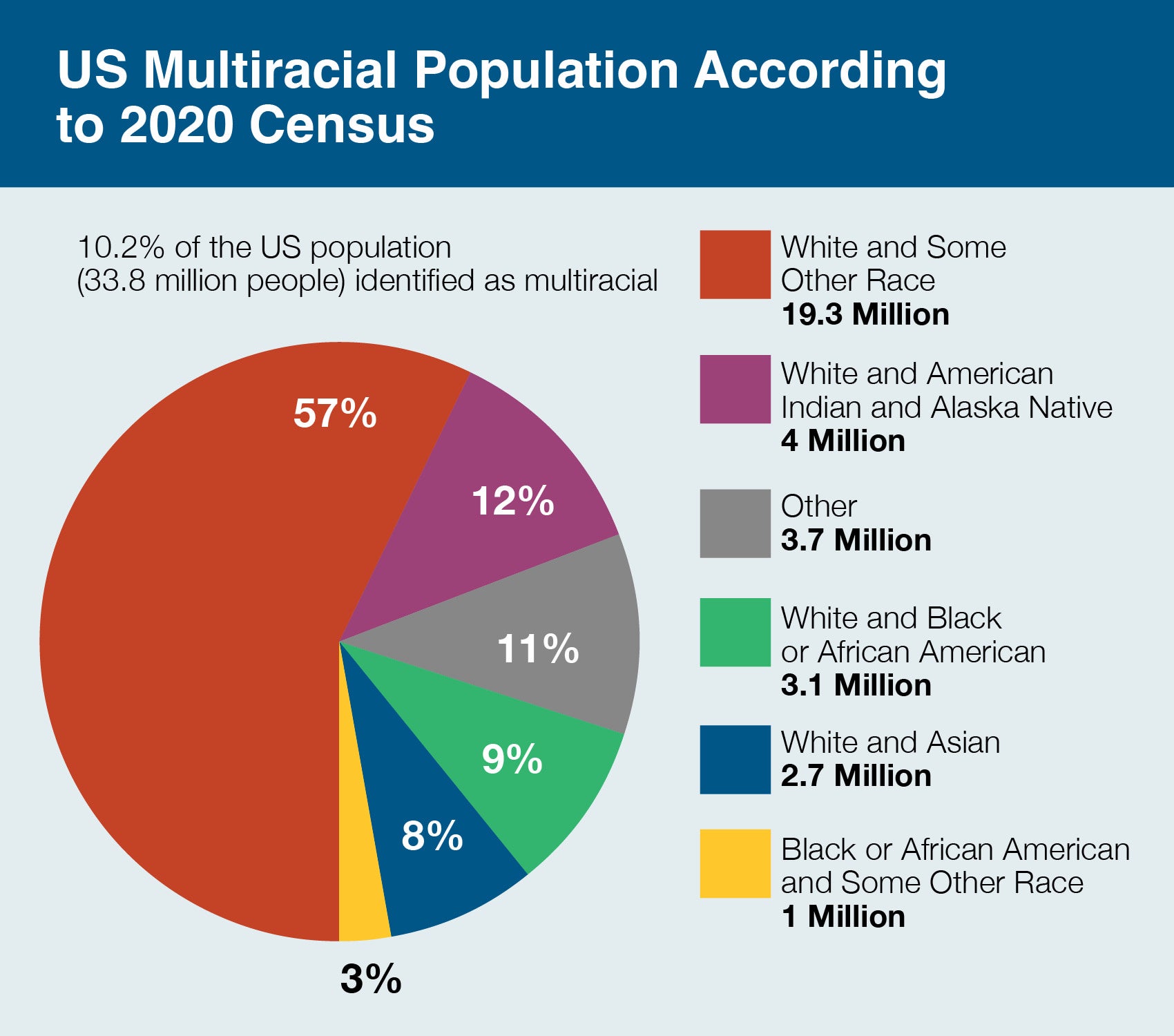
Image 34.01.04 — Among the 10.2 percent of the United States population that selected more than one racial category on the 2020 Census, the largest combination was “White and Some Other Race.” “White and Asian” was the fourth most common combination. (Source: US Census Bureau, 2020)
The US Census Bureau collects demographic information, including birth rates, racial identities, marriage patterns, and where people live in America. In the 2020 Census, 10.2 percent of the US population selected more than one racial category. The largest combination was “White and Some Other Race” (19.3 million people) followed by “White and American Indian and Alaska Native” (4 million), and “White and Black or African American” (3.1 million). The fourth most common combination was “White and Asian” (2.7 million). These numbers reflect the larger size of the US white and Black populations compared with Pacific Islanders and Asian Americans.
States with the highest proportions of multiracial people in 2020 were:
- Hawaiʻi: 25.3 percent
- Texas: 17.6 percent
- Florida: 16.5 percent
- California: 14.6 percent
- New Mexico: 9.9 percent
These states have diverse demographics and particularly high numbers of Asian, Native American, and Latino communities.
Over half of Native Hawaiians and Pacific Islanders identify as mixed. At much lower but still significant rates, about 17 percent of Asian Americans identify as multiracial (about 4.1 million Americans), with over half of those identifying as Asian and white. While earlier Asian migrants faced anti-miscegenation laws, it was different for Pacific Islanders whose legal systems tended not to have race-based marriage prohibitions. In addition, Pacific Islanders have had long and direct interaction with Europeans, dating back centuries through whaling, missionaries, and colonialism. As a result, many Pacific Islanders, like Native Hawaiians, have been mixed for generations, with ancestors who are not only Kānaka Maoli (Native Hawaiian), but also, for example, Scottish, British, Portuguese, and Chinese.
It is important to note the distinction between Indigeneity and race, especially as many Pacific Islanders, despite their mixed heritage, may identify as “just” Fijian for example, even if they also have ancestors from India or England. Racial identification is often imposed on people based on existing categories related to their phenotype or looks. Indigeneity, however, is a political and legal identity rooted in a person’s genealogical connection to the land of their ancestors.
Many Pacific Islanders may be mixed for generations—their parents and grandparents may also be multiracial—whereas many Asian Americans are biracial: their parents are not mixed and represent two different backgrounds. Singer H.E.R., for instance, has a Filipina mother and a Black father (although many African Americans are also multiracial). A significant proportion of Japanese, Koreans, Filipinos, Thais, and Indonesians in the United States identify with more than one race.
Conclusion
Multiracials are the fastest-growing population in the United States, yet they have been part of Pacific Islander and Asian American communities for centuries. Where they live across the nation is shaped by historical systems of slavery and immigration, as well as the regulation of marriages and citizenship. Whereas most multiracial people identify as part white, there are growing numbers of dual-minority multiracial people. The US Census is one tool that charts these demographic changes in the nation.
People who identify with more than one race challenge traditional ideas about race, including monoracialism, or the expectation that people only have one race. Multiracial Pacific Islanders and Asian Americans often live in the Pacific and on the US West Coast. They contribute to our understanding of the complexity of identity, including how law and immigration shape what we think we know about “race” in the United States.
Glossary terms in this module
afakasi Where it’s used
A Samoan word developed in the context of Europeans’ (primarily German) presence in Sāmoa, initially meaning “half-caste.” The term generally refers to people of mixed ancestry in Sāmoa, especially those with (Indigenous) Samoan and European ancestry. Some people find this term problematic, whereas others consider it descriptive.
anti-miscegenation laws Where it’s used
Laws from as early as the 1660s that deemed marriages between white people and non-white people as illegal. More than thirty US states adopted these laws with the primary goal of preventing white women from marrying Black men, until these laws were expanded to include other populations like Chinese, Filipinos, and other nonwhite groups.
census Where it’s used
An official nationwide count that charts the US population over time through self-identification on a survey that is administered by the US government every ten years.
dual-minority biracials Where it’s used
Multiracial people who do not have a white parent. People also use the term “dual-minority multiracials.”
hapa Where it’s used
From the Hawaiian word meaning “of mixed blood,” this term now refers to a person who is part-Hawaiian and part haole (white). It can also include people with other racial backgrounds, such as Hawaiian and Korean, or Hawaiian and Black.
Loving v. Virginia Where it’s used
A 1967 US Supreme Court case that struck down antimiscegenation laws banning interracial marriages on the basis that they violated the Fourteenth Amendment prohibiting the government from discrimination.
Mexipinos Where it’s used
Refers to a person of Mexican and Filipino heritage. The term originated in San Diego, California, where Mexican women married and created families with Filipino men to form a multigenerational community of mixed Mexican Filipinos since the early 1900s.
monoracialism Where it’s used
The false assumption that individuals have only one racial identity, and that identity is the same as their parents’ identities. This assumption can lead to monoracism.
monoracism Where it’s used
A specific form of oppression against people who do not fit into or identify with only one racial category, including racial misidentification, an assumption that one is disloyal or untrustworthy, or assumption that one uses their racial backgrounds only for strategic gain.
multiracial Where it’s used
People who identify with more than one racial background, including people whose parents identify with different racial backgrounds.
Punjabi Mexicans Where it’s used
Refers to a person of Punjabi Indian and Mexican heritage, as well as to the larger community of primarily Punjabi men who married Mexican women in the Central and Imperial Valleys of California in the early 1900s.