





Module 2: Homeland Ties
To what extent are the histories and memories of colonialism part and parcel of Asian American and Pacific Islander identity?
Asian immigrants in the US have traditionally formed ethnic associations based on their places of origin. These groups provide mutual aid, observe cultural and religious customs, and nurture ethnic connections in unfamiliar, foreign, and often hostile environments.
First-generation immigrants, especially, have become champions of anti-colonial struggles in their home countries, often guided and led through exiled leaders who found sympathetic compatriots abroad. The diasporic communities of Chinese, Indian, and Korean descent helped raise funds, advocate for homeland political causes, and appealed to the American people and government for international support.
This module explores examples of anti-colonial political movements among Chinese Americans, Indian Americans, and Korean Americans.
What ties do immigrants maintain with their home countries?
To what extent do Asian American and Pacific Islander immigrants contribute to anti-colonial movements?
How do homeland politics affect Asian Americans and Pacific Islanders in the US?
China: Political Unrest in the Qing Dynasty
In the face of Western aggression and encroachments, the Qing Dynasty (1644–1911) faced a deep crisis. The Confucian system of hierarchical relations, which had dominated Chinese society for hundreds of years, was not able to accommodate demands for social reform, modernization, women’s rights, and equality among nations. The Qing was also practically bankrupt from the war indemnities it owed Western countries and from the cost of putting down the peasant-led Taiping Rebellion (1850–1864).
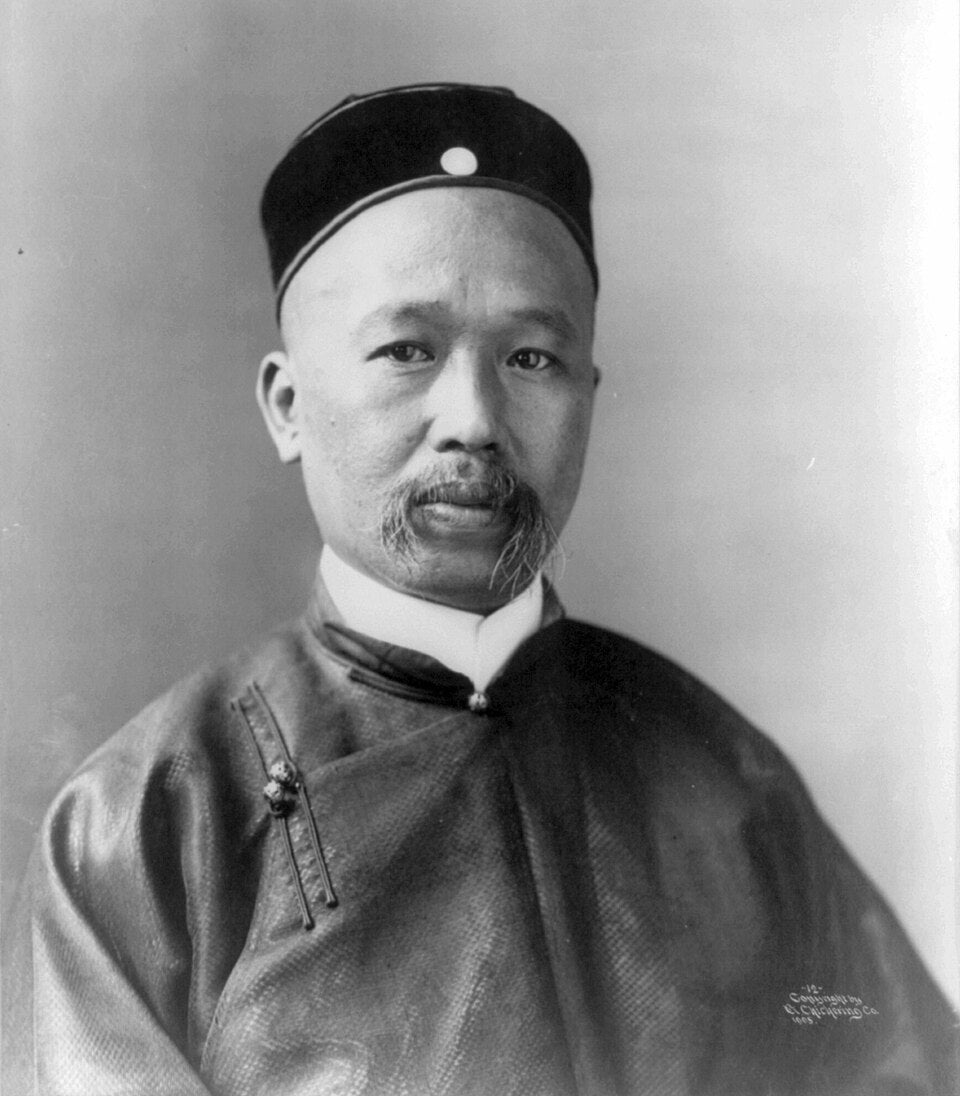
Image 03.02.01 — Chinese philosopher Kang Youwei (pictured in 1905) was chief advisor to Emperor Guanxu, and aimed to modernize China by adopting Western science and technology. He eventually fled to Canada and mobilized Chinese communities overseas.
Kang Youwei (1858–1927), a philosopher and reformer, came to prominence during the late Qing, reinterpreted the Confucian ideal of Great Unity or “datong,” in which he envisioned a utopian world based on peace, democracy, and equality.
In 1898, Kang was the chief advisor to Emperor Guangxu when he instituted the Hundred Days of Reform, aimed to modernize China by adopting Western science and technology. It abolished the two-thousand-year-old civil service exam, and rooted out corruption in the government.
Conservative elements in the court, led by the Empress Dowager Cixi, overthrew the Emperor and executed or exiled his advisors. Kang Youwei and his disciple Liang Qichao managed to escape and went into exile. They continued to forge ties with overseas Chinese communities and organized to modernize Qing China with reforms from abroad.
Kang went to Canada where he formed a reform party called the Protect the Emperor Society, or Baohuanghui. The party established 175 chapters around the world and set up newspapers, schools, and businesses. Its commercial corporation invested in real estate, restaurants, railways, and mining ventures in the United States, Canada, Mexico, and Southeast Asia.
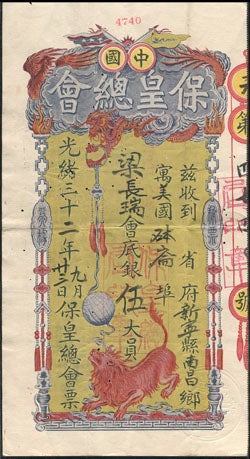
Image 03.02.02 — A membership certificate from 1906 for a member in Portland, Oregon, of the Baohuanghui (Protect the Emperor), a reform party founded by Kang Youwei, which focused on modernizing China.
By mobilizing communities of overseas Chinese, the party raised money and provided investment opportunities for Chinese excluded from mainstream Western economies. Kang believed overseas Chinese were integral to China’s modernization efforts. He wrote that emigration was a form of economic expansion driven by remittances, or money sent back to an immigrant’s home country, and is a sizable part of its economy. He also believed that the anti-Asian exclusionary policies of the US and other Western countries threatened China’s survival and expansion abroad.
Image 03.02.03 — Liang Qichao (1910) took up exile in Yokohama, Japan, where he published the influential New Citizen Journal newspaper.
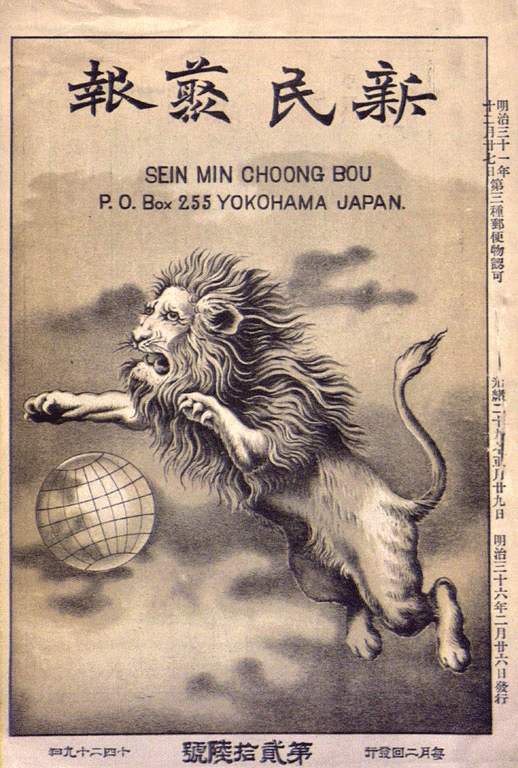
Liang Qichao took up exile in Yokohama, Japan. From there, he published the newspaper, New Citizen Journal, or Xinmin congbao, which was part of a new, energetic print culture in Chinese cities. Dozens of newspapers and magazines ran the gamut of moderate and radical politics to intellectual and popular genres. They took up issues such as foreign relations, the examination system, foot binding, hygiene, beauty, taste, style, and more.
The New Citizen Journal was enormously influential. Liang’s friend, the diplomat and scholar, Huang Zunxian, praised Liang’s writing for its power to “move hearts and shock minds.” In 1903 Liang toured twenty-two US and Canadian cities, and wrote his observations in the “Travelogue of the New Continent,” which was serialized in the New Citizen Journal. It offered Chinese readers a comprehensive account of the Chinese communities in North America, or huaqiao, with a searing critique of its racist Exclusion Acts.

Image 03.02.04 — A cover for an edition of the New Citizen Journal, or Xinmin congbao, from 1903. The highly influential newspaper was published by Liang Qichao who was in exile in Japan.
Chinese Diaspora and Political Expression
Huang Zunxian served as the Qing consul in San Francisco in the 1880s. While stationed in California, Huang helped Chinese Americans file lawsuits against discriminatory laws. These included Tape v. Hurley (1885), a school exclusion case in San Francisco, and Yick Wo v. Hopkins (1886), a suit highlighting the mistreatment of Chinese-owned laundries that ultimately went before the US Supreme Court and resulted in the ruling that guaranteed economic rights under the Fourteenth Amendment.
Both Liang Qichao and Huang Zunxian were keenly aware that the treatment of Chinese immigrants abroad was part of China’s unequal standing in the world. In his poem, “The Expulsion of the Immigrants,” Huang wrote:
Today is not yet the Age of Great Unity
We only compete in cleverness and power.
The land of the red man is vast and remote;
I know you are eager to settle and open it.
The American eagle strides the heavens soaring,
With half the globe clutched in his claw.
Although the Chinese arrived later,
Couldn’t you leave them a little space? 1
Kang Youwei’s Protect the Emperor Society advocated for reforming, rather than overthrowing, the Qing Dynasty. Kang wanted a constitutional monarchy—a republican government that would still be headed by a royal family. Challenging this vision, Dr. Sun Yatsen, another exiled Chinese leader, called for the revolutionary overthrow of the Qing Dynasty and the establishment of a new republican government.
Sun was based in Hawaiʻi and organized support from Chinese residing in the mainland US and Southeast Asia. Although Kang Youwei and Liang Qichao were the most influential modern intellectuals in China and overseas Chinese communities in the 1890s, by the 1900s Sun Yatsen became the most influential after leading the 1911 revolutionary overthrow of the Qing Dynasty, becoming the first President of the Republic of China.
More to explore
India: Ghadar Means Revolt
In 1913, a group of South Asian immigrants gathered in San Francisco, California, to form the Ghadar Party. Ghadar, or “revolt” in Urdu, was a published newspaper by the same name calling for the immediate and armed overthrow of British rule in India. The newspaper’s masthead read, “O People of India, Arise and Take Your Sword.” Within a year, there were thousands of members and dozens of chapters in California and British Columbia, as well as London, Paris, Geneva, New York, Panama, Manila, Shanghai, Fiji, and Natal. The paper was even smuggled back into India itself.
The Ghadar Party united Sikhs, Muslims, and Hindus, and its leaders included exiles such as Taraknath Das (1884–1958) and Lala Har Dayal (1884–1939). Both men were from elite families and active in Indian nationalist politics. Das was a college dropout who joined a secret anti-British society and traveled around India. In an autobiographical sketch from 1908, he described himself as a traveling preacher, explaining the miserable economic, educational, and political conditions of the Indian people. He also set up village schools for poor peasant children. Har Dayal, a high-caste Hindu and brilliant student, resigned from his scholarship at Oxford, describing the British colonial education system as a giant octopus sapping the moral “life-blood” of the nation. He also rejected a career in the civil service to commit to the anti-colonial movement.
Das and Har Dayal were harassed by colonial agents and police until they left India, eventually ending up in Canada and the US. Unknown to each other in India, they met abroad while active in anti-colonial politics in the Pacific Northwest.
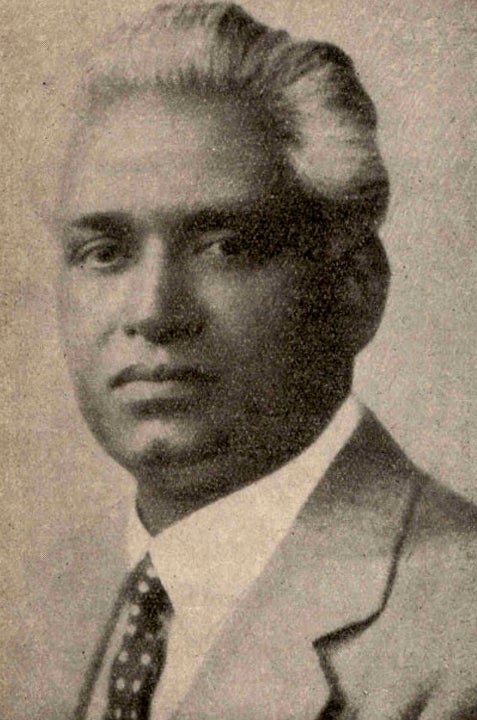
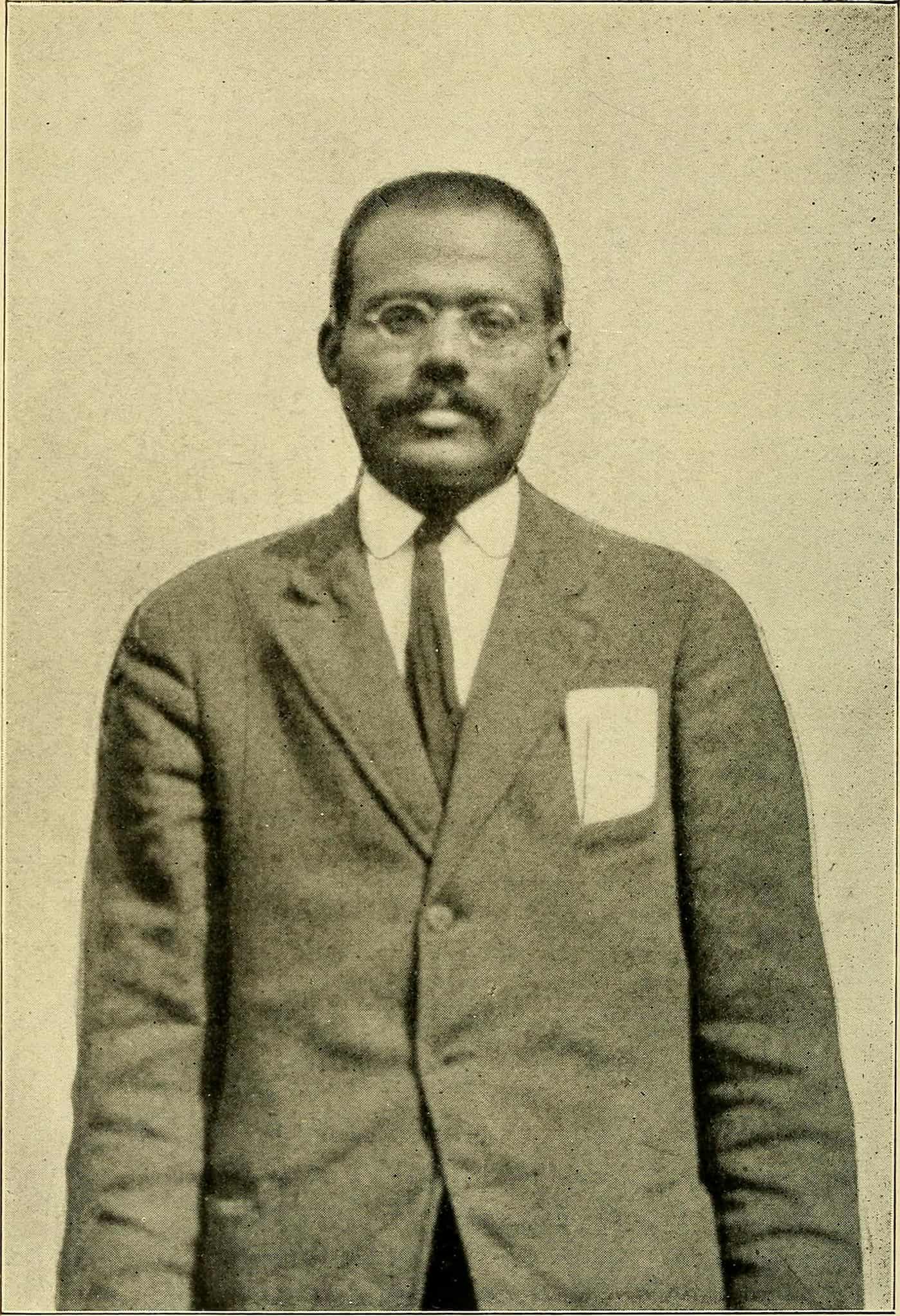
Image 03.02.05, Image 03.02.06 — Taraknath Das (left, in 1937) and Lala Har Dayal (right, in 1916) were Indian expatriates living in the US and leaders of the Ghadar Party, which advocated for India to be freed from British colonial rule through armed insurrection.
Punjabi Sikhs comprised a majority of the Ghadar Party’s membership. They were students at the University of California, Berkeley (UC Berkeley), or workers and farmers in the Pacific Northwest and California. Most also arrived in the earlier wave of migration in the 1890s as ordinary migrants and not as political exiles. Sikh laborers worked across North America in the lumber, milling, railroad, mining, and agriculture industries.
Upon arriving in the Sacramento Valley, an Indian immigrant named Puna Singh described a love for the farmlands of central California and how he was reminded of Punjab, with its fertile fields, flat valley, and foothills in the distance. As poor farmers and workers, their material reality did not leave much room for political organizing compared to their elite counterparts. Yet, their exploitative working conditions, first in British and later North American companies and farms made them receptive to the Ghadar Party’s nationalist appeals.
Ghadar Party Organizing and Repression
Both Taraknath Das and Lala Har Dayal connected British colonialism in India to the treatment of South Asians in North America. They believed the United States was complicit with British colonialism. As leaders of the Ghadar Party, they leveraged their positions as working professionals in the US and Canada to fight for their cause. Eventually, this came with repression, both locally and from the British empire.
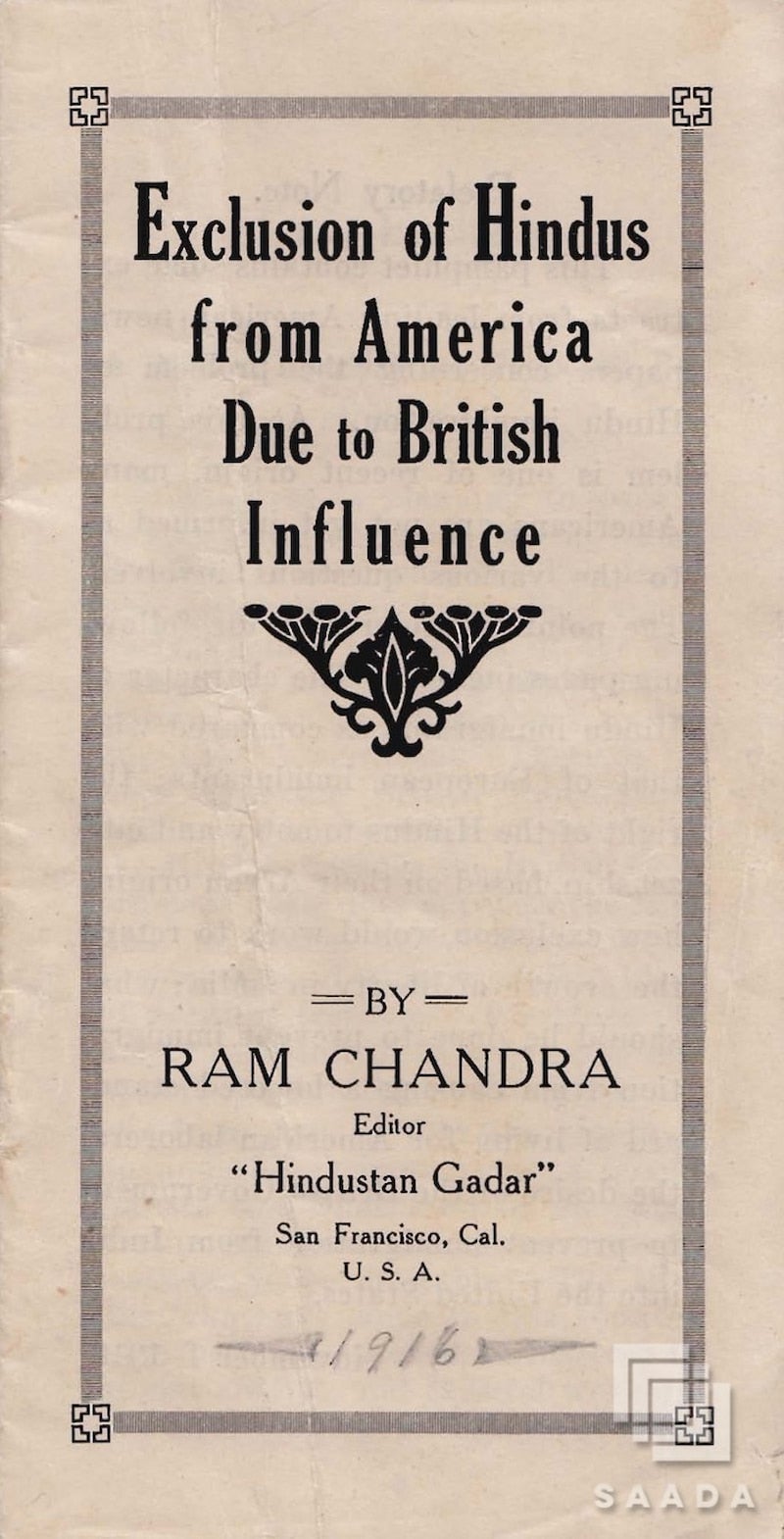
Image 03.02.07 — A 1916 pamphlet from the San Francisco-based Ghadar Party with editorials on discrimination against South Asian (“Hindu”) immigrants in America, due to British colonial influence.
While living in Vancouver, Canada, Das worked as an interpreter for the US immigration service. In this position, he saw US immigration officials denying Sikhs entry based on racist pretexts, such as claims of ‘diseased and dirty’ turbans, accusations of polygamy (which goes against the Sikh religious practice), or the “liable to become a public charge” (LPC) clause—a vague, catch-all category for exclusion. Das challenged his superiors regarding individual cases, gaining him respect in the local South Asian community. Ultimately, his persistent questioning led to his dismissal.
Das also published a newspaper in Vancouver called Free Hindustan. In Seattle, he gave lectures to Sikh laborers at India House, a local community center. Seeking specialized training for an armed insurrection in India, he enrolled in the private military school, Norwich University in Vermont. However, the university eventually suspended him due to his anti-British organizing.
In California, Stanford University hired Har Dayal as a lecturer to teach Sanskrit and Indian philosophy. He, however, was dismissed as a consequence of promoting “radical ideas” like free love and Indian nationalism. He continued to organize, giving fiery speeches to Indian students and workers. In one address to a meeting of Indian students at UC Berkeley he said:
Prepare yourselves to become great patriots and wonderful warriors. Great suffering and sacrifice are required of you. You may have to die in this revolutionary cause. Anybody can be a Collector, or an Engineer, or a Barrister, or a Doctor. What India [sic] needs today is warriors of freedom. Better death in that noble cause than living as slaves of the British Empire. 2
Har Dayal joined the International Workers of the World, a militant, anarchist labor union. He and other organizers traveled throughout the Pacific Northwest and central California, meeting workers and farmers in their work camps and bunkhouses, spreading their message of justice. They read aloud newspaper articles and revolutionary poetry to the laborers, many of whom were illiterate. A Ghadar Party chapter subsequently formed in Stockton, California, the agricultural capital of the Central Valley.
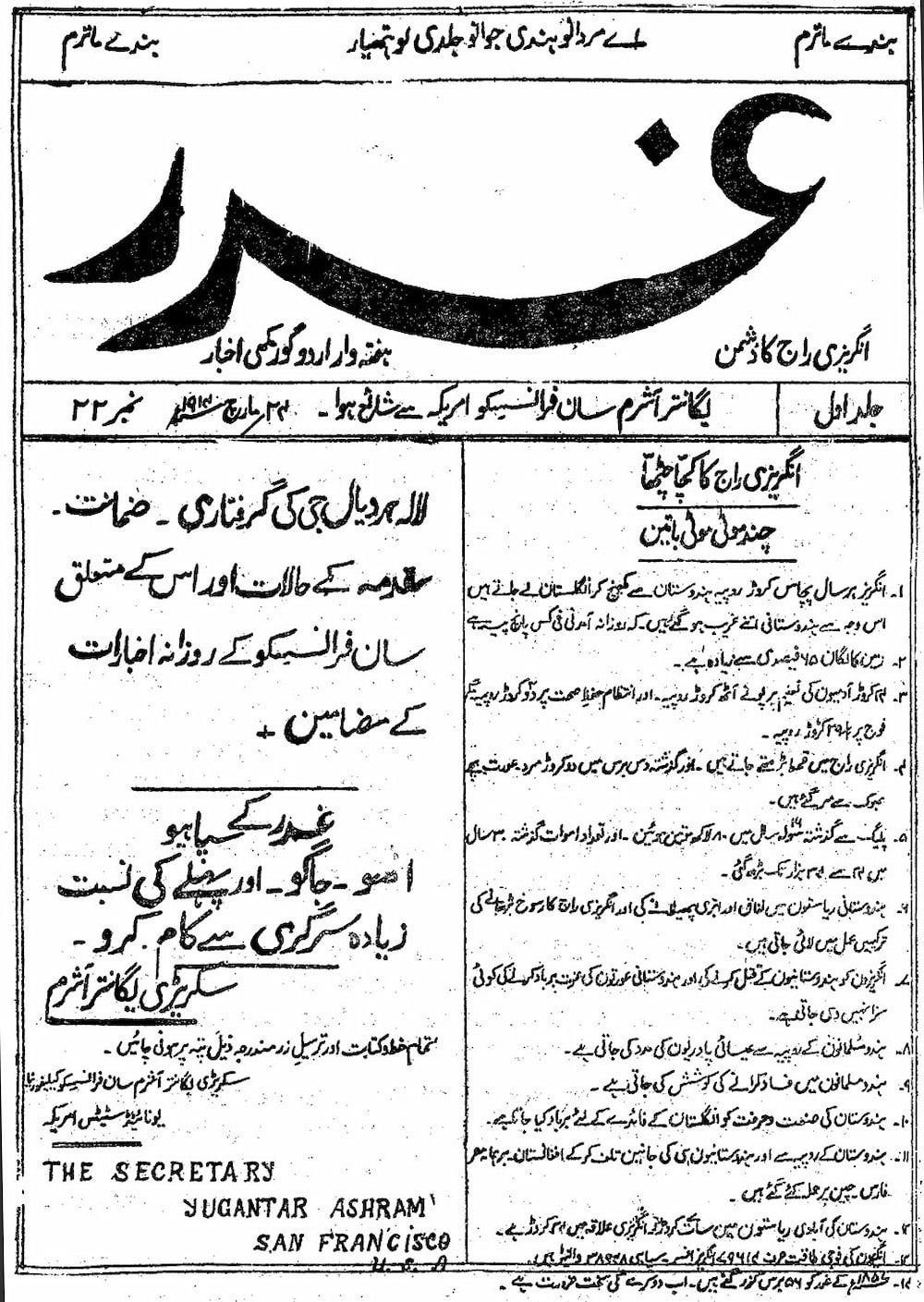
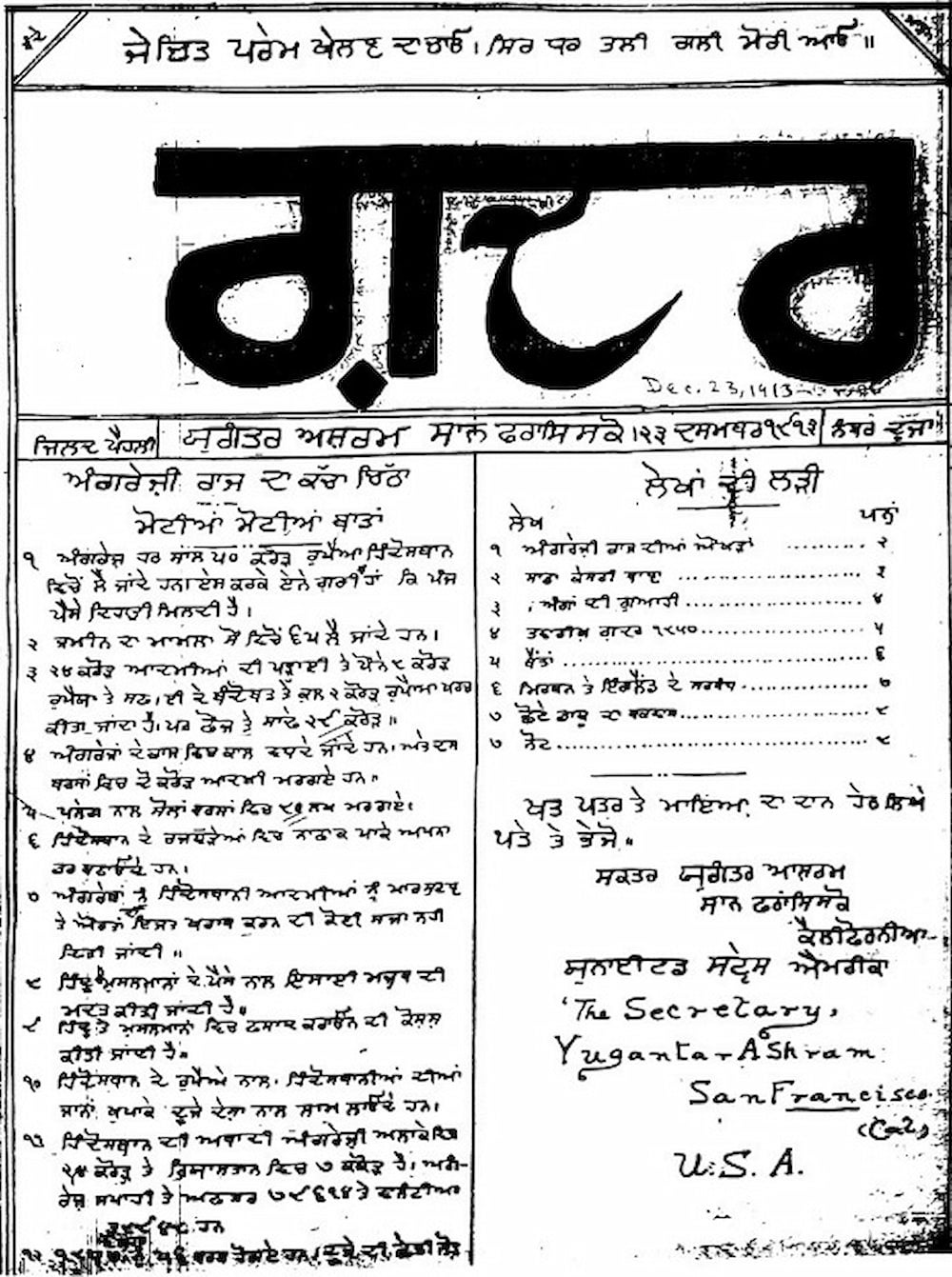
Image 03.02.08, Image 03.02.09 — The Ghadar Journal in Urdu (left) and in Punjabi (right), from 1914. The newspaper of the Ghadar party, circulated amongst its members throughout North America and elsewhere, called for the immediate and armed overthrow of British rule in India.
British intelligence networks in North America considered Das, Har Dayal, and the Ghadar Party dangerous threats to British rule in India. They banned the Ghadar newspaper in India, and worried that the radicalization of Punjabi Sikhs in Canada and the US might infect the British imperial army’s two hundred thousand Indian soldiers–many of whom were Sikhs. Har Dayal was arrested in 1914 for promoting anarchism, which was considered a deportable offense, but he fled to Germany. Das was convicted in 1917 for taking part in a “Hindu conspiracy” to aid Germany during World War I (WWI). He served twenty-two months in Leavenworth federal prison.
The Ghadar Party often compared themselves to Irish nationalists in the US who protested Ireland’s colonization under British rule. Like the Irish, the Ghadar Party smuggled not only newspapers and print media, but also money and weapons into India. Colonial intelligence services working in India and abroad detected and even thwarted several ambitious plans for uprisings in India in 1915.
In the end, the British crushed the movement. Ghadar revolutionaries were imprisoned or fled into exile. After WWI, Mahatma Gandhi mobilized the Indian people in a long struggle for independence through campaigns known as satyagrahas, or “truth force,” characterized by non-violent demonstrations and resistance. This built upon his earlier work in the British colony of Natal, South Africa, where he had organized peaceful protests among the Indian community through non-violence during the 1900s.
Das later earned a PhD from Georgetown University in Washington, DC, and became a political science professor at Columbia University in New York City. He wrote about education and fostered cultural relations between the US and India. Har Dayal lived mostly in Europe, lecturing and writing about education, culture, and religion. Both men are now honored in India as national heroes who fought for their country’s independence.
Korean Americans and the Struggle for Korean Independence
In April 1919 Nodie Dora Kim, an Oberlin College student, addressed the First Korean Congress in Philadelphia, Pennsylvania. The Congress was a gathering of Korean Americans from across the country to protest and condemn Japanese colonialism in Korea. Kim declared:
We, the Korean women, are cooperating with the men of Korea and are trying to help in securing her independence and liberty. Girls are suffering for Korea, and the men have to realize that they have to raise their women to an equality with them… (I)n the future Korea will be proud of her girls. They are ready to fight for liberty and freedom, for the little innocent girls who were abused, whose blood has been shed on the soil of Korea. 3
Korean immigrants in the US voiced strong opposition to Japan’s 1905 annexation of Korea and formal colonization in 1910. This colonization included the taking of Korean land, imposing the Japanese language and legal system, and brutally suppressing dissent. In 1910, Koreans living abroad became legally classified as Japanese subjects, a move that erased their identity as Koreans. This transformation shifted Korean Americans’ perspective, as noted in the US-based newspaper Sinhan Minbo, they no longer saw themselves as laborers, but as stateless “political wanderers” and “righteous army soldiers” fighting for Korean independence.
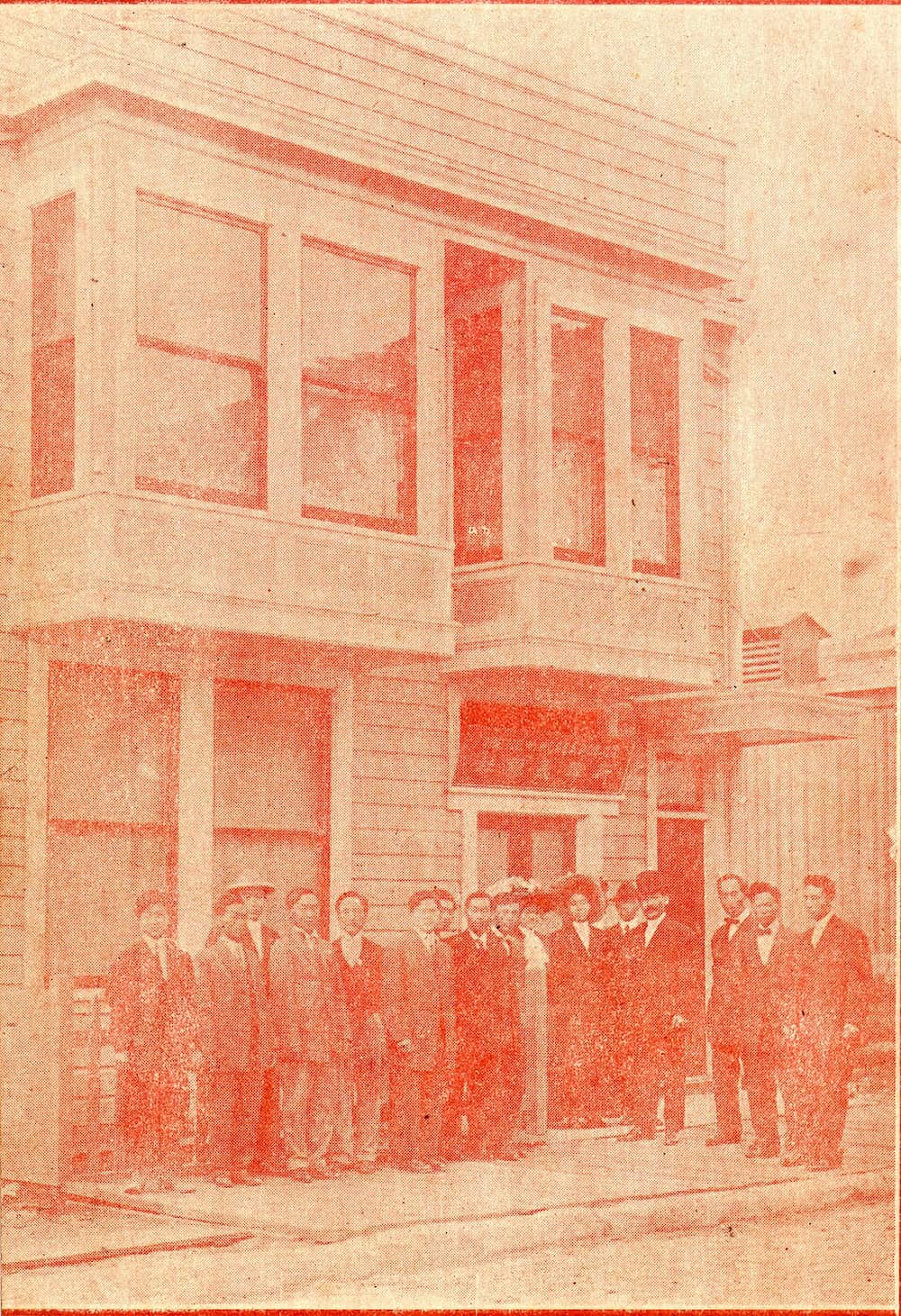
Image 03.02.10 — The San Francisco offices of Sinhan Minbo, a Korean American newspaper, circa 1911. The medium of print was a crucial tool for immigrant communities in advocating for the independence of their homelands.
Among these wanderers and soldiers were Chun Myung-won and Chang In-whan of San Francisco. In 1908 the two men fatally shot Durham White Stevens, an American advisor to the Japanese government in Japan-US diplomatic affairs. While Chun fled to Siberia, Chang was charged with murder and pleaded not guilty on grounds of “patriotic insanity.” Jurors were moved to tears during the trial when they heard of Japan’s cruel oppression in Korea.
Chang was ultimately convicted of second-degree murder and sentenced to twenty-five years in prison. Korean American associations and newspapers rallied to support Chun and Chang. While careful not to condone the assassination, they called the two men patriots and heroes. Mass support likely spared Chang from the death penalty.
From the Korean National Association to the March First Movement
In 1909, Chun and Chang’s cases also spurred Korean American groups to unite under a single organization called the Korean National Association (KNA). The KNA aimed to “advance the education and industry of Koreans abroad, promoting freedom and equality, and regaining the independence of Korea.” By 1914, the KNA had over one hundred local chapters and three thousand members in Hawaiʻi and North America.
With a sense of great urgency, the KNA called for a National Congress in Philadelphia in April 1919. This was a direct response by Korean expatriates and supporters in the United States to the March First Movement in Korea. During that movement, Japanese soldiers and police brutally responded to the nationwide mass demonstrations in Korea calling for independence. Some seventy-five hundred Koreans were killed, and another sixteen thousand were wounded. In the KNA’s printed remarks by US-based activist Nodie Dora Kim, the gory details of the March First atrocities—including rape and the severing of Korean protesters’ heads and limbs with swords—was omitted.
The presence of women at the National Congress meeting distinguishes Korean American anti-colonial activism from the almost all-male organizing within South Asian and Chinese immigrant communities. While all Asian immigrant communities were dominated by men—laborers, merchants, and students—the Korean community included relatively more women. The first wave of Korean immigrants, who arrived between 1905 and to work on the sugar plantations in Hawaiʻi, included some families.
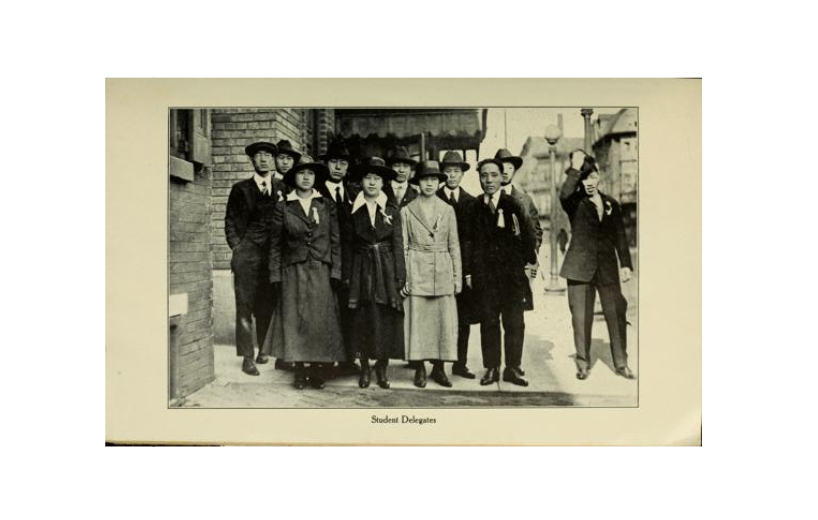
Image 03.02.11 — Student delegates at the Korean National Congress in Philadelphia, Pennsylvania, in 1919. While many Asian immigrant communities were dominated by men, Korean American anti-colonial activism often included women at the forefront.
In addition to these women, the prevalence of Christianity among Korean immigrants served as another distinguishing factor from other Asian groups. Protestant missionaries in Korea had worked as doctors and teachers since the nineteenth century. They also welcomed women into church and social work, fostering a willingness among Korean women to participate in public affairs. While some missionaries collaborated with Japanese colonizers, many others spread ideas about American democracy, winning them popular support. In Hawaiʻi and California, the church provided Korean immigrants with a place for Christian fellowship, ethnic solidarity, and mutual aid—a space to share news from Korea and to nurture dreams of independence.
The KNA and the National Congress of 1919 were important parts of an international March First Movement, the reverberations of which echoed among Koreans exiled in China, Manchuria, and Russia. Though the Koreans in the US were a relatively small population, they influenced and financially supported the formation of the Korean Provisional Government in Shanghai . Its Constitution was written in the US republican style.
In his opening remarks to the 1919 Congress, Dr. Philip Jaisohn, a naturalized US citizen and leading nationalist figure, declared, “There is no other nation in the world whom the Koreans love more than the United States of America, excepting only their own country.” Jaisohn’s affection for the US reflected long-standing ties to American Christians and the experience of Koreans in the United States, especially among educated figures like Jaesohn and Syngman Rhee, a Princeton graduate and the first Korean PhD recipient in the US, who cultivated ties with American politicians.
However, not all Korean Americans strongly identified with the United States. Throughout World War II, they remained united in their efforts against Japanese colonialism, lobbying for US government support–with little success–until Japan’s defeat at the end of the war. Syngman Rhee, with American backing, became the first President of the Republic of Korea. Soon after, pre-war differences in Korean politics resurfaced and brought in the involvement of the United States, the Soviet Union, and China. The subsequent Korean War became the first “hot war” of the global Cold War whose division and political differences of the peninsula continue today.
Conclusion
Chinese, Indian, and Korean American communities continue to pay close attention to the political developments in their homelands through media, return visits, and contact with exiled leaders. The overseas anti-colonialist movement mobilized support and raised funds within these immigrant communities. In some cases, it was easier to organize in the United States than in China, India, or Korea, where political repression was severe. Consequently, these diasporic communities played an important role as overseas co-ethnics connecting to their homelands’ struggles against colonialism.
Glossary terms in this module
Cold War Where it’s used
Beginning at the end of World War II and ending with the fall of the Soviet Union in 1989, the Cold War was a period of indirect war and competition between the United States and Soviet Union (USSR), and their allies. Though there was no direct fighting between the US and USSR, their rivalry brought forth a nuclear arms race and the formation of strategic alliances that supported one or the other side (NATO, Warsaw Pact, others). Both the US and USSR pressured decolonizing nations to take sides instead of remaining neutral. The Cold War also included several “hot wars,” or proxy military conflicts, in Korea, Vietnam, and elsewhere.
colonialism Where it’s used
When one country takes partial or complete control over another country economically and politically, exploiting its natural resources for profit. The colonizer forces their beliefs and way of life onto the colonized.
solidarity Where it’s used
A political, cultural, and collective stance that recognizes the mutual responsibility and support that is necessary to achieve change. Taps into the power in numbers and considers the collective interests of communities.
Endnotes
1 Huang Zunxian, “Expulsion of the Immigrants,” in Land Without Ghosts: Chinese Impressions of America from the Mid-Nineteenth Century to the Present, ed. David Arkush and Leo Ou-fan Lee (University of California Press, 1989), 62–65.