




Module 2: New Homes and Returns
Have Thai Americans found or created a home in the United States?
On December 31, 1977, Drs. Yutthana and Thanasri Samroengrajaya hosted a party to ring in the new year. They invited twenty or so other Thai doctors who practiced in New York, New Jersey, and other nearby states. This group had met regularly over the past few years, attempting to form an association for Thai doctors in the United States. They wanted to create a support system for each other as they navigated practicing medicine.
As the party continued well into the evening, the discussion about establishing a mutual support system came up again. Finally, Dr. Chalotorn Locharoenkul had an idea: Every doctor at the party could pitch in 50 dollars as seed money, and he could start an association that way.
How did Thais make themselves feel at home in a new country? How did temples, churches, masjids, and organizations help Thais adjust to a new way of life and create opportunities in the United States?
This module addresses these and other related questions by serving as an overview of the creation of Thai American spaces, places, and associations. We learn how Thais began to build a home and create community for themselves in the United States, as well as learn how various Thai American social and professional organizations helped newly arrived Thais feel more at home.
Where did Thais end up when they moved to the US?
How do Thais build lives in the US?
What challenges do Thais face in building a life in the US?
Founding of the Thai Physicians Association
On April 1, 1978, Dr. Chalatorn began his effort in earnest, sending letters to other Thai doctors within his social networks. He asked everyone to pay 30 to 50 dollars as a membership fee. Over half the recipients replied, and some provided contact information of other Thai doctors. On April 22, they held their first meeting as the Thai Physicians Association of American (TPAA). This was one of the first Thai organizations to have nationwide membership. There are now over one thousand association members across the country, many of whom are second-generation members.
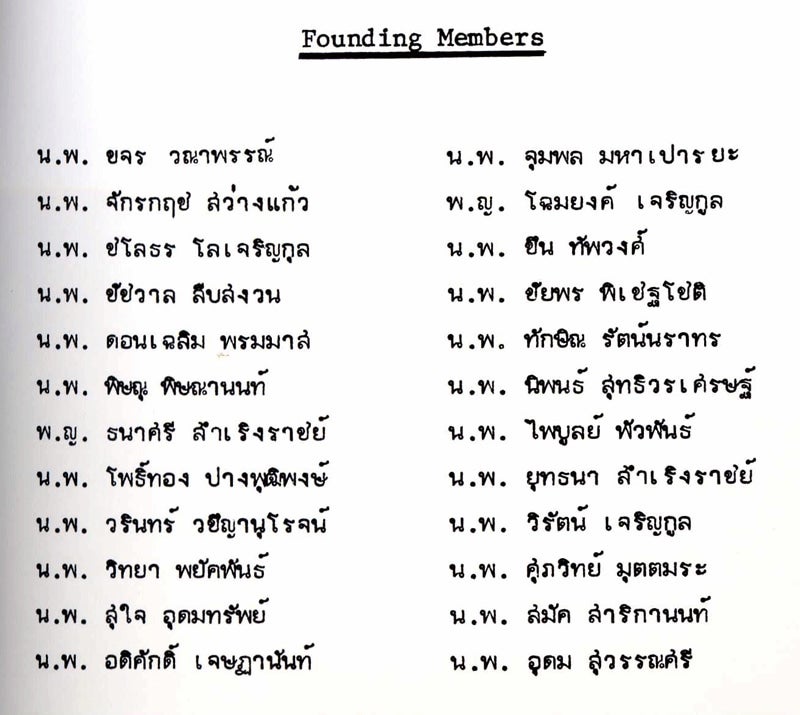
Image 18.02.01 — Names of the twenty-four founding members of the Thai Physician Association of America. The two party hosts, Drs. Yutthana and Thanasri Samroengrajaya, and Dr. Chalotorn Locharoenkul, writer of the initial recruitment letter, were all present at the inaugural meeting. (Source: TPAA (Thai Physicians Association of America))
The Thai diaspora communities in the United States expanded quickly after 1965, and Thais found several ways to build networks, communities, and live in their new home. This module outlines the conditions that enabled the US Thai community to grow, as well as conditions that made life difficult for Thais in the United States.
More to explore
Image
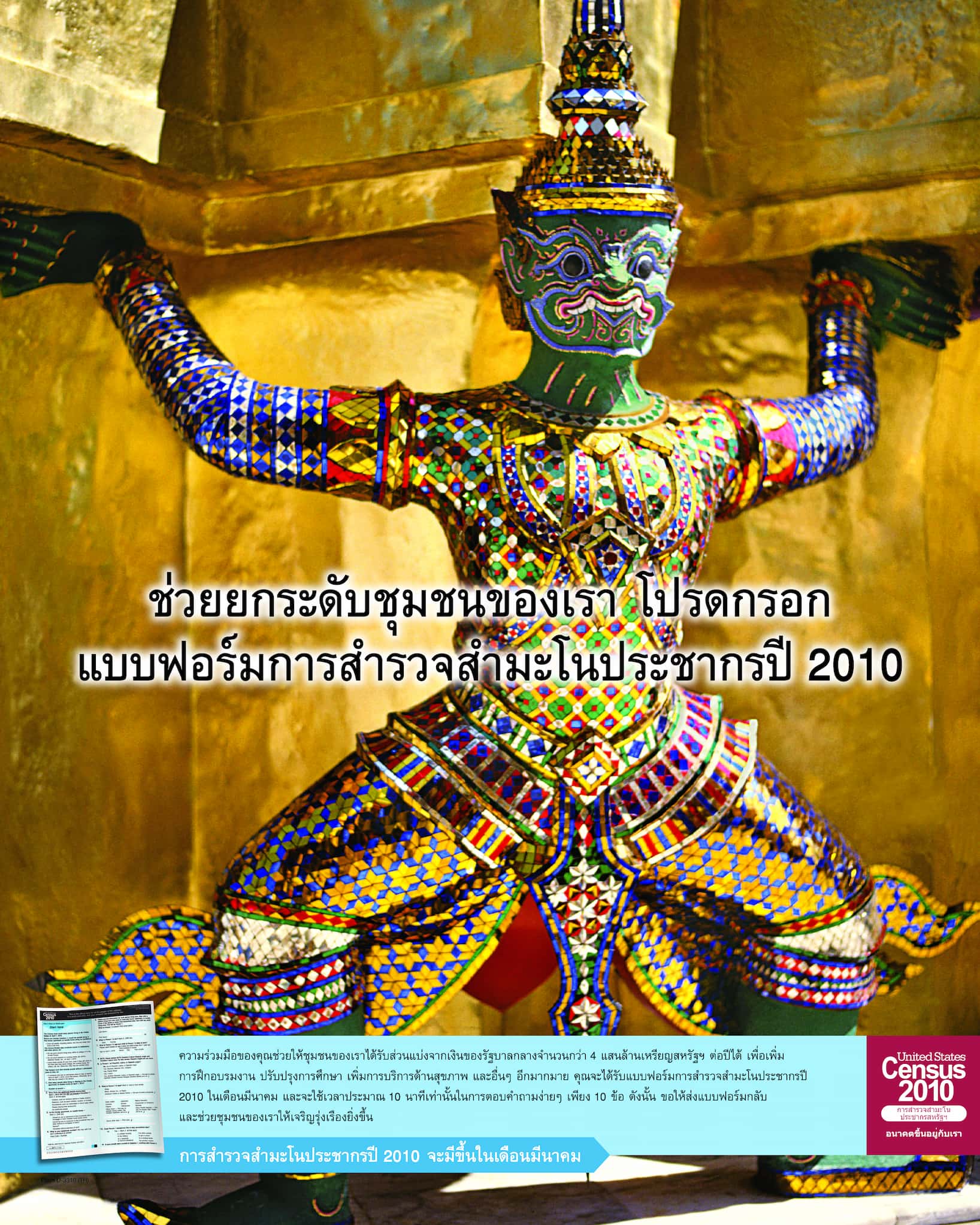
US Census Thai Awareness Poster
The US Census Bureau created outreach materials in Thai, with references to Thai culture. This poster depicts Karuda, a mythical creature from Hindu lore that many Thais would recognize.
The doctors who started TPAA were part of a larger pattern of Thai medical professionals who arrived in the United States in the mid-1960s and 1970s. Two factors enabled them to come to the US in large numbers: the Immigration and Nationality Act of 1965 and the Educational Commission of Foreign Medical Graduates.
The Immigration and Nationality Act of 1965 outlined two main areas of preferences for immigration to the US: skill-based preferences and family preferences. In the 1960s the US Thai population was quite small, and few Thais were eligible to use family connections to emigrate to the United States. They therefore relied on skill-based preferences to enter.
Throughout the 1950s the US made several healthcare reforms that, in turn, caused a rapid expansion of the US healthcare system. A shortage of medical workers followed. The Educational Commission for Foreign Medical Graduates (ECFMG) was founded in 1956 to address this issue. ECFMG facilitated the selection, recruitment, and accreditation required for the entry of foreign medical professionals from Thailand.
After this generation of Thai doctors and nurses entered, they then used the family preference condition of the 1965 law to sponsor members of their immediate family. Both family and skill preferences aided in the influx of Thai women settling in the US, as nurses or spouses of Americans (often US servicemen).
The connection between Thailand and the United States and medicine began much earlier than 1965, however. Nearly half a century earlier, Prince Mahidol, the founder of the House Mahidol of the current ruling Chakri Dynasty of Thailand, arrived in Cambridge, Massachusetts, to study public health at Harvard University. While there, his youngest son, Bhumibol Adulyadej, was born, but he was never a Thai American because of his royal lineage.
Bhumibol later ascended the throne as King Rama IX and was the first Thai monarch to be born in the United States. Six of the king’s grandchildren are Thai Americans. In 1990 a square in his name commemorated the royal family’s ties to Massachusetts. King Bhumibol Adulyadej Square is located between John F. Kennedy Memorial Park and Harvard Square. Today, Thai Americans gather at the Square when they want to venerate or protest the monarchy.
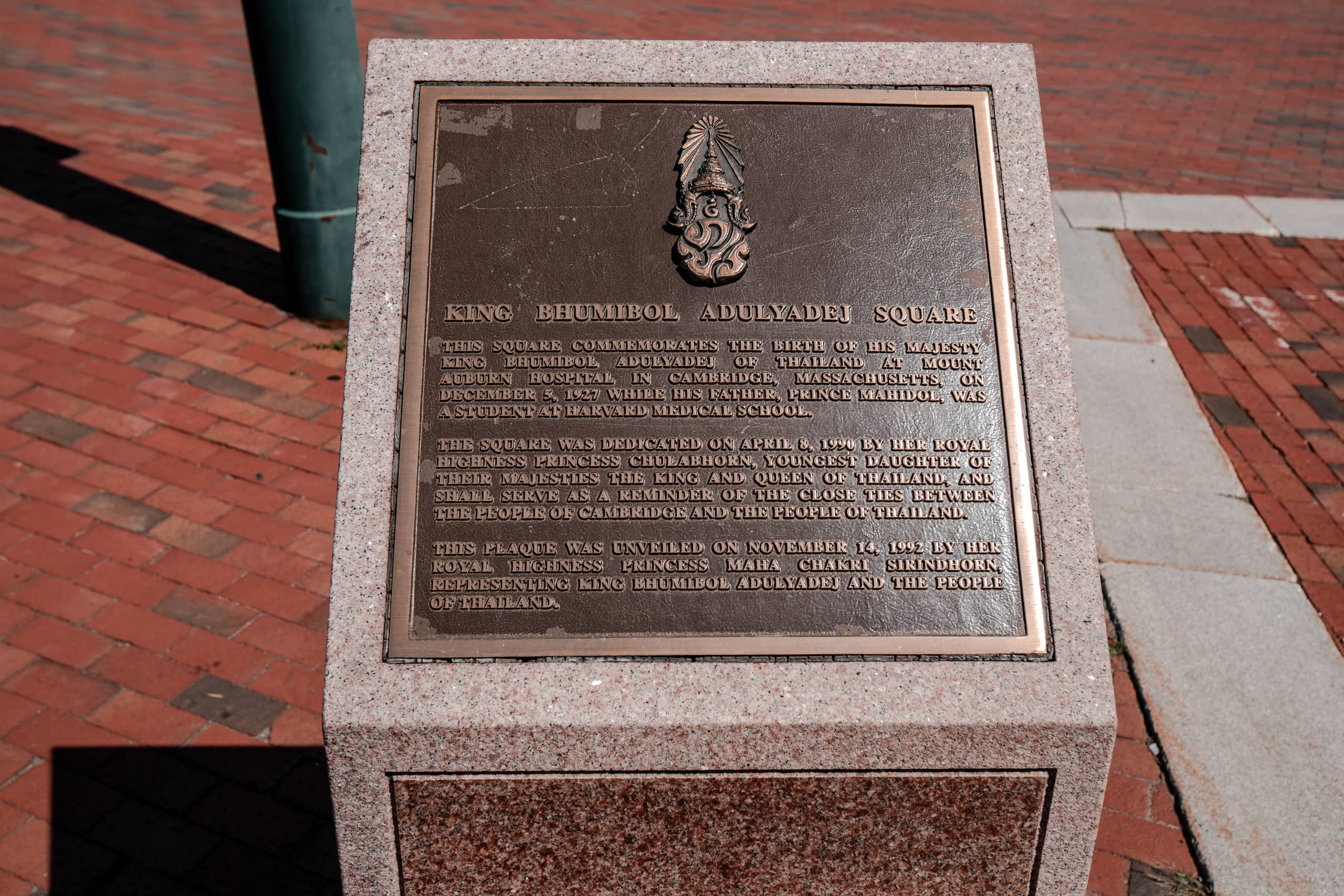
Image 18.02.03 — This plaque in Cambridge, Massachusetts, commemorates King Bhumibol’s birthplace and his connection to Harvard University, where his father Prince Mahidol studied public health and medicine. It has recently become a gathering place for the veneration and protest of the monarchy.
Serving the Community
As Thai communities grew across the United States, they formed various local organizations to gather, build community, and connect. Early organizations included the Thai Nurse Association of the Northeast of America, Thai Golf Association of Illinois, and Thai Isan Association of New York (Isan is the northeastern region of Thailand).
Wats provided a consistent gathering location for growing Thai communities. Wats (วัด), or Thai Buddhist temples, were founded across many cities with large Thai populations, such as Los Angeles, Washington, DC, and Chicago. In addition to being places of religious worship, wats are central places where Thais gather for social events and cultural celebrations. They were also a community resource where newly arrived Thais sought social support.
Many wats contain weekend cultural and language schools for Thai Americans. The rapid founding of wats in the 1970s spurred the establishment of the Council of Thai Bhikkhus in the USA. This council oversees religious assignments of Thai Buddhist monks in the US. Today, the organization supports 116 wats. While the majority of Thai religious establishments are wats, there are now also Thai churches. The first Thai mosque in the US was the Masjid Al-Fatiha of America.
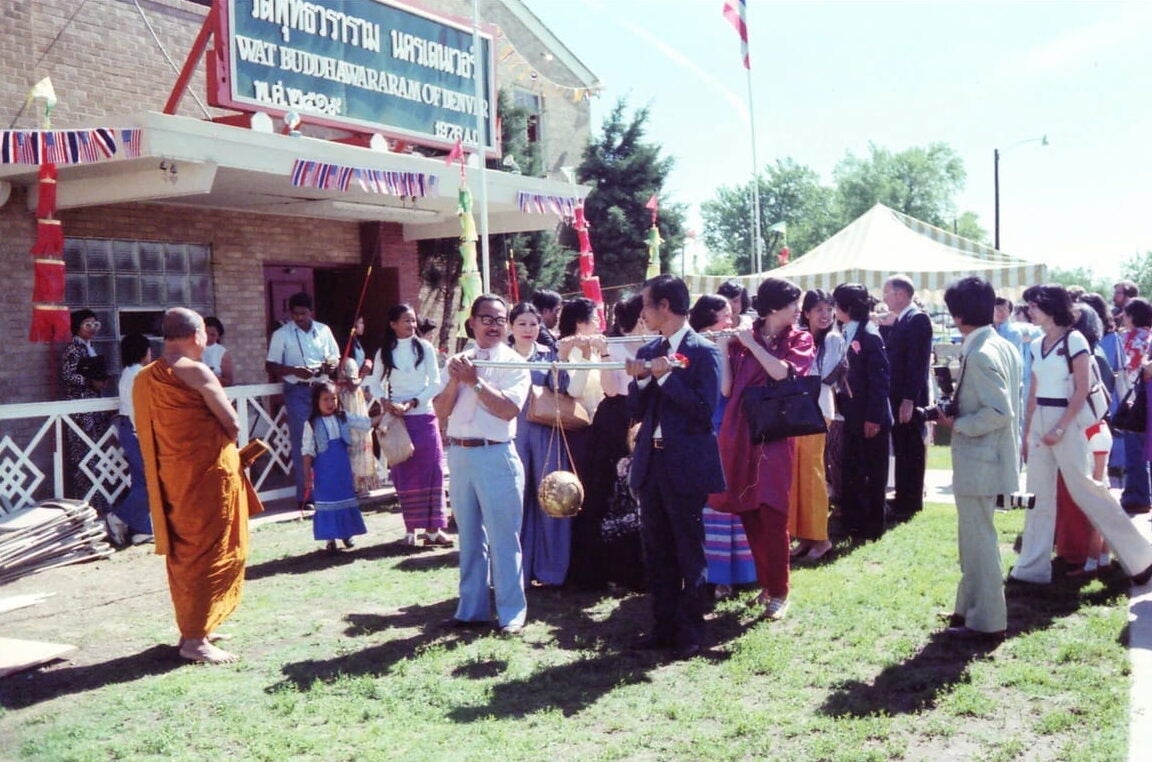
Image 18.02.04 — Thais gathered at Wat Buddhawararam in Denver, Colorado, for the prayer hall consecration ceremony (งานผูกพัทธสีมา) in 1978. Senior monks flew from Thailand to preside over the ceremony due to a shortage of monks in Denver.
Thais also opened businesses both to meet the demands of their growing communities and to support economic development. Some were able to open stores because of community connections and informal loans from other community members. These business owners fostered the growth of Thai communities.
Many early business owners were relatives of Thai medical workers who sponsored their entry into the US. In the 1960s, Uraivan Thithuan was a nurse in the Chicagoland area. She sponsored her younger sister, Rushanee Suksod, who in turn opened a restaurant with her husband Wanchai in 1973. Tawan Restaurant stayed open until their eldest daughter, Runchana Pam, was born.
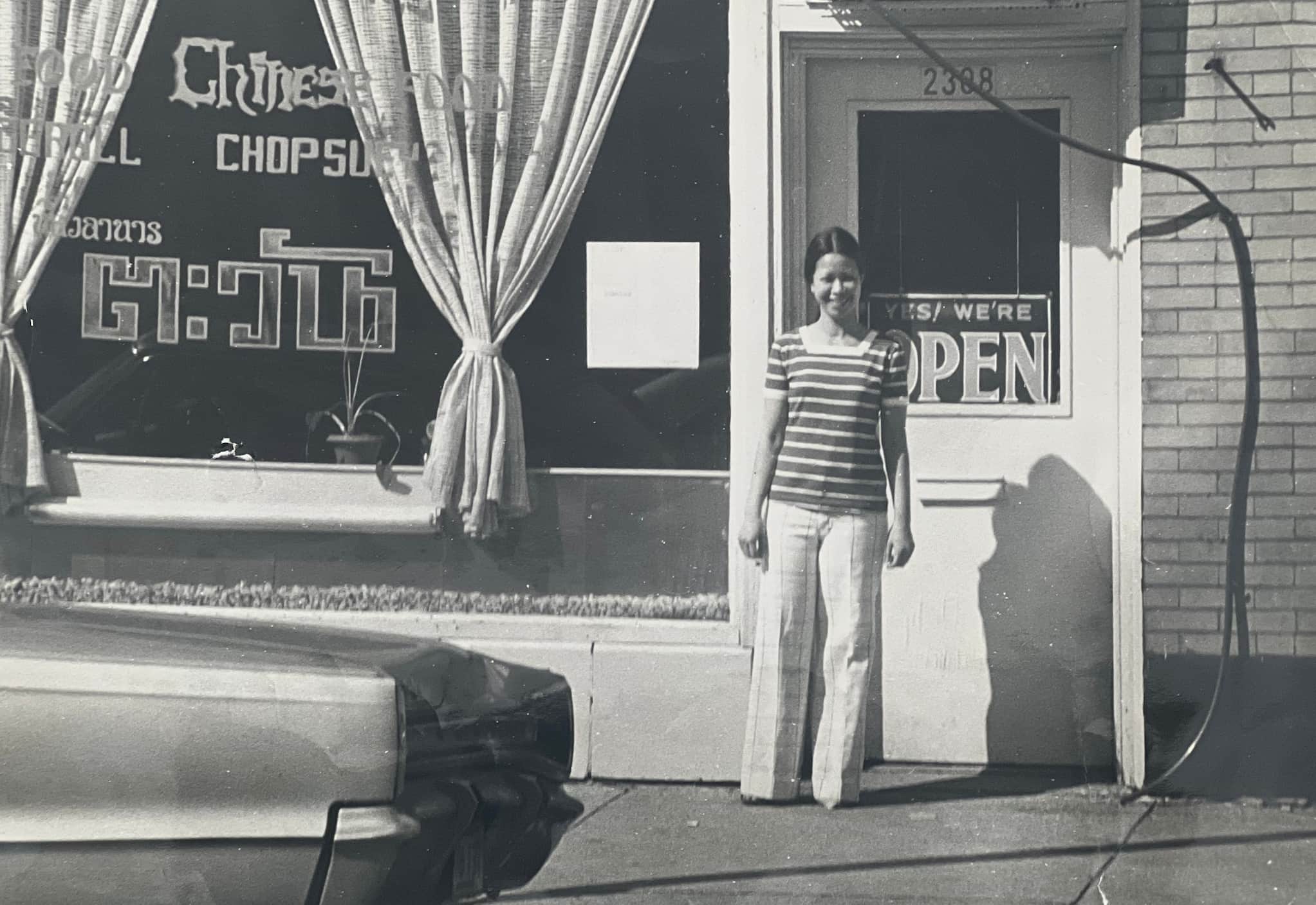
Image 18.02.05a — The owners of the newly opened Tawan Restaurant posing in front of their business. The names in Thai and English did not match, showing the ways early Thai restaurant owners had to appeal to both Thais and non-Thais in their business model.
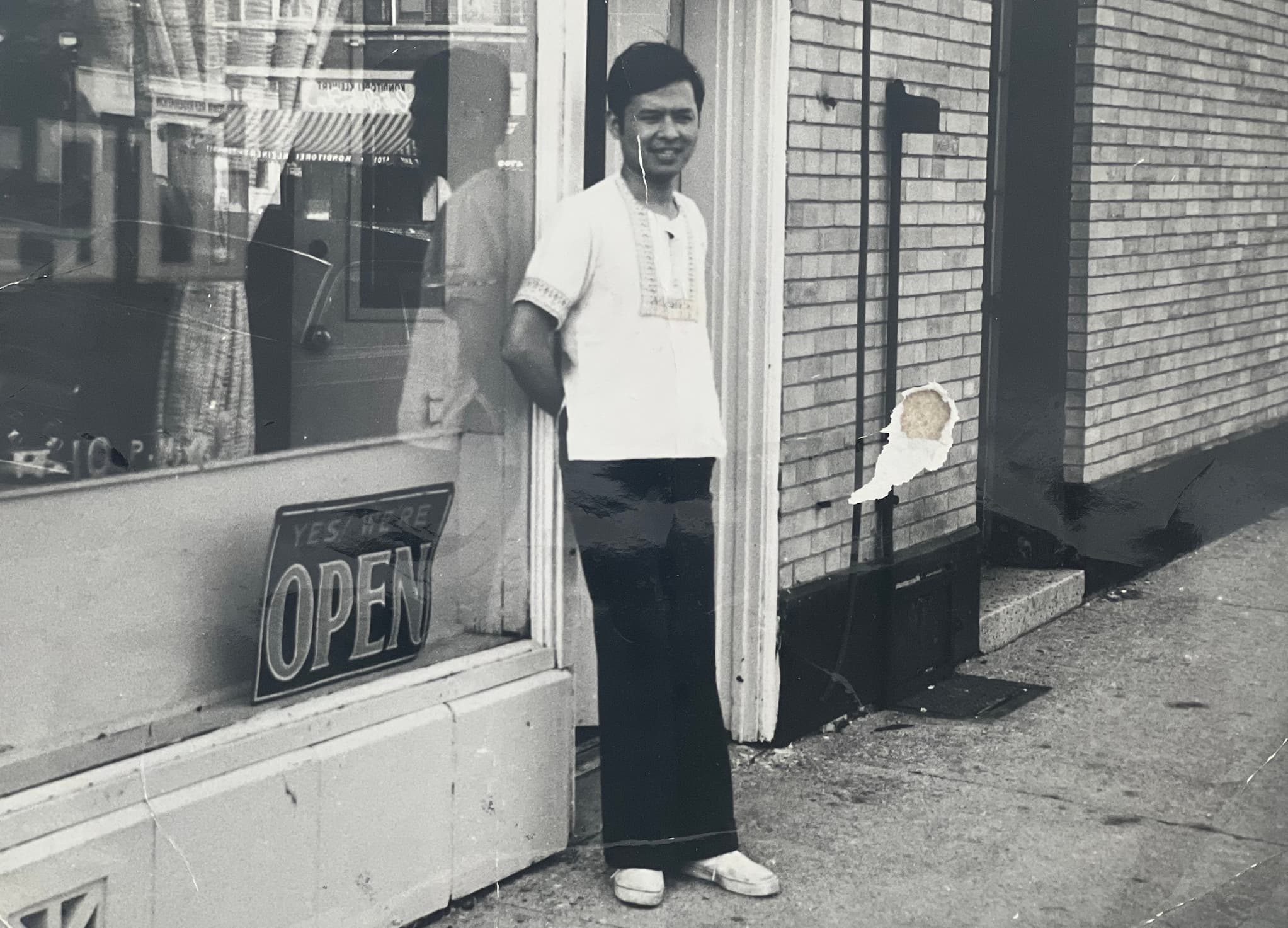
Image 18.02.05b — The owners of the newly opened Tawan Restaurant posing in front of their business. The names in Thai and English did not match, showing the ways early Thai restaurant owners had to appeal to both Thais and non-Thais in their business model.


Even though Tawan closed, it stayed within the Thai community. The family sold the restaurant to another family, who renamed the restaurant, Rosded. Without credit history in the US to get a formal loan, the family paid the Suksods monthly. This method of informal financing helped new arrivals build their capital; today, this continues to be a common diaspora practice. Rosded was a beloved Thai restaurant in Chicago and was featured in a 1976 Chicago Tribune list of recommended new ethnic restaurants.
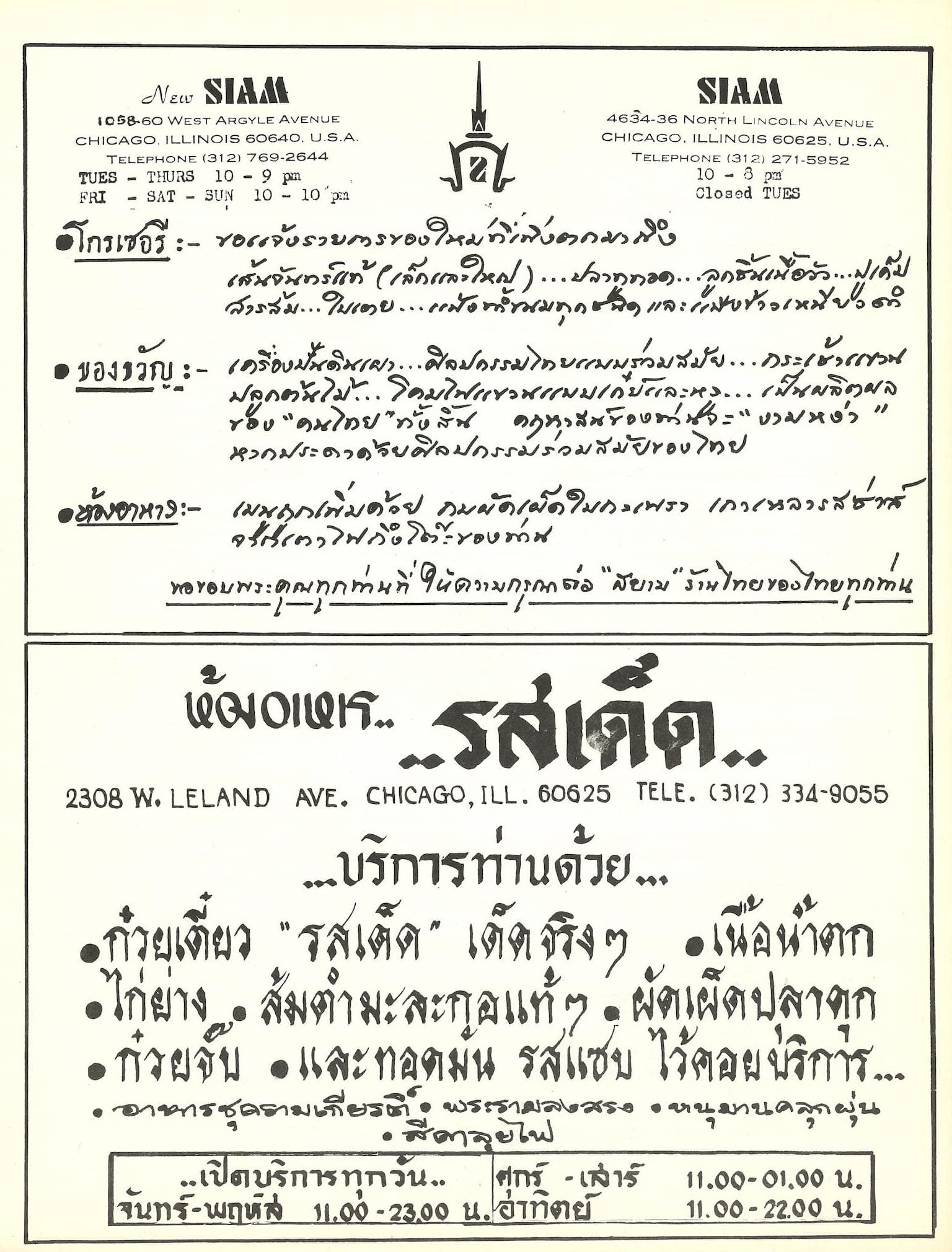
Image 18.02.06 — A handwritten advertisement for Rosded Restaurant and Siam and New Siam restaurants printed in Dhammophas Magazine, Vol. 2, No. 3 (June–August 1976), published by Wat Dhammaram in Chicago, Illinois. Early Thai businesses were important financial supporters for Thai temples in the early years.
In 1971 Bangkok Market—the first Thai grocery store in Los Angeles, California—opened on Melrose Avenue. Pramorte “Pat” Tilakamonkul received a large loan from his wife’s family to start the business. Bangkok Market gave the surrounding community access to Thai ingredients and, soon after, Thai people opened restaurants in the area. Bangkok Market remained in business until 2019, when Pat’s wife retired at the age of seventy-two. However, the legacy of Bangkok Market continues. Pat’s son, celebrity chef Jet Tila, carries on the culinary traditions of his family.
Many longstanding Thai small businesses closed at the onset of the COVID-19 pandemic. These closures were one of many hardships the Thai community faced, as we’ll discover in later modules.
Exploitation and the El Monte Garment Workers
Not all businesses acted out of goodwill for their community. In the early morning of August 2, 1995, authorities raided a series of townhomes in El Monte, a suburb of Los Angeles, and found seventy-two Thai women held captive, forced to do garment work under slavery-like conditions. Some had been there for as long as seven years, sewing clothing for seventeen to twenty-two hours per day. Their meager pay was deducted for room, board, and daily necessities like toiletries. Their letters home were censored, and they were prohibited from outside contact.
These garment workers were recruited from various parts of Thailand and all recounted similar stories. A recruiter (a Thai national) arrived in their area and offered high-paying jobs in the United States. The recruiter told the women that they would owe 5,000 dollars and promised them they could pay off this debt through their new job. At the airport, the women were given jewelry to appear as tourists on vacation and escape detection from immigration inspections. Once they were admitted into the US, they were stripped of their belongings, including their identification and travel documents, and were locked inside the garment facilities. Because room and board were deducted from their pay, the 5,000-dollar debt was insurmountable, and they were stuck.
Years after escaping the compound from a second-story window, a worker finally shared the narrative of her captivity with a boyfriend, which set off a chain of events. Then Deputy Labor Commissioner TK Kim sought help from the newly founded Thai Community Development Center (Thai CDC). The workers were rescued from the garment work compound.
However, the workers were still not free. Because they were tourists who overstayed their visas and were working without permits, they were detained at the local immigration detention center for nine days. The Thai CDC worked quickly to form a coalition with other workers’ rights organizations and Asian advocacy groups. They were successful, and the women were released, finally free to build their lives in the United States.
In 2015 the women gathered, along with Chanchanit Martorell, the Executive Director of the Thai CDC, to celebrate the twenty-year anniversary of their freedom and new life. One survivor, Rotchana Sussman, is an outspoken advocate for human and workers’ rights. Rotchana testified to the California State Assembly to support the elimination of sweatshop conditions in garment factories.
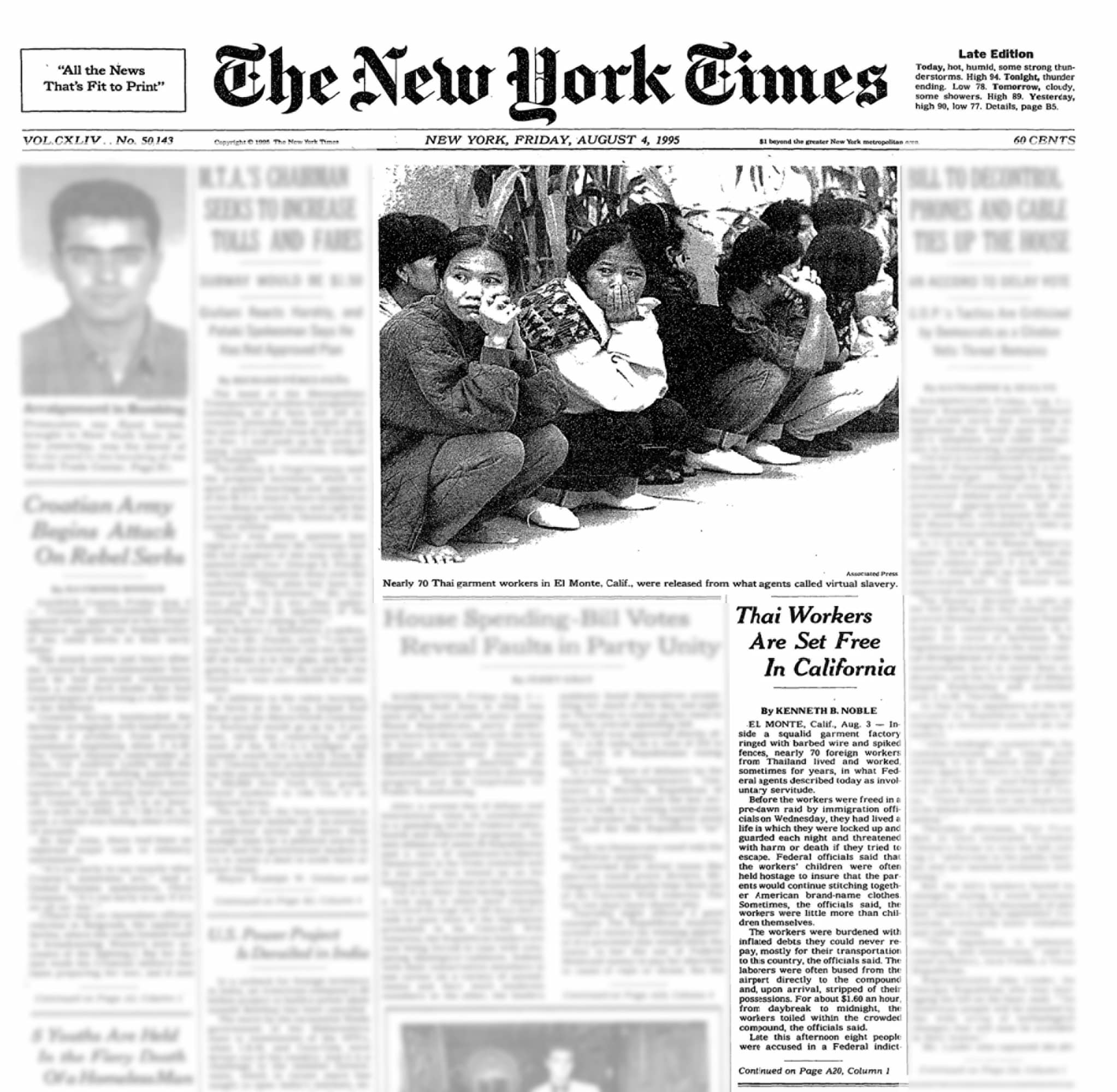
Image 18.02.07a — A story covering the release of the El Monte Thai garment workers from captivity was featured on the front page of the New York Times on August 4, 1995.
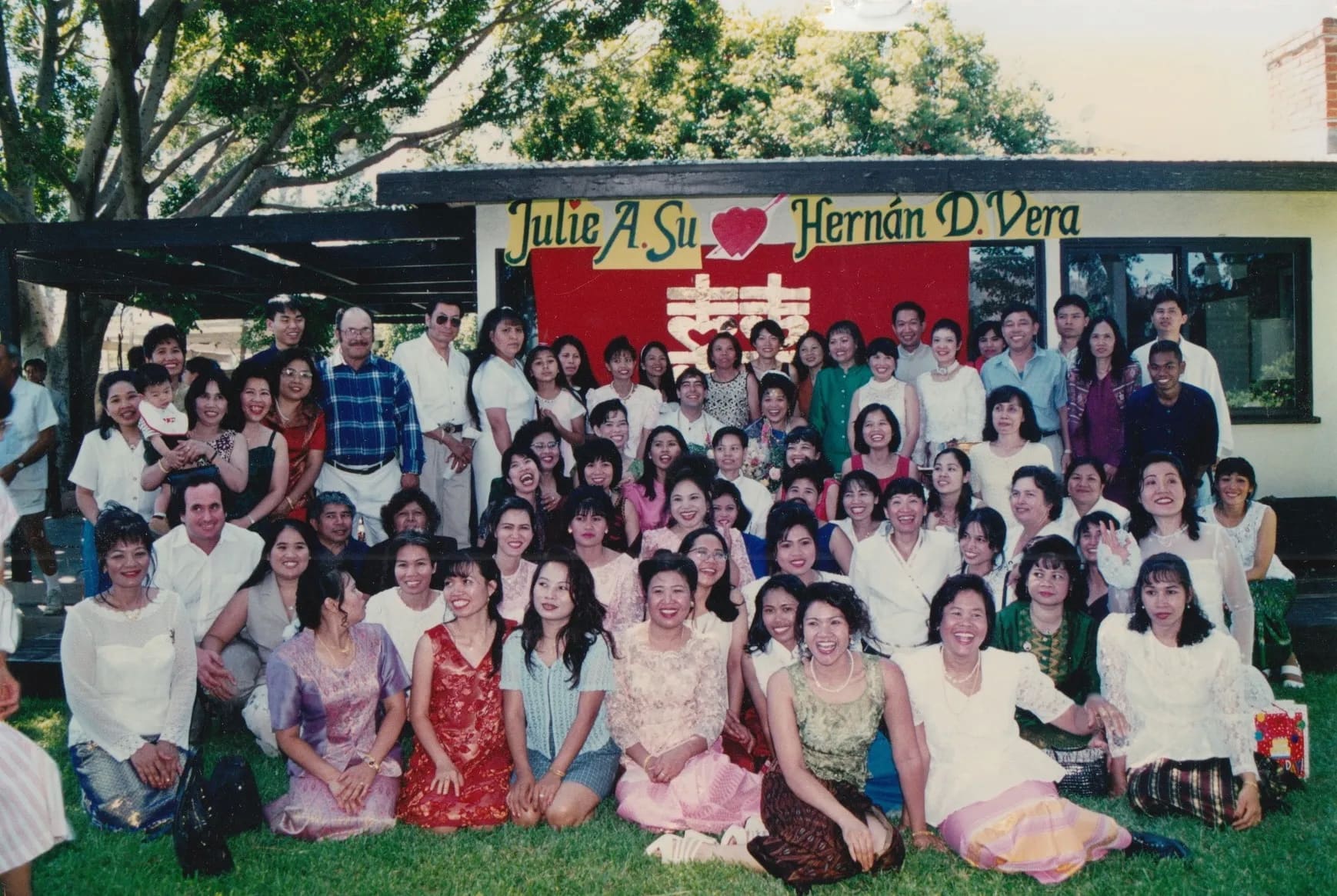
Image 18.02.07b — A gathering of the Thai garment workers commemorating the anniversary of their freedom. Julie Su, an attorney with Asian Americans Advancing Justice Southern California, represented workers in a groundbreaking civil case that resulted in a multi-million dollar settlement and sweeping labor legislation reforms.


The El Monte case is cited as an example of modern-day slavery in the United States. Its worldwide coverage exposed immigrant worker exploitation and human trafficking and sparked advocacy and awareness on these issues.
Conclusion
Thais began building their communities in the US within a few years of their arrival. The 1970s was a decade of tremendous growth of Thai American communities across the US. Many founded their first Thai Buddhist temples, or wats, during this time, as well as numerous social and professional organizations, like the Thai Physician Association of America, that provided ways for Thais to connect to each other.
Thais also opened various businesses to serve Thais and non-Thais, especially restaurants. Many of the business owners of this era were relatives of medical professionals already working in the US. Like the women garment workers who were held captive in El Monte, Thai immigrants faced numerous challenges. Organizations such as the Thai CDC responded to these issues and continue to advocate for the Thai community today.
In the next module, we learn more about different types of Thai spaces and how Thai understanding of public spaces and cultural practices were at odds with the predominantly white spaces of suburban US. We also learn how traditional Thai spaces are transformed into Thai American spaces in the diaspora.
Glossary terms in this module
diaspora Where it’s used
The dispersal, movement, migration, or scattering of a people from their established or ancestral homeland.
human trafficking Where it’s used
The act of transporting a person using threats or coercion with the purpose of exploitation. A key part of trafficking is the lack of control the individual has in being transported and making decisions.
Immigration and Nationality Act of 1965 Where it’s used
This act, also known as the Hart-Celler Act, officially ended the era of Asian Exclusion and created an immigration system based on family relationships and job skills. The law significantly changed the demographics of Asian immigrants in the US.
masjid Where it’s used
Also known as “mosque” in English. A place of prayer for Muslims. Thais use the Arabic word “masjid” to refer to what English speakers call a “mosque.”
wat Where it’s used
“Buddhist temple” in the Thai language.