





Estella Habal sitting in an ornate highback chair smiling and holding one fist above her head.
Module 1: Overview of Asian American Activism
Was Asian American Activism successful in improving the lives of Asian Americans?
Movements … begin when large numbers of people, having reached the point where they can’t take the way things are anymore, see some hope of improving their daily lives and begin to move on their own. I have also learned that if you want to know what a movement is going to be about, you should keep your ears close to the grassroots to hear the “why” questions that people are asking.
– Grace Lee Boggs, Living for Change: An Autobiography 1
Though little is known about Asian American activism, there have been widespread and sustained political activity, along the lines of Grace Lee Boggs’ statement. This chapter introduces students to the vibrant history of Asian American justice struggles.
Social movements never start at one single moment but rather build on the past, while imagining new futures. Asian Americans have been fighting back against injustices since their arrival beginning in the mid-1800s. Most came as railroad workers, farm workers, domestics, and other laborers. They faced racist violence, exclusion laws, and labor exploitation. And they protested unfair wages, challenged anti-Asian immigration laws through the courts, and demanded justice and dignity in their work and community lives.
Asian American activism continues on.
This module highlights three significant activists who were part of the most intensive activism that occurred in the late 1960s and 1970s. Students, youth, and elders as well, came together to create the Asian American Movement (AAM).
What kinds of injustices have Asian Americans faced, and how have their experiences shaped their resistance and political organizing?
What are the political meanings of “Asian American,” and where does the term come from?
How have Asian American activists practiced solidarity with other marginalized groups and what happened as a result?
Vicci Wong: Starting the Asian American Movement (AAM)
Do you know where the term “Asian American” comes from?
The Asian American Political Alliance (AAPA) introduced the phrase in 1968. It was political from the start, meant to unite Asian-descended groups to fight back against the racism that was constraining their lives.
Vicci Wong was a founding member of AAPA. She understood injustices based on her own family’s experiences. She recalled:
I was born and raised in Salinas, California—the “Salad Bowl to the World.” My father was a first-generation farmer/scholar from Toishan, China. My mother was a third-generation Chinese American from Fresno, California, who worked as a waitress. At age twelve, she had to support her family after her father, a railroad worker, was incarcerated at San Quentin Prison for a murder he did not commit. He was exonerated decades later after the real killer confessed. My parents lost our farm, and I worked in the fields and onion-bunching sheds of Salinas from childhood to my teen years. 2
For Vicci, these conditions gave her reasons to fight for justice, saying: “I was involved in activism at a very young age—supporting farmworkers unionization, draft resisters at nearby Fort Ord (then the largest United States Army base), the Antiwar, the Youth/Cultural Revolution, and Civil Rights movements.” 3 While at the University of California, Berkeley (UC Berkeley), Vicci met Yuji Ichioka and Emma Gee, who invited her to a meeting that led to the founding of AAPA. This was May 1968.
AAPA became the first major pan-Asian political organization in the nation. The organization coined the term “Asian America” (introduced by Yuji Ichioka) to refer to a political Asian American identity. It was pan-Asian in bringing together different Asian-descended ethnic groups to work towards a common goal. To AAPA, the term “Asian American” also promoted Third World solidarity, a political stance in which people from Asia, Africa, Latin America, and the Americas (Indigenous people) stand in political unity against racism and colonialism. They were fighting racism and they also opposed imperialism in, for example, their support of Vietnamese self-determination. In short, AAPA created a “political Asian American” formation that was at once anti-racist and anti-imperialist, and pan-Asian and Third Worldist. 4
The AAPA chapters at San Francisco State College (now University) and UC Berkeley provided leadership in the Third World strikes for ethnic studies. AAPA further supported the Filipino farmworkers who were organizing for better wages and working conditions. They worked in San Francisco Chinatown and Manilatown to save the International Hotel (I-Hotel) where many low income Filipino elderly lived; it also housed AAM community organizations . As one of their earliest actions, AAPA supported the Black Panther Party at Free Huey rallies in defense of Panther co-founder Huey Newton, who was later released from prison after his conviction was overturned. The young activists in AAPA, including Vicci, wrote articles on issues such as these and published AAPA’s newspapers.
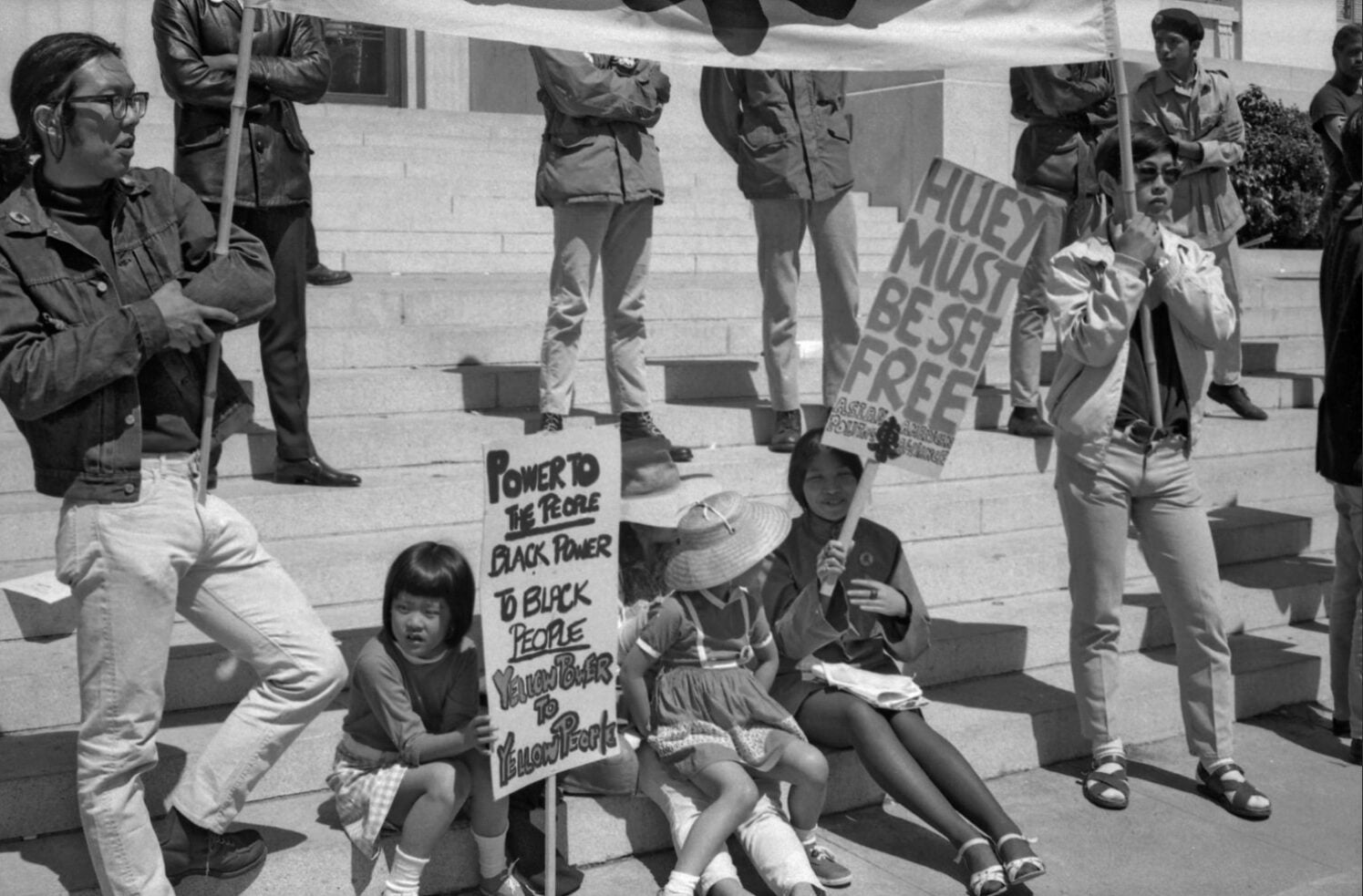
Image 41.01.01 — Vicci Wong (right) takes a break from the demonstration in support of Huey Newton, co-founder of the Black Panther Party, at his trial in Oakland, California, July 1968.
AAPA energetically protested the Vietnam War to end the war and save American lives. But they also wanted more. They wanted the United States to end its imperial invasion in Vietnam and called out the war’s racism, killings, and dehumanization of Vietnamese and of Asian Americans broadly. Scholars estimate well over three million war-related deaths over nearly twenty years, mostly civilians. AAPA intertwined the local and the global and promoted slogans such as “books not bombs,” “no Vietnamese ever called me a gook,” “End US Imperialism,” and “support self-determination.”
AAPA is historically significant for giving rise to a new political identity and a new political movement. AAPA Berkeley inspired other AAPA groups across the country that formed the first nationwide Asian American Movement. This is why Vicci insists that the Asian American Movement has an origin. It started in May 1968, in Berkeley, with the founding of AAPA.
Mike Tagawa and The Black Panther Party
Mike Tagawa has six digits tattooed on his right hand. “11820-F” was the family number given to the Tagawas during their World War II incarceration. Unlike enslaved Africans, interned Japanese Americans did not suffer physical branding on their bodies. So, why would Mike choose to have this number visibly imprinted on his hand?
For Mike, the concentration camps are branded on his soul. He was born inside the Minidoka concentration camp, in Idaho, on February 19, 1944. This was two years to the date after President Roosevelt signed Executive Order 9066 that, while not mentioning the Japanese nor exclusion, set in motion the procedures for the mass removal of 110,000 Japanese Americans from the West Coast.
After their release from Minidoka, his family returned to the Seattle area in 1945, poorer than when they left. His father died of complications from tuberculosis when Mike was only nine years old. His mother was left to raise five children and support her father, and moved the family into the Rainier Vista Housing Project in Seattle’s Central District, or the “CD.” Some might have negative views of the CD as a “ghetto,” but Mike loved growing up there. He recalled, “I never really thought much about… race or racism” because in the CD “all the races mixed without any problems and I thought it was like every place.” 5
In 1962, Mike went into the Air Force a month after graduating from high school. After a stint in Texas, Mississippi and Florida, he was transferred to Travis Air Force Base in Northern California. He traveled to the San Francisco Bay Area for blues concerts, and also picked up an education about the antiwar movement. He relayed:
It got to the point where I’d go off base through the main gate and then turn around and join the protestors holding up signs, “Out of Vietnam”…. It was bothering me because… (pause) you know, the war was really escalating and a lot of people were getting killed over there. 6
After finishing his military service in 1966, Mike returned to Seattle and got involved in anti-war rallies. One day, he said, “I saw this incredible sight—fifty or sixty Black brothers and sisters in black leather… marching in military formation.” 7 It was the newly formed Seattle chapter of the Black Panther Party (BPP) and Mike knew the drill leader from his elementary school days.
He learned that the chapter was patrolling the police to try to stop police violence against Black communities and later began serving free breakfasts for children, among many other activities. When invited, Mike joined the Party and he worked with the police patrols and political education classes. Readers might be curious about an Asian American in the BPP. Yet,there were a few non-Blacks in the Party, including three Asians in the Seattle chapter alone. The BPP struggled for liberation for Black people as well as for all oppressed people.
Mike was instrumental in building the early Asian American Movement in Seattle. Mike, with Alan Sugiyama, co-founded the Oriental Student Union at Seattle Community College campus in 1970 and soon demanded the hiring of Asian American administrators, whom they hoped would bring greater understanding of and be more responsive to the concerns of Asian American students. After unsuccessful negotiations, they organized a Sit-in of the Administration Building, which led to their winning their demands. Significantly, the students learned a lesson about what we can achieve through collective organizing.
This was the kind of activism animated by Mike Tagawa’s tattoo, visibly placed on the back of his right hand that serves as a daily reminder and a guide to action.
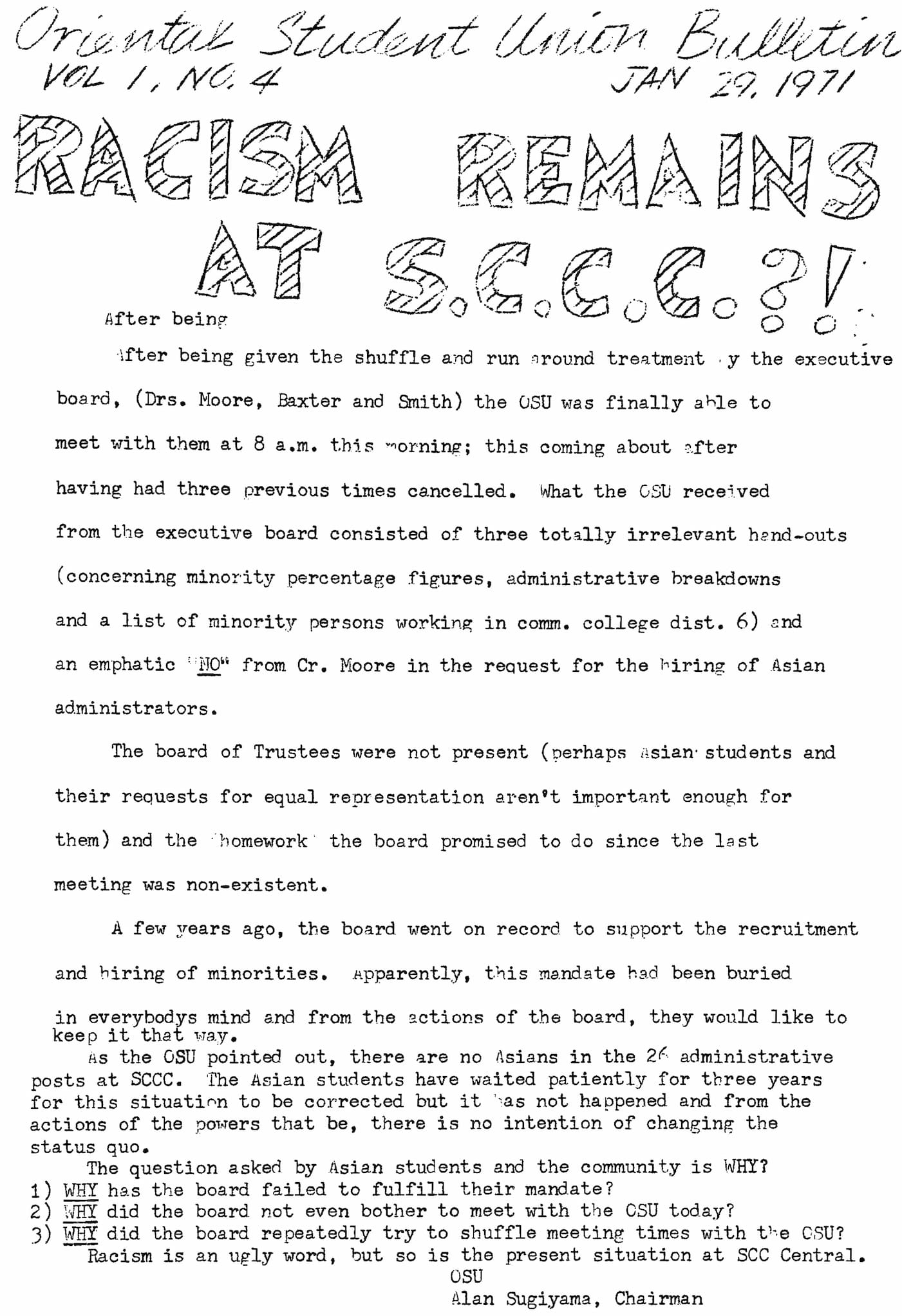
Text 41.01.04a — Read the Oriental Student Union (OSU) Bulletin Number 4, “Racism Remains at SCCC?!” What do you notice about what the OSU was demanding and why? What kind of obstacles did they face?
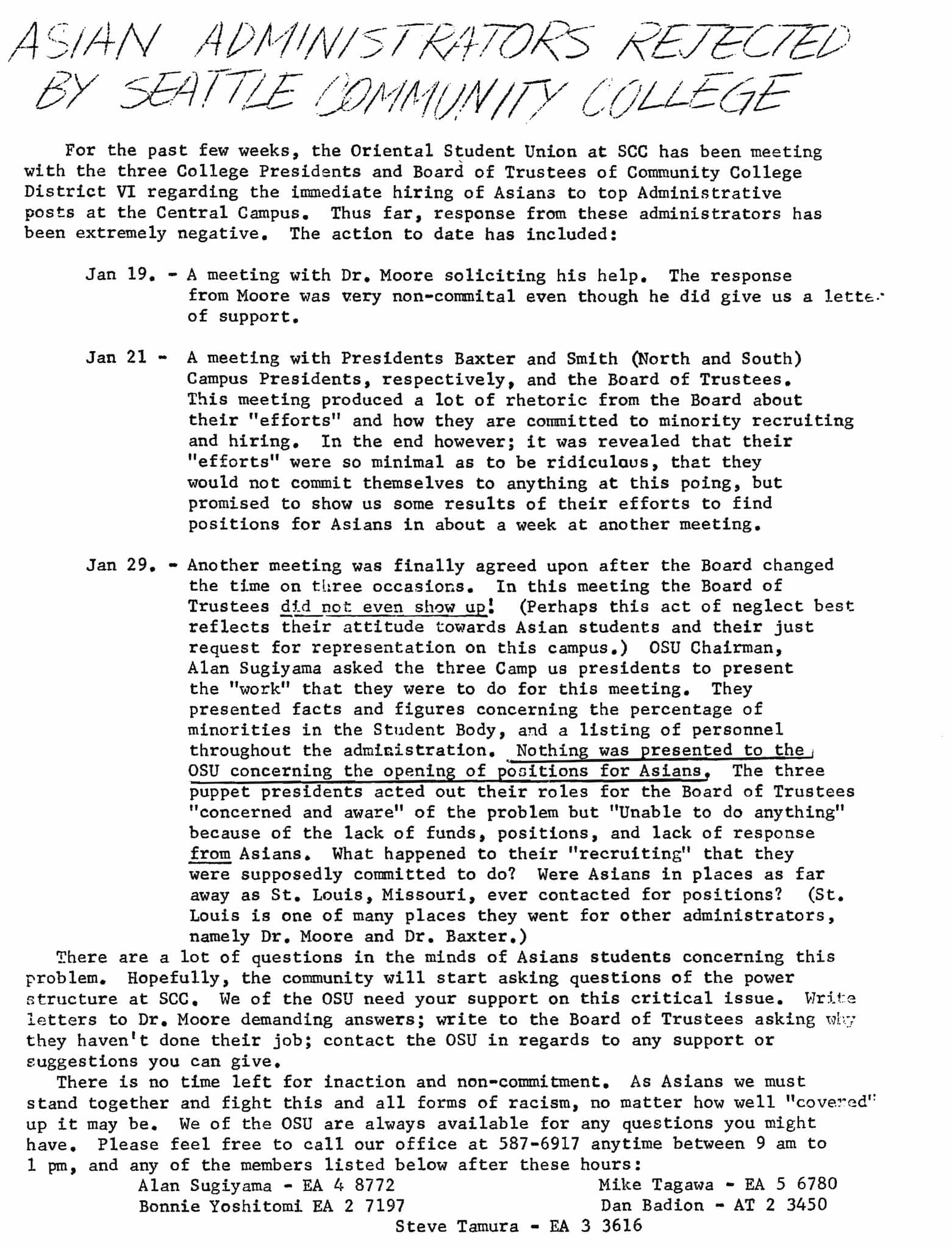
Text 41.01.04b — Read the Oriental Student Union (OSU) Bulletin Number 4, “Racism Remains at SCCC?!” What do you notice about what the OSU was demanding and why? What kind of obstacles did they face?
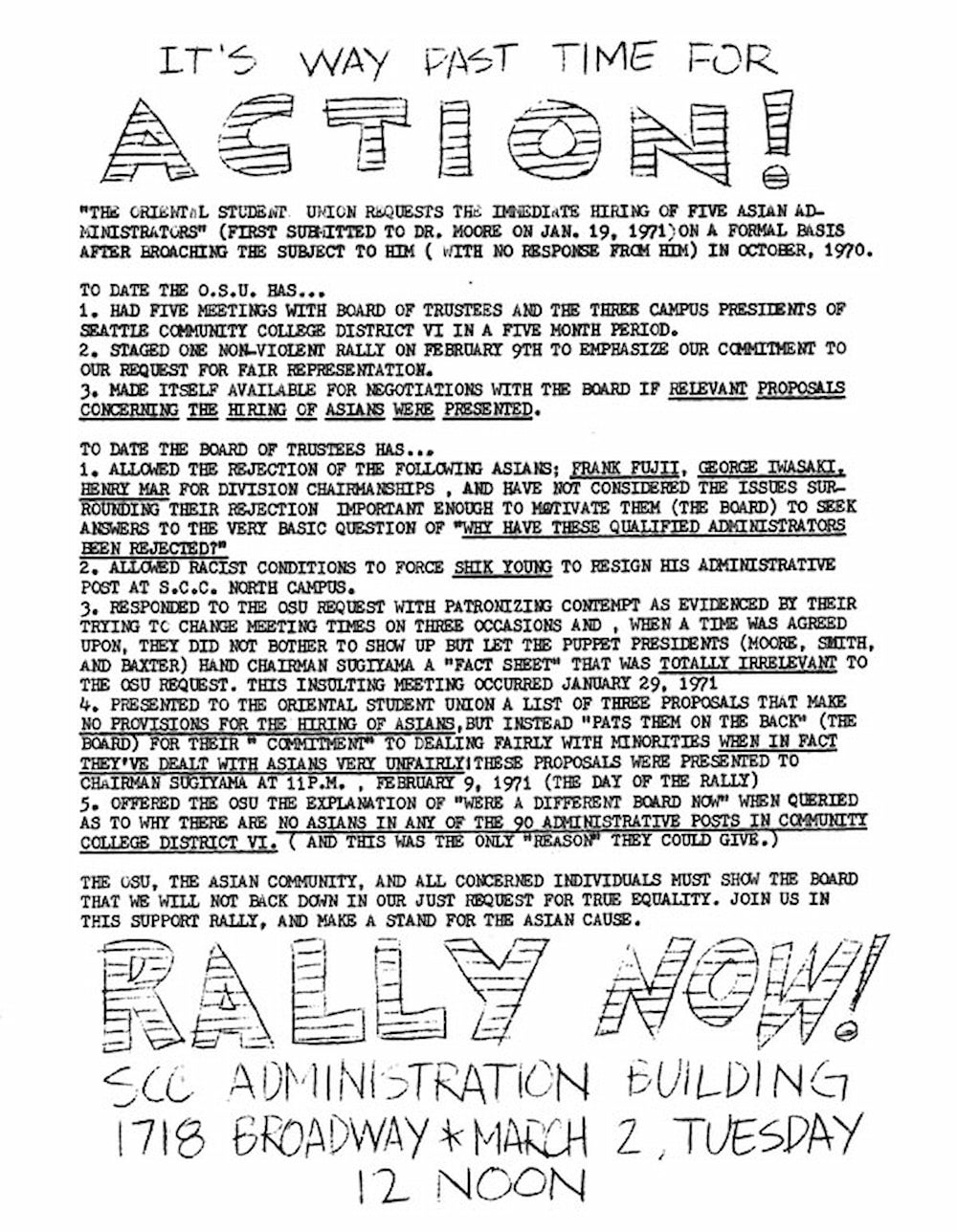
Text 41.01.04c — Read It’s Way Past Time for Action, created by Asian American activists at the Oriental Student Union (OSU). What actions did OSU take before organizing the sit-in? What led them to this more high-profile action?



Estella Habal: Filipino Organizing and the I-Hotel Struggle
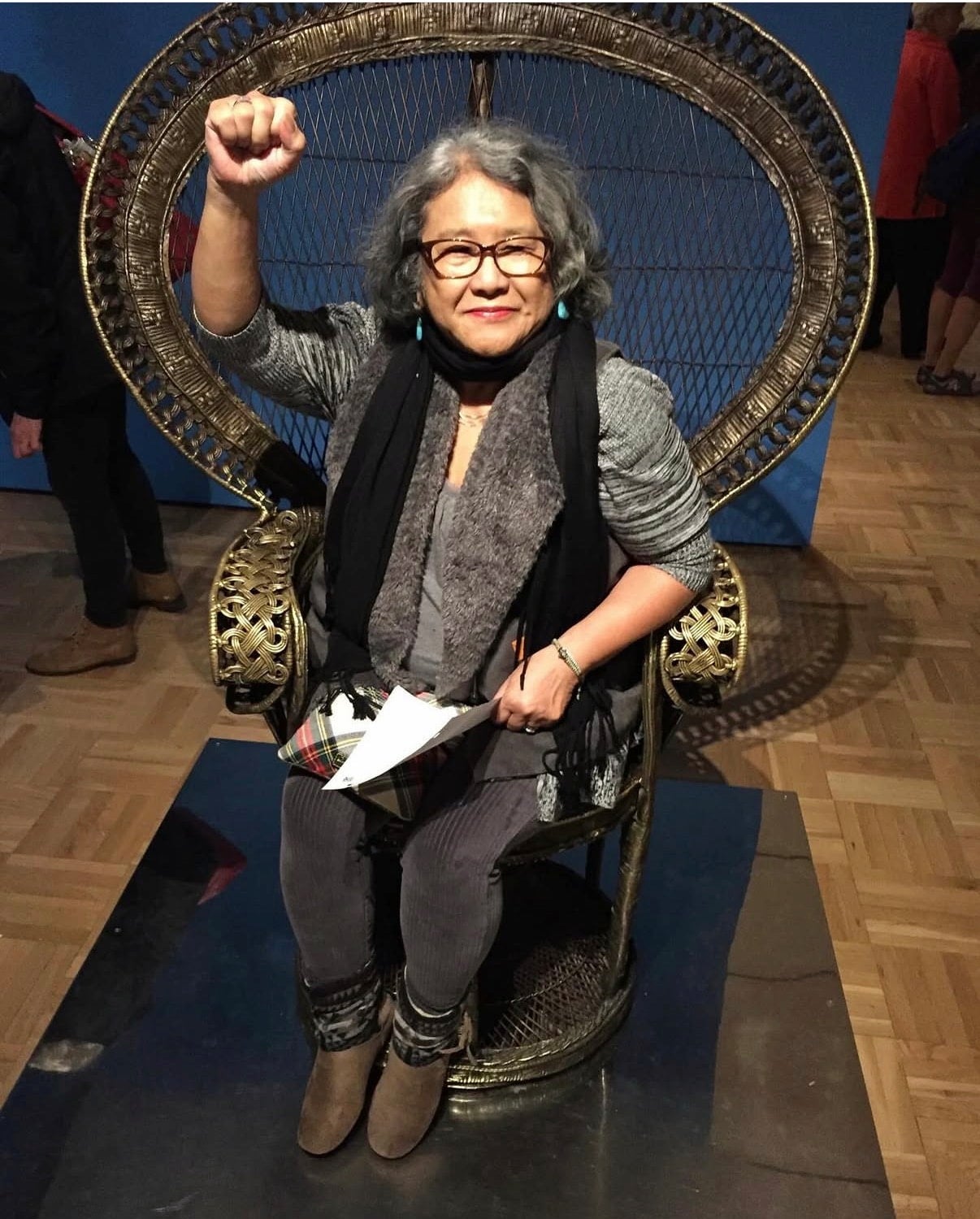
Image 41.01.05 — Estella Habal was a full-time Union of Democratic Filipinos (KDP) organizer during the International Hotel struggle to resist evictions and gentrification.
Estella Habal came to the Asian American Movement as a young, single mother. She had had two children as a teenager and a husband who could not understand her aspirations to attend college. She dreamed of a life beyond the options seemingly available to Filipino farmworkers like Estella, her husband, and their siblings. With the support of her mother who provided childcare, she attended college at the California State University, Long Beach, and was awakened to the political protest in the late 1960s. The Chicano student movement introduced her to revolutionary ideas and their opposition to Spanish colonialism, which impacted the Pilipino community as well.
In 1971, she parted ways with her husband and moved with her children to San Francisco. Her first stop was the International Hotel (I-Hotel), where she had earlier visited with an organization raising awareness of Filipino history and culture.
“It is hard to describe one’s feeling when you discover that you do have a history worth studying and a culture to be proud of,” Estella reflected. 8 She joined the I-Hotel struggle to fight the gentrification of Chinatown and evictions of residents, but also found a place of belonging and a Filipino political community. As a member of the Union of Democratic Filipinos (KDP), she worked as a full-time organizer at the I-Hotel for several years, including to support the tenants and coordinate actions against evictions.
It was August 4, 1977, the night of the I-Hotel evictions. Estella was part of the team of young activists who stayed with the remaining older tenants to help face the evictions. Though evicted that night, they had worked with enormous fortitude for ten years to stave off the evictions, and learned tremendous lessons in the process.
How was Estella, as a working-class single mother, able to participate so actively in political movements of mostly young people without children? She makes clear that “household collectives”—for her, with the San Francisco Newsreel, Kalayaan, and the KDP—made possible her political organizing. Estella explained:
“Collectives” back then were a “total experience.” .… It was a living arrangement… [where] people should share everything…rent money was pooled according to an agreed upon amount, household cooking and chores were shared, and even childcare was carefully planned. One of the purposes of the collective which attracted me was to liberate people, especially women, from household drudgery so that they could participate in more meaningful, productive work. 9
As important as the collectives were, Estella also noted, “I never entertained utopian ideas that the ‘collective’ or even ‘socialism’ could fully take care of children. I knew that I was the primary caregiver and the burden of responsibility for raising my kids would still remain with me, regardless of the amount of help I received.” 10
After the I-Hotel evictions, Estella left the movement for a period to care for her own mental health. But she felt the tug of liberation and renewed her activism. Years later, she wrote a scholarly book, San Francisco’s International Hotel (2007), informed by her own experiences. She also helped to create the museum, archive and senior housing that now sit at the site of the former I-Hotel.
In social movements, even if you lose one battle, other things might be gained over the longer run. What do you think I-Hotel activists like Estella Habal gained as a result of their efforts to save the I-Hotel?
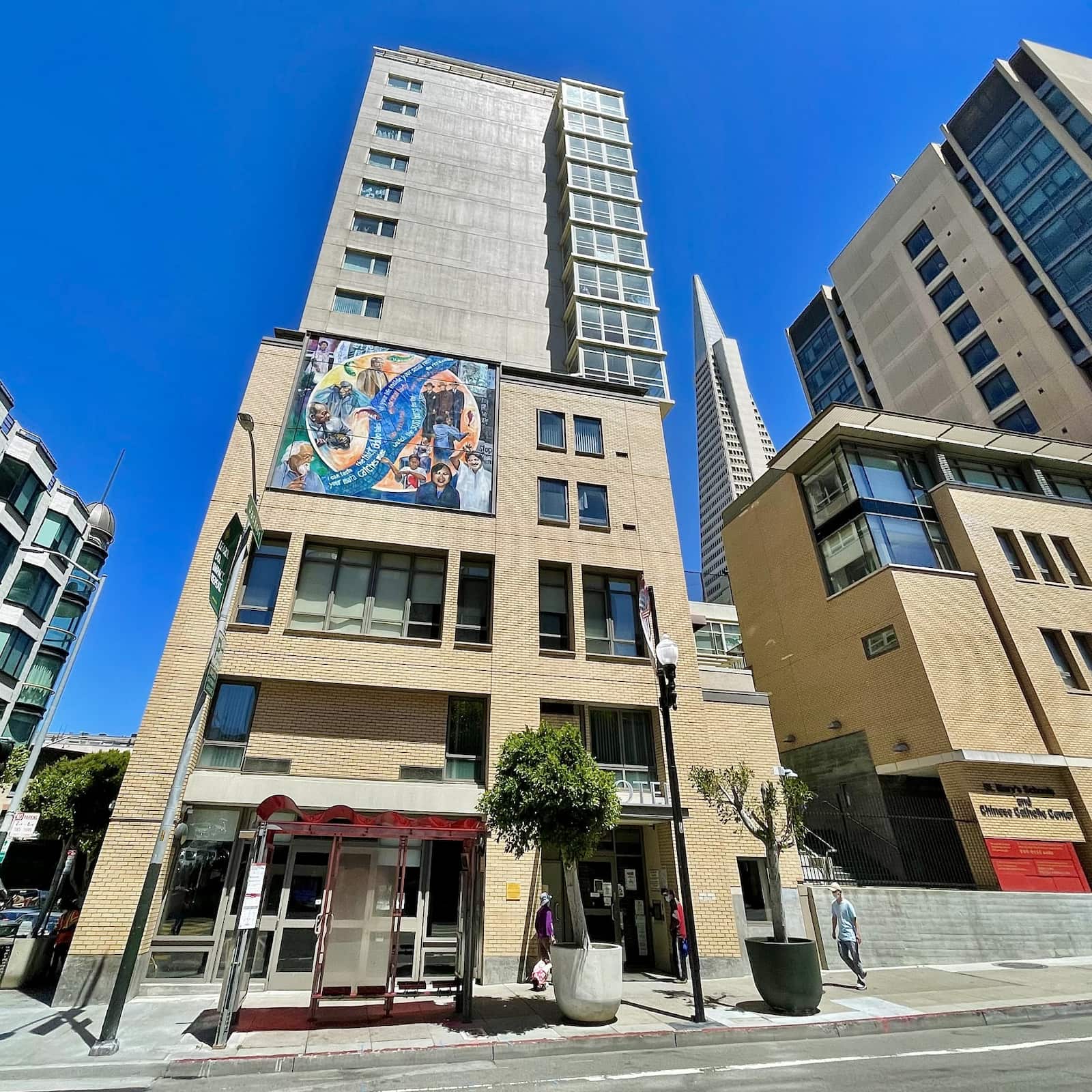
Image 41.01.07 — Community efforts led to the 2005 completion of the International Hotel Manilatown Center low-income senior housing, which includes a community center, a historical display commemorating the original I-Hotel, and a mural depicting activists fighting to preserve affordable housing in San Francisco.
Reflection questions
Have you ever heard of collectives? What do you think of collectives as intentional communities of people coming together to care for each other? What might be shortcomings?
Asian American Activism as Ongoing Struggle
While this module focuses on the Asian American Movement of the 1960s and 1970s, we do not want to give the impression that Asian American organizing ended with the fall of the I-Hotel. Instead, continuing to the present, numerous Asian American activists, organizations, and campaigns work towards greater equality, well-being and justice through many different avenues. These range from immigration justice and citizenship rights, to expanding access to affordable housing, health care and education, to opposing war and militarism, occupation and incarceration.
Numerous Asian Americans political artists use the power of culture to transform ideas and conditions. They include Ruby Ibarra, a commanding Pilipina rapper drawing on Filipino culture and resistance; Jess X. Snow, a Chinese-diasporic filmmaker, muralist, poet, and children’s book author whose art inspires us to imagine new futures; Saiyare Refaei, a Chinese-Iranian visual artist, muralist, and print-maker with the Justseeds artist collective and an organizer at the Tacoma Detention Center in Washington; and Kyoko Takenaka, a musician, filmmaker, and dancer, who brings “butoh dance,” emerging from the ashes of Hiroshima in postwar Japan and featuring anguished bodily movements, to create stirring performances. And there are countless more.

Image 41.01.08a — Ruby Ibarra is a Pilipina American rapper, producer, and director who often performs in English, Tagalog, and Bisaya.

Image 41.01.08b — Jess X. Snow is a Chinese-diasporic filmmaker, multi-disciplinary artist, and poet.
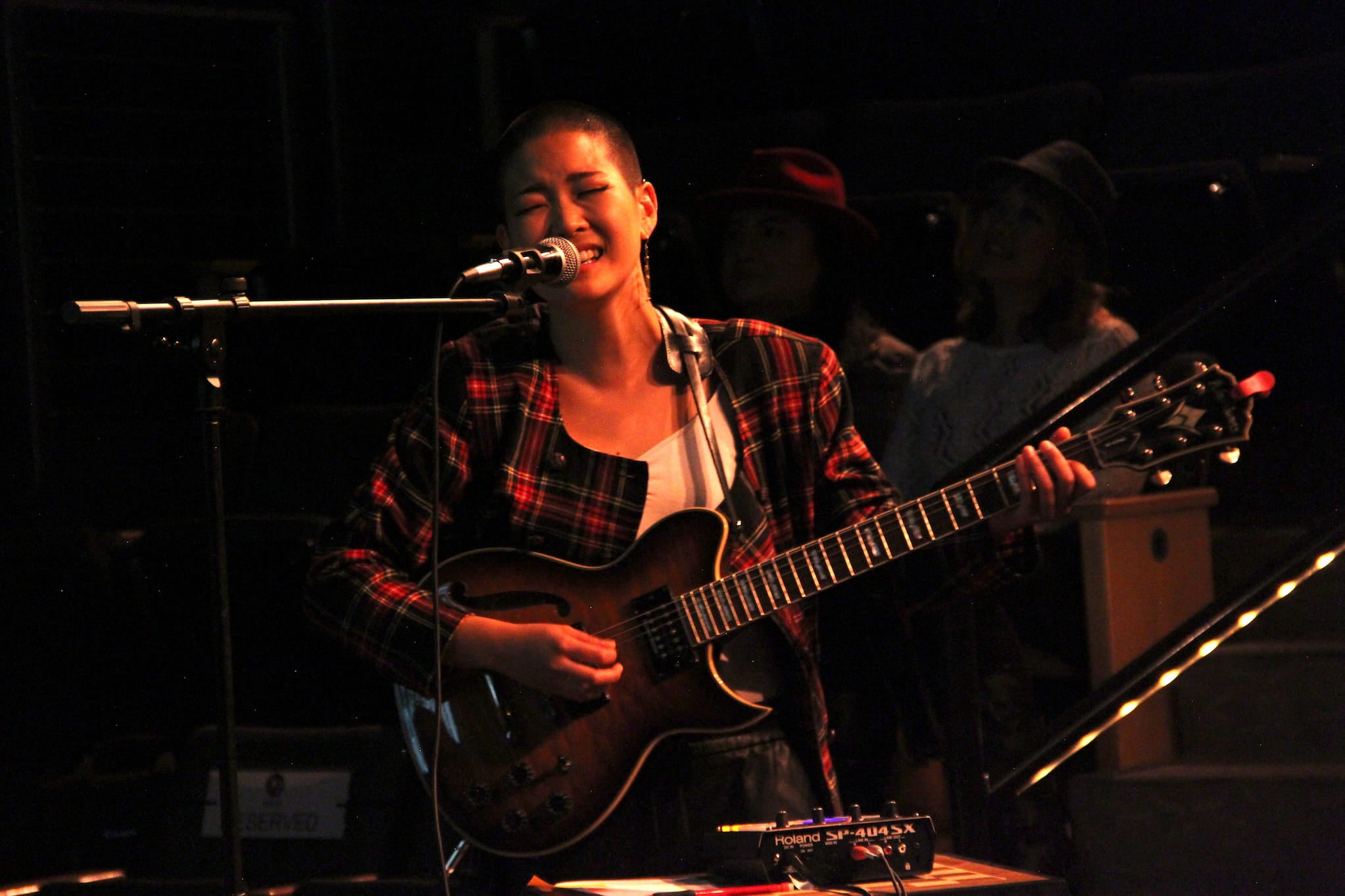
Image 41.01.8c — Kyoko Takenaka is a musician, filmmaker, performance artist, and Butoh dancer based across the US and Japan.



Reflection questions
What are you curious to learn about Asian American activism? What inspires you to create a more just world for future generations?
Glossary terms in this module
affordable housing Where it’s used
Generally defined as housing in which the person living there is paying no more than 30 percent of their income for housing costs, including utilities.
eviction Where it’s used
A legal process in which a landlord forces a person or group to leave their home.
gentrification Where it’s used
The process in which real estate developers displace neighborhood residents out of their community by upscaling or establishing new properties and businesses. These new establishments attract wealthier residents and raises the cost of living, which eventually forces longtime neighborhood residents to move. Gentrification often disrupts the original community’s history, culture, and social networks.
imperialism Where it’s used
The process in which a country extends its power or control over other peoples or countries, often involving the use of militaries.
militarism Where it’s used
The belief in and use of force, including full-scale war, to assert power, authority, and control over a nation or people.
self-determination Where it’s used
Within a global context, self-determination is the right of a people to freely determine their political status and freely pursue their economic, social, and cultural development without external interference. For students in the Third World Liberation Front, self-determination meant having the power to develop their own classes and change university procedures.
strike Where it’s used
Traditionally, a strike is when workers collectively refuse to work to achieve certain goals. In the context of the student strike, students refused to go to class, held educational workshops, and organized demonstrations.
Endnotes
1 Grace Lee Boggs, Living for Change: An Autobiography (University of Minnesota Press, 2016, reprint from 1998), 39.
2 Victoria Wong, “Cultural/Political Activism and Ethnic Studies (1969-2019),” Ethnic Studies Review 42 (2019): 151–157.
3 Wong, “Cultural/Political Activism and Ethnic Studies,” 151.
4 Diane C. Fujino, “Political Asian America: Afro-Asian Solidarity, Third World Internationalism, and the Origins of the Asian American Movement.” Ethnic Studies Review 47 (2024): 60–97.
5 Mike Tagawa, “Mike Tagawa,” interview by Janet Jones, University of Washington, Seattle Civil Rights and Labor History Project, June 6, 2005, https://depts.washington.edu/civilr/tagawa.htm.
6 Mike Tagawa, interview by Diane Fujino, April 18, 2013.
7 Tagawa, interview.
8 Estella Habal, “How I Became a Revolutionary,” in Legacy to Liberation: Politics and Culture of Revolutionary Asian Pacific America, ed. Fred Ho (AK Press, 2000), 199.
9 Habal, “How I Became a Revolutionary,” 201.
10 Habal, “How I Became a Revolutionary,” 203.


