






Module 2: Contours: A Profile of the Pakistani American Community
Do Pakistani Americans fit under the broad umbrella of an “Asian American” panethnic identity?
This module examines the landmark Immigration and Nationality Act of 1965 (INA), family migration laws, and their collective impact on the Pakistani American community.
The Immigration and Nationality Act of 1965 (INA) became instrumental in shaping all Asian American demographics in the US since it reversed the Asian exclusion laws of the late nineteenth to the early twentieth centuries. For Pakistani immigrants, in particular, the act created opportunities and pathways for white-collar professionals to move to the United States.
Such a brain drain from Pakistan shaped the Pakistani American community in the US, while leaving a lasting impact on patterns of education, employment, and emigration decisions back home. Later, the family immigration policies passed in the 1980s and 1990s in the US created more class diversity within the Pakistani American population.
How did immigration laws after 1965 support Pakistani migration?
What broad patterns have shaped the Pakistani American community in the twentieth and twenty-first centuries?
How have Pakistani American women contributed to the US labor force?
The Immigration and Nationality Act of 1965
The Immigration and Nationality Act of 1965 provided a reversal of the decades-long policy of Asian migration exclusions to the US, while earlier postwar laws set some precedent. The Luce-Celler Act of 1946 partially ended the Immigration Acts enacted in 1917 and 1924 that created the “Asiatic Barred Zone,” which had denied South Asians the rights to legal residency and naturalized citizenship. Additionally, a 1952 law expanded these rights to all Asians but still maintained a race-based quota for new immigrants from the “Asia-Pacific Triangle.”
The real turning point, however, in securing a more fair and equal treatment for the admission of Asian immigrants was the Immigration and Nationality Act of 1965. Passed during the height of the Civil Rights Movement, the INA removed both the race-based and national-origin quotas that had determined numerical ceilings on Asian migration previously. It also eliminated the separate category for Asian migration that had been in place since the 1880s. Further, the INA amended the existing admissions preference categories, allocating approximately 75 percent of annual immigration quotas to family reunification and 20 percent to occupational skills.
Whereas the US had previously barred Asians from entering the country, President Lyndon B. Johnson assured the American people that this new legislation would not significantly alter the nation’s white majority. At the same time, the INA worked to quiet international criticism of the US’s exclusionary immigration policy.
An unintended consequence of the INA was that Asian immigrants quickly became one of the largest and fastest-growing segments of the American populace. Highly educated Asians from Taiwan, South Korea, the Philippines, India, Pakistan, and elsewhere applied for newly available visas for professionals. Most applicants were men, many of whom sponsored their wives and children under different provisions of the INA. Women also directly applied for positions in professions such as nursing and sponsored their families as well. Previously, US immigration law had largely prohibited Asian immigrants from sponsoring or applying for family migration.
Furthermore, the INA included a visa category for international students, for which many Pakistanis applied. After graduation, many Asian international students filed to transfer their student visas into employment-based visas, which could later become pathways to permanent residency. The process was fairly straightforward and easily obtainable at that time, unlike today, when backlogs often hinder legal pathways toward residency and citizenship.

Image 16.02.01 — Pakistani international student, Fawzia Afzal-Khan, arrived in Boston to pursue a PhD in English at Tufts University in 1979. She reflected, “That first day in America…I was young and naive enough to believe that here … I was totally, blissfully ‘free.’”

Listen to
An interview with Ali Khataw
Image 16.02.02 — Ali Khataw, seen here in 1980, immigrated to the United States from Pakistan as a student. In this interview clip, he describes his first days in America.
In this fashion, the INA fundamentally transformed the Pakistani American community in the latter half of the twentieth century. Prior to 1945, South Asian immigrants faced racially exclusionary laws and discriminating customs barring them from land ownership and equal employment especially in the American West. After 1965, however, Asians could more easily access education, employment, housing, and land. These changes came about as a result of three factors including the shifting terrain of Cold War foreign policy that favored political alliances with Asian countries, the achievements of the Civil Rights Movement, and the passage of the INA.
Not only did the INA create legal access for expanding Pakistani immigration, but it also reinforced the exemplary selection of US-bound Pakistanis, similar to the case of Taiwanese, Korean, Iranian, Indian, and other Asian immigrants at the time. From the 1960s to the 1980s, college-educated immigrants and white-collar professionals such as engineers, researchers, and physicians, and their families comprised over 90 percent of new Pakistani immigrants.
Even as this trend decreased over time, the effect of such policies created a predominantly middle-class migration that reinforced the myth that South Asian Americans were part of a “model minority,” a limiting and harmful Asian American stereotype that lingers, despite the reality of the vast class differences that exist in the Pakistani American community.
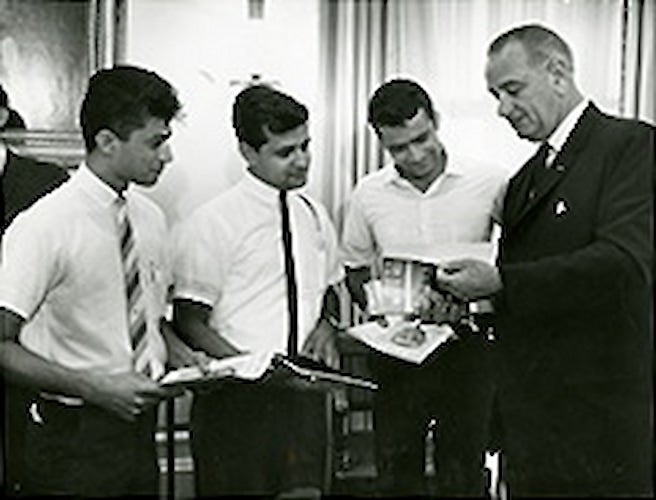
Image 16.02.04 — President Lyndon B. Johnson gives White House literature to students from Pakistan and India after personally conducting them on a tour of his offices in 1965.
Pakistani Immigration in the 1980s–1990s
The post-1965 pathway for extended-family migrations led to a greater number of Pakistanis from various economic backgrounds to enter the US. By the mid-1980s, the proportion of college-educated Pakistani Americans decreased to 80 percent of new arrivals compared to higher percentages in the 1960s and 1970s. Still, this percentage was quite high when compared to the 45 percent of new, college-educated Chinese and 64 percent of Korean immigrants entering the US at the time. Following the Immigration Reform and Control Act of 1986 (IRCA) and the Immigration Act of 1990, however, more working class Pakistani Americans started entering the fray of Pakistani American communities.
Both the IRCA and the Immigration Act of 1990 provided opportunities for nonprofessional workers to settle in the United States legally. The IRCA, in particular, gave unauthorized immigrants a pathway to legal residency. Further, the Immigration Act of 1990 revised the annual quotas and preference categories. Additionally, it created the Diversity Immigrant Visa Program, also called the Diversity Visa, that allowed for the migration of individuals and families from countries underrepresented in the United States in the preceding five years.
Under the Diversity Visa, residents of countries with low rates of US-bound migration such as Bangladesh, Nepal, and Pakistan could enter an immigration lottery if they met a minimum prerequisite of basic education and occupation conditions. The randomly selected applicants received permanent residency status for themselves, a spouse, and any children. Pakistanis entering after 1990 thus tended to have fewer qualifications and skills and found lower-wage jobs, unlike the earlier wave of highly educated, professionalized Pakistanis. The Pakistani American population in the United States more than doubled during the 1990s, and immigration authorities removed Pakistan from the Diversity Visa list in 2002.
|
Year |
Population |
|---|---|
|
1970 |
1,708 |
|
1980 |
6,182 |
|
1990 |
81,371 |
|
2000 |
204,309 |
|
2010 |
409,163 |
|
2015 |
519,000 |
|
2020 |
550,834 |
Table 16.02.05 — The growth of the Pakistani American population in the United States, from 1970 to 2020. Source: Data aggregated from tables at https://data.census.gov/
Pakistani American Immigration in the 2000s
A new century dawned in the United States after the September 11, 2001 attacks on the World Trade Center and the Pentagon. The US government’s crackdown on Pakistani Americans and immigrants of Muslim backgrounds resulted in a drastic reduction in migration from Pakistan to the United States. As US government policies specifically targeted American Muslims in the US, and the US military launched a series of wars against the Muslim-majority countries of Afghanistan and Iraq, anti-Muslim and anti-Sikh hate crimes in the US peaked.
In the two years following the attacks, the government denied permanent US residency to many more Pakistanis applying for a green card than before 9/11. Likewise, in the years immediately following 9/11, the number of students from Pakistan attending American universities plummeted more than 40 percent. Even as immigration from Pakistan rebounded by 2006, the number of Pakistani foreign students in universities has remained low, nearly twenty-five years after 9/11. By 2024, the number of international students from South Asia’s Muslim-majority countries including Pakistan (10,164 students in US), Bangladesh (13,563), and Afghanistan (682) paled in comparison to the roughly 270,000 Indian international students.
Between 2010 and 2020, the government erected further barriers to migration from South and Central America. Asian Americans became, by far, the fastest growing racial group in the United States. Asian Americans grew by 36 percent during this decade, surpassing the 23 percent growth rate of the much larger Latino population. While the majority of this growth included millions of Chinese, Asian Indian, Filipino, and Vietnamese immigrants, over 140,000 new Pakistani immigrants also entered the US, and the US Census counted more than 550,000 Pakistani Americans in the year 2020. Since the census does not dedicate a written category for Pakistani Americans or other South Asian Americans, they had to write-in their ethnicity manually, likely resulting in a census undercount for ethnic Pakistanis. Since 1990, as a result of an organized campaign, the US Census designates a stated category for Indian Americans on the census.
The recent flow of South Asians changed the US population in terms of its diversity, socioeconomic backgrounds, religious affiliations, and cultural-linguistic practices. By 2020, two-thirds of Pakistanis had recently arrived on family-related visas; 8 percent entered as refugees; and a comparatively small number were undocumented. About 75 percent of Pakistani immigrants today speak English fluently upon arrival, but in terms of occupation, there is a wide range, from management and taxi-driving to office and sales jobs.
As an ethnic group, Pakistani Americans are simultaneously among the most highly educated and the poorest Americans. On the one hand, well over half of Pakistani Americans have completed at least a bachelor’s degree, with a quarter of this group going on to obtain a postgraduate degree. Education remains an important strategy for success and survival for Pakistani immigrants and their descendants. Their elevated level of education enables them to earn more per household than other racial groups.
On the other end, according to the 2020 US census, 14 percent of Pakistani Americans live below the federal poverty level. In effect, a greater number of Pakistani Americans suffer from poverty than many other ethnic groups. For example, about 11 percent of whites, and between 6 and 12 percent of other Asian Americans live under the poverty line.
Similar to other first-generation Asian American immigrants, there are also those Pakistani Americans who hold university degrees and have professional experience in Pakistan but cannot gain employment in the US with their foreign credentials. Consequently, after moving to the United States, some 20 percent of highly educated South Asian Americans experience underemployment by working in delivery or service industries, occupations that pay much less than their qualifications merit. Relatedly, like other Asian Americans, even Pakistani American white-collar workers such as engineers have faced a glass ceiling that often hinders advancement into management or executive positions.
Reflecting a growing Pakistani American working class and exploitative working conditions, two Indian Americans, Bhairavi Desai and Biju Mathew, and a Pakistani American, Javaid Tariq, co-founded the New York Taxi Workers Alliance (NYTWA) in 1998. That same year, they led the city’s largest ever taxicab strike to protest excessive fines levied on cab drivers. Since then, the NYTWA enrolled twenty thousand members, chartered with the American Federation of Labor and Congress of Industrial Organizations (AFL-CIO), and has become the nation’s first union of independent contractors. Such a movement for equal access and fair working conditions highlights the difficulties faced by Asian American minorities with divergent socioeconomic status, but also the potential for success through solidarity.
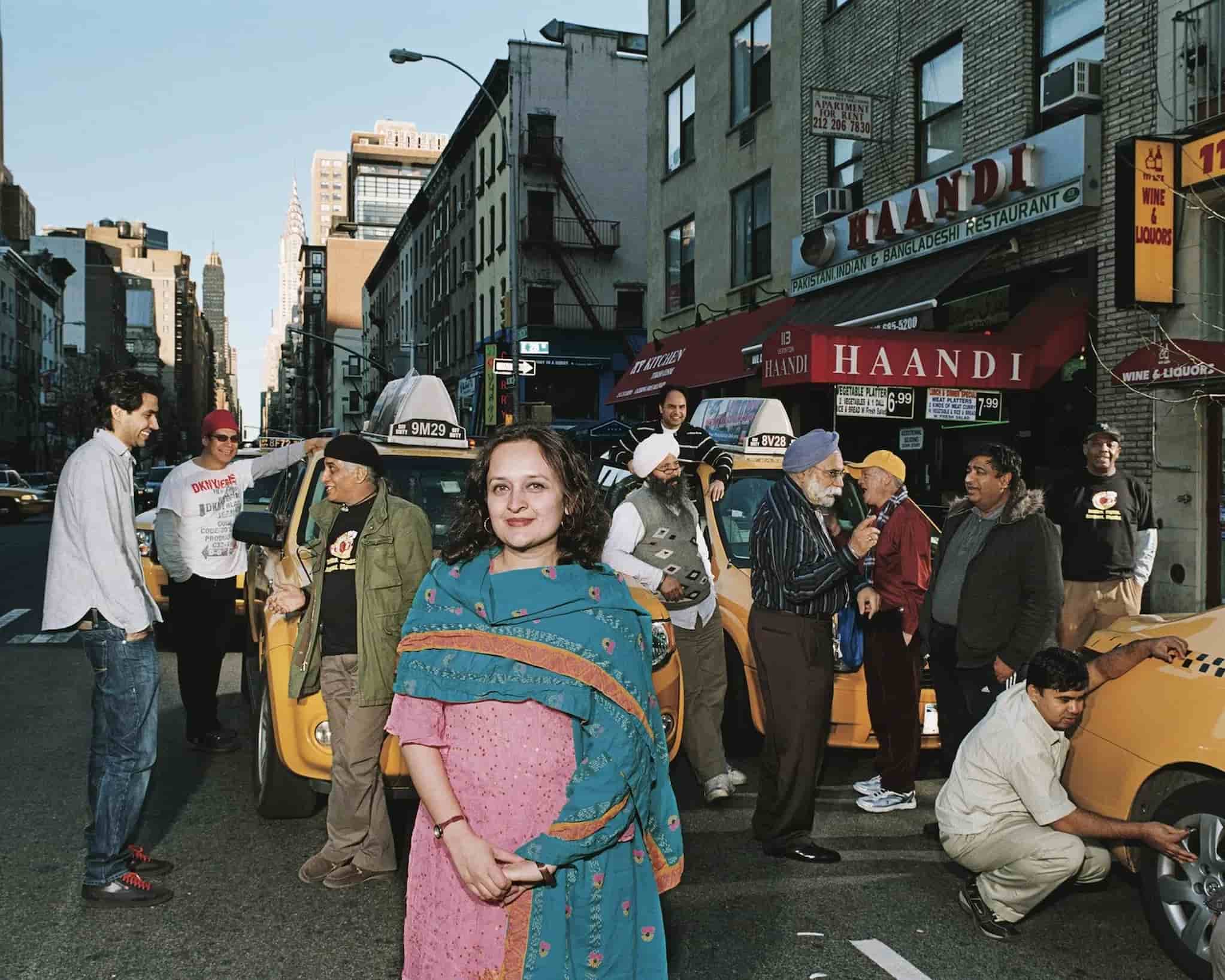
Image 16.02.06 — Co-founders of the New York Taxi Workers Alliance, Bhairavi Desai (center) and Pakistani American Javaid Tariq (third from left), in a photo from The New Yorker, captured in 1998.
Pakistani American Women and Labor
Since the mid-1960s, women and families have comprised a majority of Pakistani immigrants to the US. The migration of family units that started in the second half of the twentieth century has allowed Pakistani American communities to grow, unlike in the first half of the twentieth century when immigration laws prevented Asian family migration. Pakistani American women’s backgrounds in terms of education, class, and religion have affected their standing in the US.
Although over half of Pakistani American women hold college degrees, they are also less likely to work outside the home, especially if they are immigrants. In fact, a little less than half of all Pakistani American women participate in the workforce, the lowest of all Asian American subgroups. This may be a result of a family-centric value system, gender norms, or higher-than-average household incomes that do not require women’s income.
Pakistani American women born or raised in the United States are more likely to work, particularly in skilled professions such engineering, computer science, consulting, therapy, medicine, or teaching. By comparison, first-generation, immigrant Pakistani American women who work outside the home are employed in a wider range of professions, from service and retail jobs to white-collar occupations, especially as physicians.
Some of those who labor as stay-at-home spouses also operate their own small ethnic businesses from home, usually in urban areas with large Pakistani American populations. Such businesses include the tailoring, food catering, ethnic textiles, henna art, aesthetic services, and special occasion gift baskets. They serve as vital but under-recognized segments of ethnic economies.
Geographic Patterns
Although the highest percentage of Asian Americans resides in California, the highest Pakistani American population according to the 2020 US Census lives in Texas, especially in and around Houston and Dallas. Other large Pakistani American populations can be found in California, Illinois, and Virginia. This heralds a change from previous decades when the highest numbers were in New York, Washington, DC, and Illinois.
Since World War II, the thriving economies of the American Southwest have attracted newcomer immigrants at higher rates than the urban centers of the Northeast and Midwest. Pakistani Americans also move to the Southwest because of family ties and access to established ethnic organizations and networks.
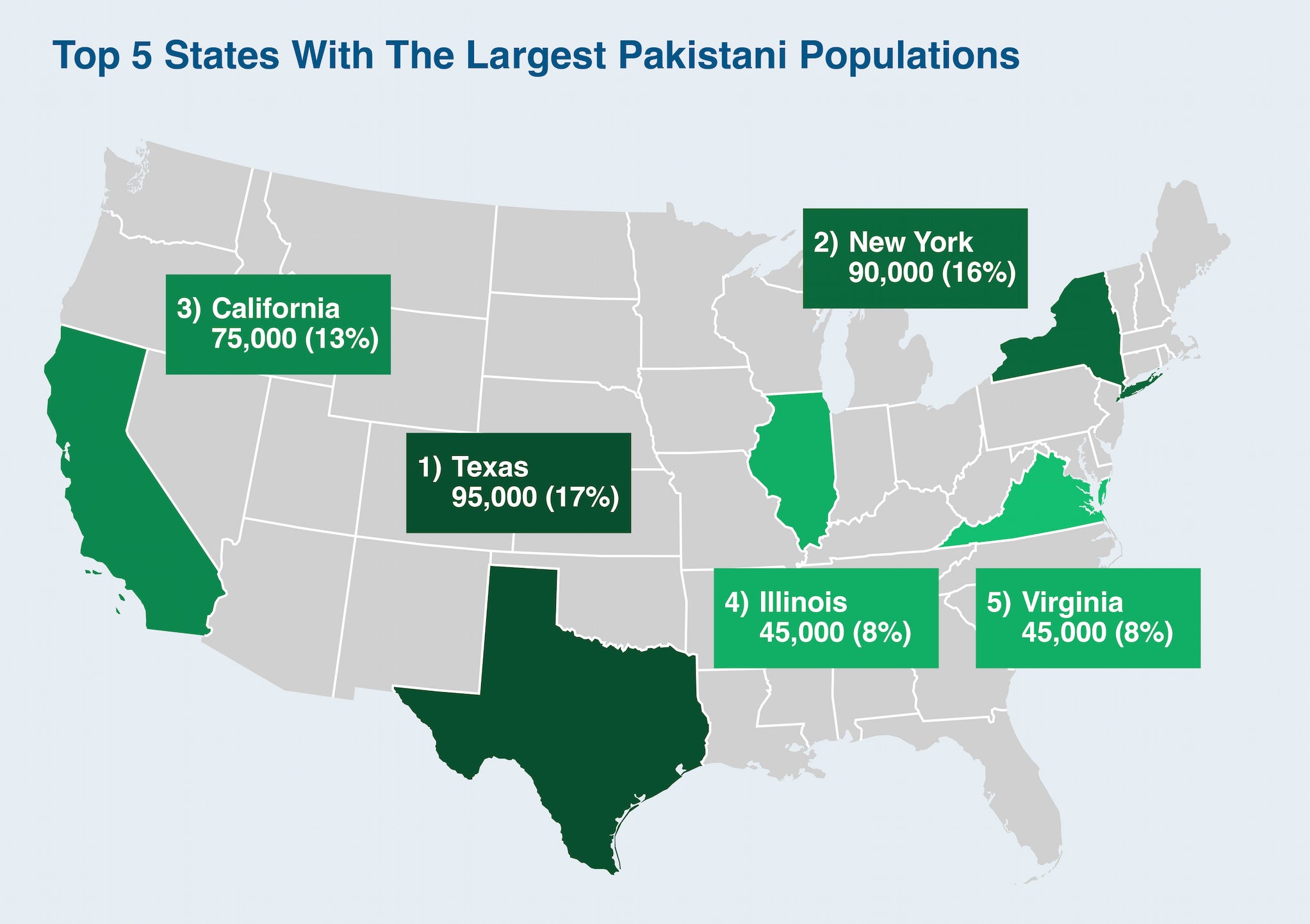
Image 16.02.07 — Percentages of the top five states with the largest Pakistani American populations from 2020. Source: AAPI Data, National State of AANHPI Report (June 2022), p. 22.
Conclusion
In the more than half century since the passage of the INA, Pakistani American communities continue to thrive. Pakistani Americans work in a broad range of occupations, from unskilled, shadow labor to highly-skilled work in professional arenas. Much smaller than the substantial Chinese and Indian American populations, Pakistani Americans live in cities and towns in every region of the country. This module demonstrates that the shifts and changes in US immigration policies tremendously impact who enters this country. Respectively, Pakistani Americans’ social, political, and economic backgrounds have evolved from highly-educated, white-collar professionals in the 1950s and 1960s to multi-faceted and diverse communities in the 2000s.
Glossary terms in this module
South Asians Where it’s used
People with ancestry traced back to Afghanistan, Bangladesh, Bhutan, India, Maldives, Pakistan, Nepal, Sri Lanka, and Myanmar (Burma).
underemployment Where it’s used
The condition of employment in low-paying or reduced-hour jobs for which an individual is overqualified.