





Painting of a vibrant sugarcane plantation and a snaking river that leads to a mill. Workers harvest sugarcane and use oxen to pull wagons.
Module 2: Hawaiʻi’s Plantation Workers Organize for Justice
Has Asian American and Pacific Islander labor activism transformed working conditions for all workers?
“Sure a Poor Man”
(Native Hawaiian Protest Song)
I labored on a sugar plantation,
Growing sugarcane.
My back ached, my sweat poured,
All for nothing.
I fell in debt to the plantation store,
I fell in debt to the plantation store.
And remained a poor man,
And remained a poor man.
I decided to quit working for money,
Money to lose.
Far better work day by day,
Grow my own daily food.
No more laboring so others get rich,
No more laboring so others get rich.
Just go on being a poor man,
Just go on being a poor man. 1
This song illuminates the difficult working conditions on plantations in Hawaiʻi. The speaker describes the backbreaking work and trappings of the spending cycles for those plantation workers who resided on the plantation land and spent their salary at the company-owned plantation stores, often the only place to buy food and goods. Such stores operated on a credit system wherein workers, described by the song, would fall into debt, owing money to the company. The song’s narrator realizes that working does not make the workers earn and save money. Rather, it only makes their employers more wealthy. By the end of the song, the speaker decides to try a different system, growing their own food for their daily needs, instead of harvesting crops for someone else’s long-term profit.
The plantation system in Hawaiʻi consisted of a network of powerful, wealthy settlers who exploited the labor of Native Hawaiians and immigrant workers brought in from other countries, including those from Asia. This module offers an overview of the plantation system in Hawaiʻi, as well as the Native Hawaiian and Asian American organizers who fought for their human rights.
Why was there such a diverse ethnic composition of plantation workers in Hawaiʻi?
How did plantation workers organize collectively for justice in the fields?
What happened to the workers and the land when the plantation system ended?
The Plantation System
When US merchant and missionary settlers came to the Hawaiian islands in the 1800s, they developed a plantation system. This was different from Native Hawaiian society, in which families lived and worked on the land provided by the local chiefs, called the aliʻi. They worked several days each month in service for their land. Although Native Hawaiians resisted the colonizing forces using various tactics, the plantation system still grew.
Settlers seized land to grow and harvest sugarcane, pineapples, and other crops. In an attempt to keep the land in the hands of Hawaiian people, King Kamehaha III proposed the Māhele of 1848, which divided the islands into three segments. This resulted in an unequal distribution of land. Soon afterwards, settlers established the Alien Land Ownership Act of 1850, which allowed foreigners to hold title to land. Even more land transferred from Native Hawaiians to land speculators from the continental US, or it was auctioned to large companies.
As more settlers arrived, they also brought diseases, and the Native Hawaiian population began to decline by the thousands. Native Hawaiians resisted their exploitation early in the implementation of the plantation system. In 1841, local Hawaiians walked off their jobs at the first sugar plantation at Koloa on Kauaʻi in the first recorded strike in Hawaiʻi. Though this strike was not successful, it demonstrated to the owners that Hawaiians would not continue to work in degrading conditions.
The plantation system relied on keeping labor costs as low as possible in order to maximize profits. Sugar companies began to bring in contract workers, first with the Chinese, and then later the Japanese, Filipino, and others. Such diversity in contract laborers guaranteed a continued wave of low wages with little to no benefits for the workers, such as adequate housing or time off. Such working conditions made the backbreaking work of plantation labor unacceptable.
Over time, some workers were able to bring their wives from their countries to join them, and the women also worked on the plantations’ fields and in the mills. By 1894, an estimated 1,618 women worked on plantations—7 percent of the total workforce. By 1920, they made up 14 percent of all Oʻahu island plantation laborers. Women workers received less pay than men for similar work.
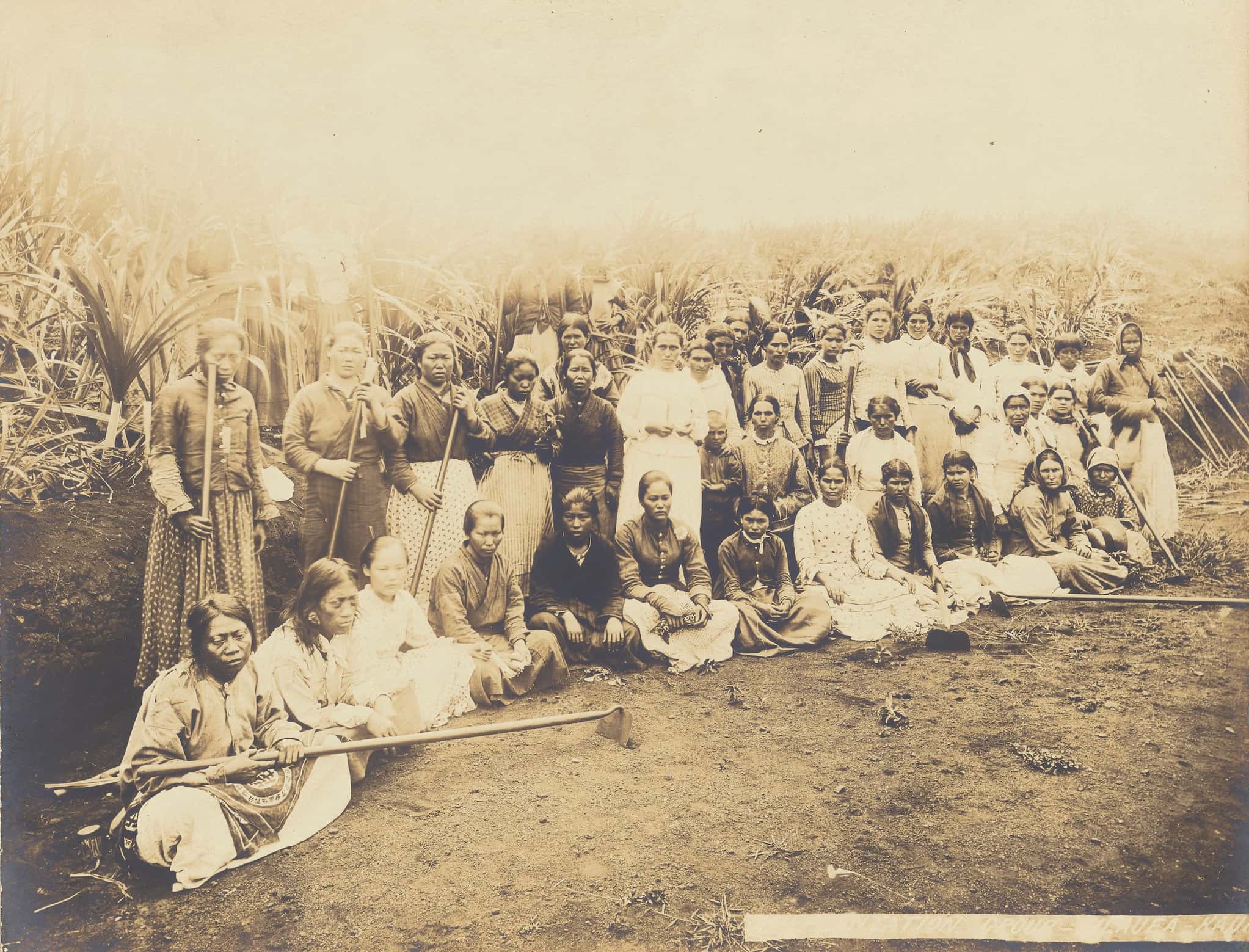
Image 40.02.01 — Women sugar plantation workers on the island of Kauaʻi. Women received less pay than men for performing the same work.
The “Big Five”
Early sugarcane plantation owners faced heavy import taxes from the US. But a treaty in 1875 changed this policy, giving the US duty-free access to Hawaiian sugar. As a result, there was a rapid increase in sugar plantations. The “Big Five” sugar companies included American Factors (AMFAC), C. Brewer, Castle & Cook, Alexander & Baldwin, and Theo H. Davies. These owners tightly controlled workers and dominated the Hawaiian economy by wielding substantial political power.
Further, the Big Five planters had ties to powerful people in the US government, and together, they planned for the overthrow of the Hawaiian monarchy in 1893. They arranged for US marines to surround Queen Liliʻuokalani, threatening to kill her subjects if she did not relinquish control of the land. In such a fashion, the US annexed Hawaiʻi as a territory in 1898.
At first, plantation owners relied on the contract labor system, which forced debt on workers who migrated to Hawaiʻi for work. These workers had to work three to five years in order to pay back expenses for transportation and housing. This system was ultimately declared unconstitutional under the Thirteenth Amendment, when the US formally abolished slavery and indentured servitude. Thus, after the US annexed Hawaiʻi and it became a US territory, the Big Five also had to abandon the exploitative contract labor system. Some plantation workers were able to leave the plantations as a result, and they subsequently returned home or moved to the mainland.
Sugar plantation owners responded by bringing in a large number of workers from different countries in Asia, as well as Puerto Rico, Portugal, and others. These workers, while not bound by the strict contracts, nevertheless, discovered the low pay and plantation stores’ trappings. In addition, they faced harsh working and living conditions. Workers were often housed by their ethnic group in crowded rooms, and those with families lived in tight quarters. By the beginning of the twentieth century, the low wages and poor working conditions led to several efforts among plantation workers to organize.
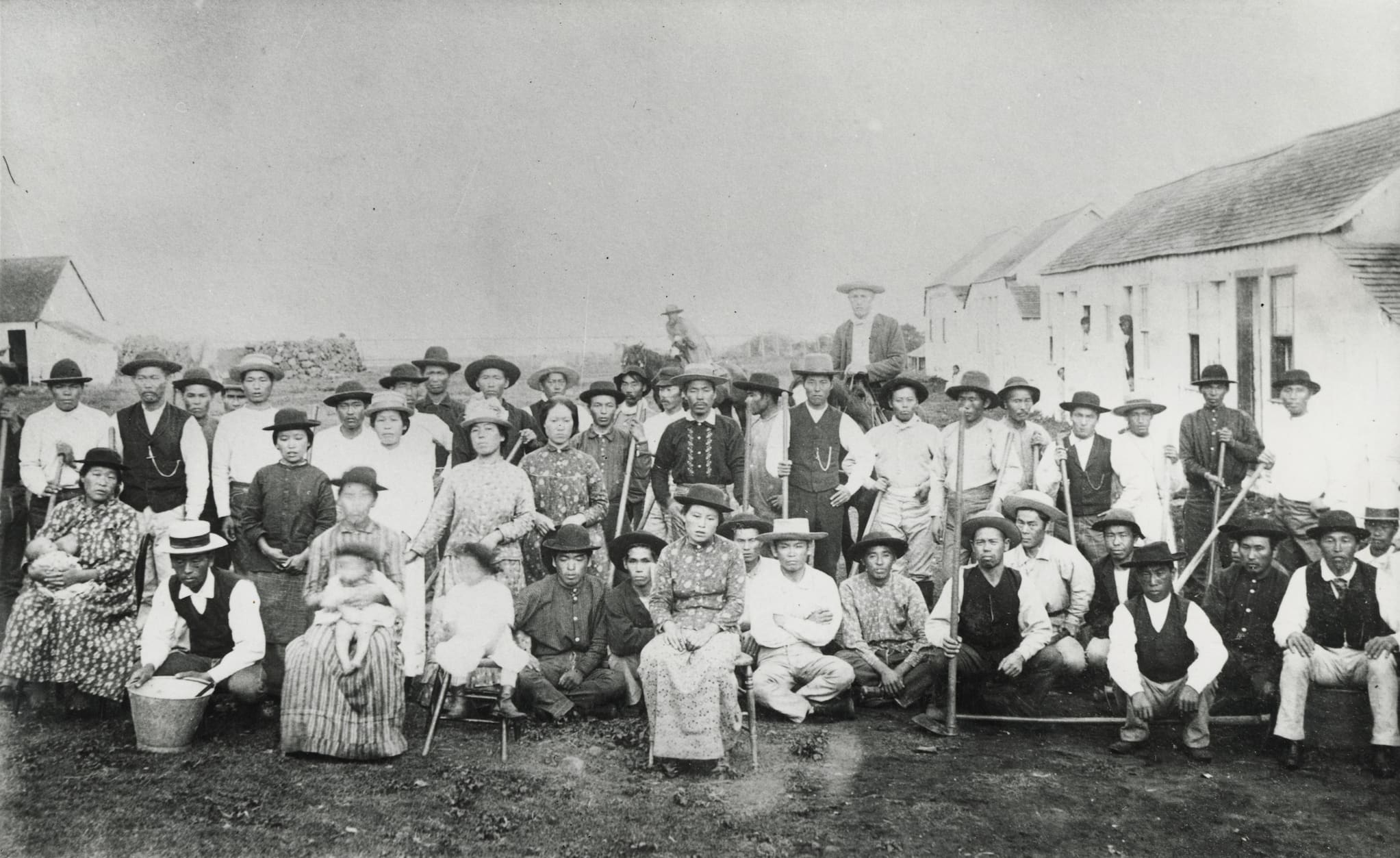
Image 40.02.02 — Japanese sugar plantation laborers photographed in 1890 in Kaʻū, Hawaiʻi; they faced harsh working and living conditions.
The Growth of Unions
Over the years, workers continued to create and join unions to fight for better working conditions in many sectors, and their interethnic solidarity continued to deepen. Plantation owners still recruited Filipino workers, particularly as the US barred other Asian workers from migrating to the US in the late nineteenth until 1943. As the workforce in Hawaiʻi grew, so did the unions. By 1924, there were an estimated thirteen thousand members of the Filipino Labor Union. These workers went on strike on Oʻahu, and the strike spread to neighboring islands, growing to over half of the forty-five plantations. After eight long months, the strike was broken.
On the West Coast, members of the International Longshoremen’s and Warehousemen’s Union (ILWU, now known as the International Longshore and Warehouse Union) built a multiracial, democratic union. In 1930, workers in Hawaiʻi formed a new local chapter of the ILWU. Soon, they began to organize plantation workers. Although their efforts halted after the Japanese military attack on Pearl Harbor in 1941, the ILWU resumed organizing in 1945. They focused on organizing all plantation workers, regardless of their ethnic background.
In 1946, after months of careful planning and organizing, workers on each plantation joined the ILWU. More than twenty-six thousand sugar plantation workers of all ethnicities—along with their families, totaling seventy-five thousand, who lived on the plantations—went on strike at thirty-three of the thirty-four sugar plantations in Hawaiʻi. The four basic demands of the strikers included:
- A sixty-five cent minimum cash wage
- A forty-hour work week
- A union shop
- An end to the “benefits” system, or one in which the plantation owners deducted expenses for housing, medical care, fuel, and light for the workers
In response to the strike, the Big Five once again brought in outside workers, hiring six thousand Sakadas to replace the strikers. However, the ILWU’s Filipino organizers boarded the Sakadas ships as they arrived onto the islands, signing up workers and welcoming them into the union as soon as they arrived in Hawaiʻi. After seventy-nine days, the strikers won their demands. A year later, forty thousand pineapple workers also went on strike for similar demands, and the Big Five plantation owners’ grip on Hawaiʻi’s economy and social fabric was significantly weakened. For the first time, workers could negotiate across the table with their employers.
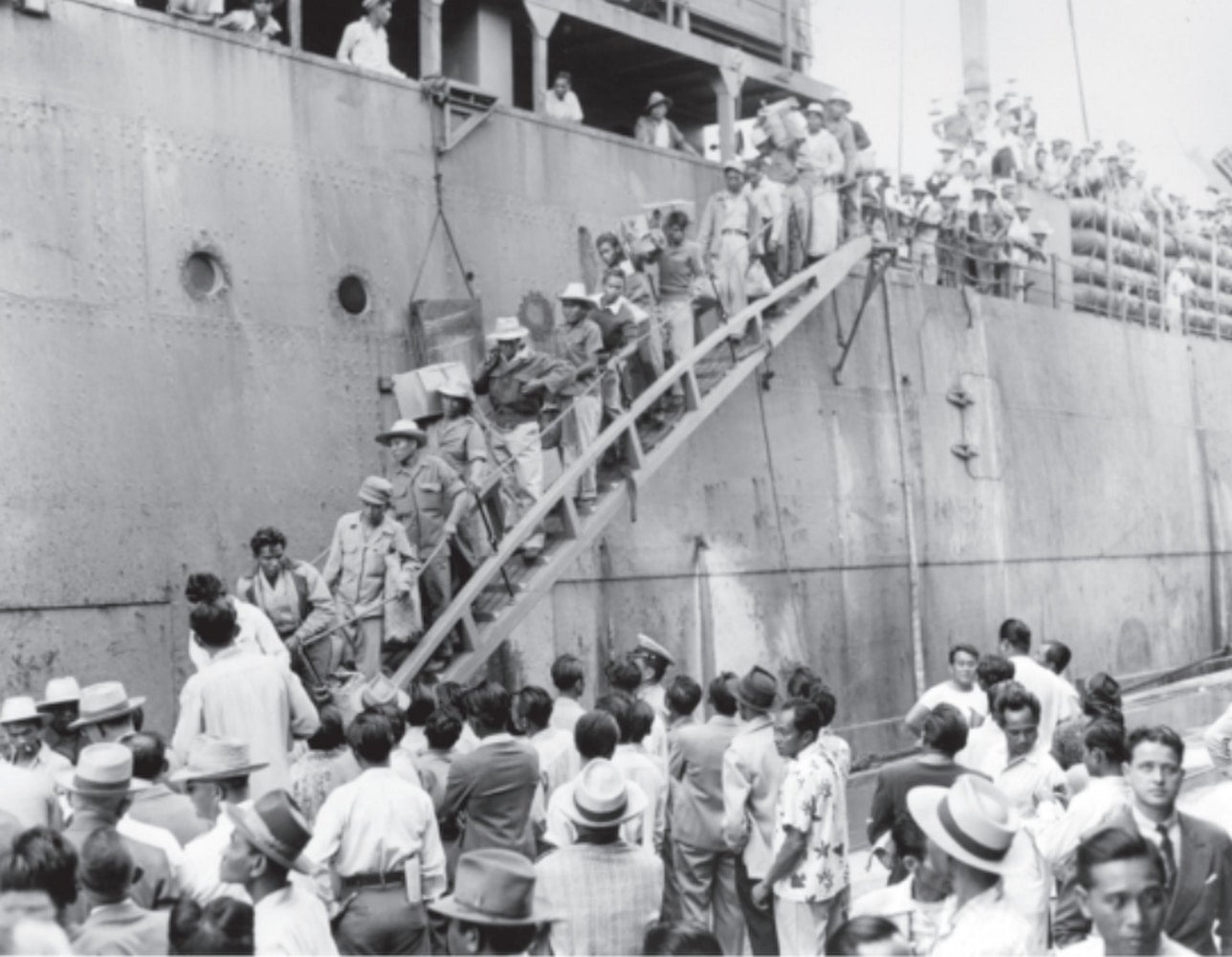
Image 40.02.04 — Filipino workers, known as Sakadas, arrive in Hawaiʻi circa 1946. Organizers from the International Longshore and Warehouse Union boarded the ships upon arrival, encouraging Sakadas to join the union, thus joining their ongoing sugar strike against the “Big 5” sugar companies.
Building interethnic solidarity was challenging, and it proved to be successful. Workers, their families, and their communities organized food kitchens and community gardens to feed everyone, as well as talent shows to keep strikers’ spirits up. The multiethnic union succeeded only through the concerted, inclusive effort of Hawaiʻi’s plantation workers and communication in multiple languages.
End of the Plantation System
As the plantation workers continued to make gains in wages and working conditions, the plantation economy gradually declined in Hawaiʻi. The ILWU helped worker members transition out of plantation work. In organized fashion, the plantation system in Hawaiʻi led to the recruitment of hundreds of thousands of workers from Asia, as well the Pacific Islands (mostly in the 1870s to 1890s) from Fiji and other parts of Micronesia and Melanesia. The sugar companies created an entire system of irrigation, wells, reservoirs, and railroads, and they built factories to process the raw sugar. They created paternalistic company towns with schools, churches, and hospitals, where workers raised families on the plantations. Entire generations of communities lived and worked on plantation land.
On the one hand, the rise of globalization over the next decades meant that sugar could be processed and brought to international markets more cheaply from other countries. Hawaiʻi’s plantations began closing due to foreign competition, as well as the rise in corn sweeteners replacing sugar cane. On the other hand and at the same time, the rise of tourism and service industries in Hawaiʻi led to the use of land for purposes outside of farming and agriculture. By 1997, there were only four plantations left, leaving plantation workers with job insecurity. As the plantations closed, workers had to find other work, housing, and schools for themselves and their families.
The ILWU helped displaced plantation workers. They worked with local and federal government agencies to transition plantation workers into other occupations. They also sought to secure affordable housing for them. The union formed a housing committee that negotiated with the sugar plantations to build housing developments where current and former workers could purchase their own homes. As a result, 350 housing units were built in Kulaimano in Pepe’ekeo, on Hawaiʻi Island.
When the Hamakua Sugar Company closed in 1994, the ILWU worked to address the six hundred impacted workers and their families, who were suddenly without a job. Through the collective efforts of the unions, government agencies, and organized workers, families who lived in plantation housing were allowed to stay in their homes. In fact, this housing still exists today. The union and the government also helped retrain and place some workers in unionized landscaping jobs at hotels on the island. Many truck drivers were able to find work driving for other companies.
Even so, the transition was not smooth for some who felt devastated by the end of decades of plantation life and community. Many were second and third generation workers who only knew plantation life. They had a difficult time coping with the dramatic changes to their livelihood and way of life.
The era of Hawaiʻi’s plantations had ended, yet the stories of plantation workers struggling for dignity and justice in the fields and mills remains part of the history of Hawaiʻi. The destruction of the Hawaiian agricultural system of self-sufficiency that the plantation system replaced also led to the migration of thousands of laborers, the rise of worker unions, and the growing interethnic solidarity, all of which has contributed to the multiethnic Hawaiʻi of today.
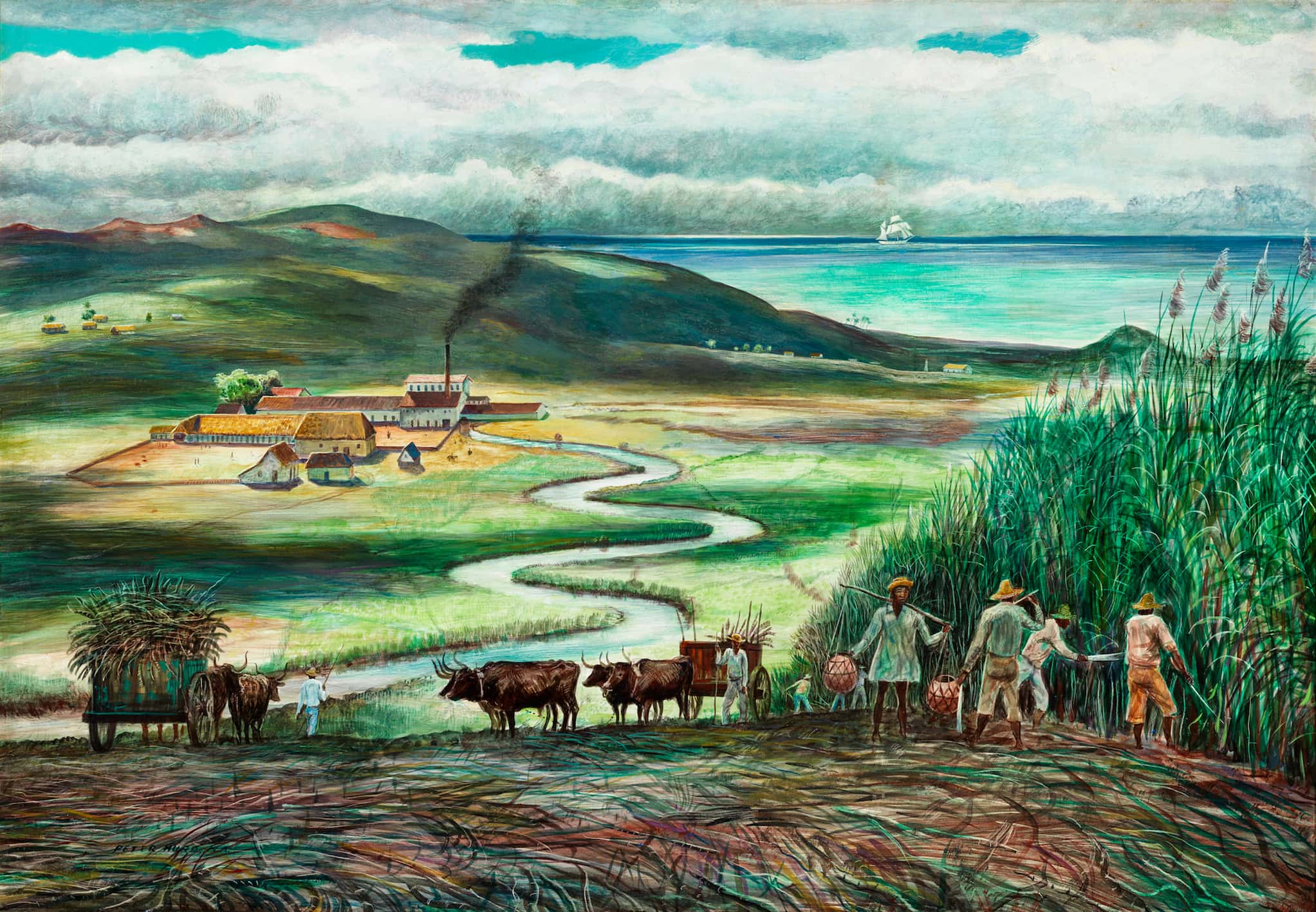
Image 40.02.06 — American painter Peter Hurd was hired by a “Big 5” company to create works to commemorate 100 years of settler development in Hawaiʻi. This painting of a sugar plantation in Kōloa, Kauaʻi, in 1841 demonstrates the diversion of water to the plantation, a disruption from the Hawaiian ahupuaʻa land system.
Glossary terms in this module
contract laborers Where it’s used
A group of people who identify the root of a shared problem and work to solve the issue. They develop leadership from within this group and build collective power, particularly energized by those most impacted by the problem.
exploitation Where it’s used
Taking advantage of someone for one’s own benefit.
organizing Where it’s used
The process of establishing a leadership structure, base of allies, and method of educating peers/allies on a specific issue, typically to support a cause well into the future.
Sakadas Where it’s used
Filipino contract workers who arrived in Hawaiʻi between 1906 and 1946 to work on sugar and pineapple plantations.
solidarity Where it’s used
A political, cultural, and collective stance that recognizes the mutual responsibility and support that is necessary to achieve change. Taps into the power in numbers and considers the collective interests of communities.
unions Where it’s used
Organizations formed by workers, typically from the same industry or company, representing the workers’ collective needs in the workplace such as pay, benefits, and working conditions.
Endnotes
1 Mary P. Pukui & Alfons L. Korn, The Echo of Our Song: Chants & Poems of the Hawaiians (Honolulu: University Press of Hawai‘i, 1973), pp. 122-124.