





Module 4: Bangladeshi Americans and Political Activism
Has the political history of their homeland shaped Bangladeshi American visibility, identities, and community formation?
Bangladeshi American activists inspire and shape solidarity across borders in the diaspora. As immigrants with diverse social justice struggles, such activities between and across national borders has, in turn, influenced the Bangladeshi American activists themselves.
Chaumtoli Huq and Tara Asgar are two Bangladeshi American feminist activists based in New York City who work with the Bangladeshi immigrant community to connect it with others across borders in an effort to create multiethnic solidarity and transnational networks. Their journeys reflect commitment to multiracial actions involving labor, immigration, economic justice, anti-racist organizing, and queer activism. Both activists are a part of an interconnected cross-generational struggle with political visions to help uplift and liberate marginalized communities.
In this module, we learn about the lives of two Bangladeshi American activists and how their life trajectories shaped their activism.
What is transnational activism?
How does Bangladeshi national history shape activism in the diaspora?
How do Bangladeshi American activists define/express/practice solidarity?
Chaumtoli Huq
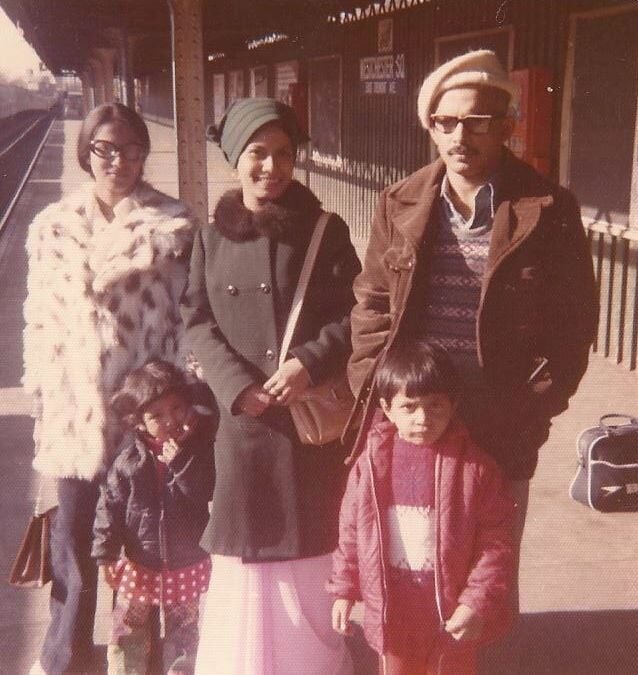
Chaumtoli Huq was born in Dhaka, Bangladesh, in the midst of the 1971 War. Her family migrated to New York soon after. Huq’s parents settled in the multi-racial Parkchester neighborhood of the Bronx, where only a handful of Bangladeshi families lived at the time.

Image 07.04.01 — Chaumtoli Huq and her family moved in the early 1970s to the Bronx, New York, after Bangladesh’s Liberation War.
Bangladesh emerged as an independent nation after the nine-month-long Liberation War and Huq’s family had strong roots in the nationalist movement as well as anti-colonial struggles, including Palestinian Liberation, which they considered an unresolved colonial occupation.
Daughter of a renowned writer and human rights activist in Bangladesh, Huq’s great-grandfather was a member of the Muslim League, an historic political organization that originated on the Indian subcontinent in 1906. It represented the interests of the Muslim population against colonization.
Her grandmother was an educator who organized with the All Pakistan Women’s Association. Huq’s initiation into social justice activism was thus framed by multiracial, intersectional, global political organizing that also embraced the Bengali Muslim ethos of her family.
In October 1971, when Huq was a newborn, her house was bombed, destroying much of the home and injuring those inside. But Huq survived, and she believes that she was given another chance to do some good and to serve the community. This story of survival is both a metaphor and a reminder for Huq’s ongoing commitment to immigrant Bangladeshi communities.
During Huq’s childhood, her mother worked at a foreign pharmaceutical company outside of Dhaka. The West Pakistani army once stopped the company-provided van her mother was travelling in. Huq recalls her mother’s vulnerability as a young woman during a war where mass rapes of Bengali women were a common tactic of war.
Before the waves of Bengali immigration to the United States in the late 1990s, Huq and her family had to hide their Bengali Muslim identity. Understanding this family history, Huq works with larger South Asian groups, specifically to organize domestic workers and offer trainings to prevent domestic violence.
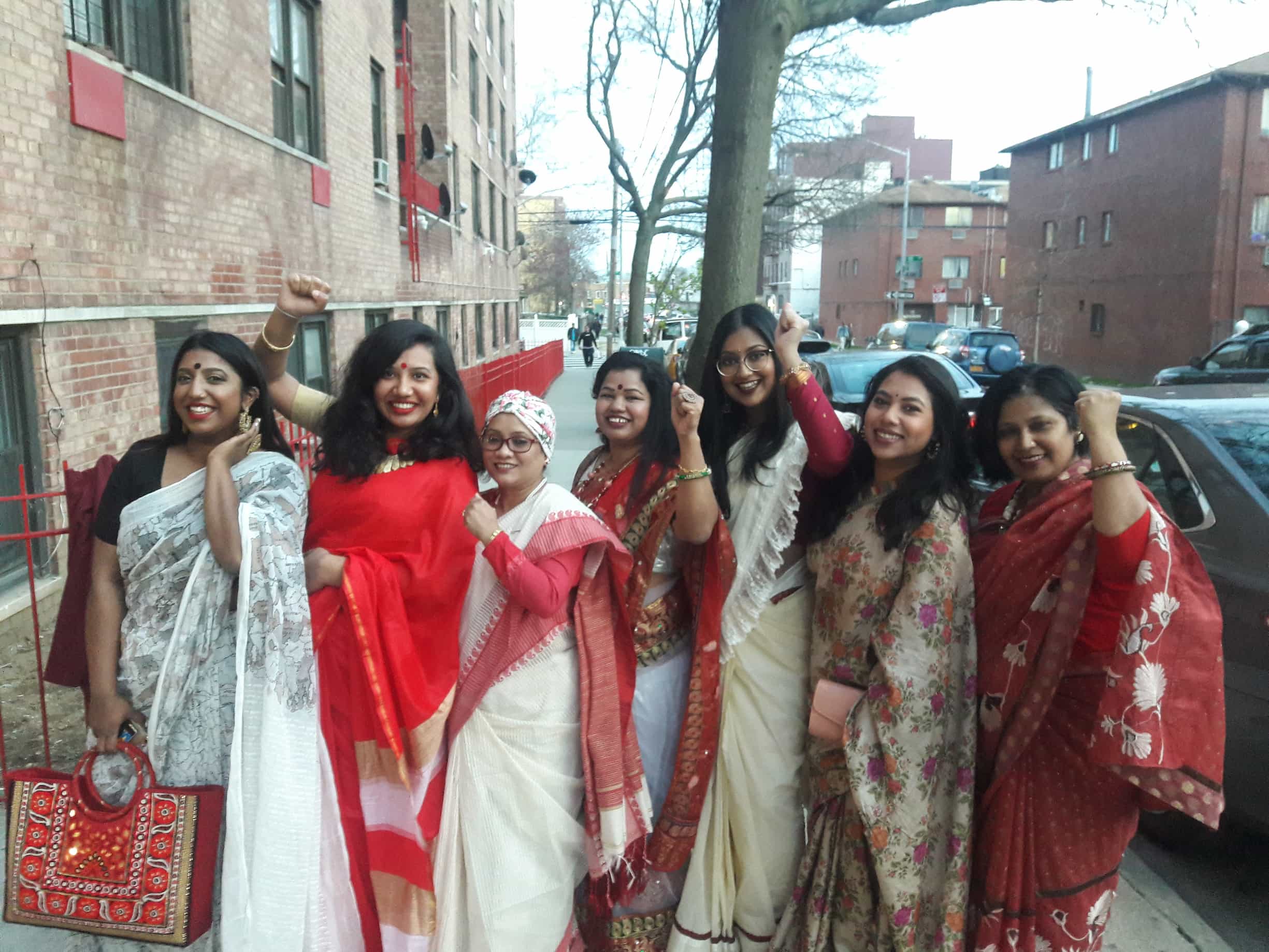
Image 07.04.02 — Bangladeshi American organizers in New York, including Huq (far right), alongside NYC Council member Shahana K. Hanif (third from right), and Sharmin Hossain of 18 Million Rising (far left).
As a student in the US, Huq aligned with the Young Communist League, drawing inspiration from intersectional feminist scholar-activists such as Angela Davis and Barbara Ransby whose work introduced her to Pan-Africanism, anti-apartheid divestment, and Third World internationalism. Meanwhile, Huq’s own family members participated in the Fourth World Conference on Women in Beijing and also led women’s advocacy groups in Bangladesh.
At Columbia University, as an undergraduate, Huq connected more with economically- and racially-marginalized African American student groups organizing against police brutality and for affordable housing and accessible college tuition, rather than with diasporic South Asians from suburban and professionally-elite backgrounds. Yet an awareness of how East Bengalis had been racialized as the “smaller, darker, peasant” classes and dismissed as “not real Muslims” by the fairer-complexioned and taller Punjabis of West Pakistan influenced Huq to claim a Third World identity. She learned to “assert her Brownness” and discovered ways to embrace her Bengali identity. Her activist consciousness was informed by the politics of 1971 in ways that did not easily map onto the South Asian model minority experience. 1
As a student, Huq also served as a Bengali interpreter for a New York Times journalist representing a Bangladeshi inmate at Rikers Island. A restaurant worker, the inmate felt betrayed by the Bengali community and was reluctant to speak with Huq, asserting that it was her class of people who were responsible for his oppression. This encounter left a deep impression on Huq, inspiring her eventual work on behalf of domestic workers, construction workers, and New York City taxi drivers’ mobilization and unionization.
Currently a professor of law at the City University of New York and founder of Law@the Margins, a labor and human rights advocacy organization for immigrants, Huq connects with her students, many of whom are first-generation, working class students of color. Huq’s own transnational research and advocacy with women garment workers and union leaders in Bangladesh criticizes the exploitative conditions under which women work in Bangladesh, the subject of Huq’s 2017 documentary film, Sramik Awaaz: Workers Voices.
In addition, Huq’s support of Bangladeshi-led group Desis Rising Up and Moving (DRUM) in 2012 helped a group of Bangladeshi political activists find asylum in the US. For Huq, transnational, intersectional organizing is at the heart of her work:
“My own lived experience resonated with engagement with transnational and grassroots activism and the inspiration to foreground migrant stories where my legal activism and activism on behalf of Bangladeshi community are interconnected….Being Bangladeshi is a big part of my activist engagements which are informed by socialist projects, anti-orthodox Islam, [and a] sense of justice informed both by spiritual beliefs and anti-colonial history and family commitment to Liberation struggles.” 2
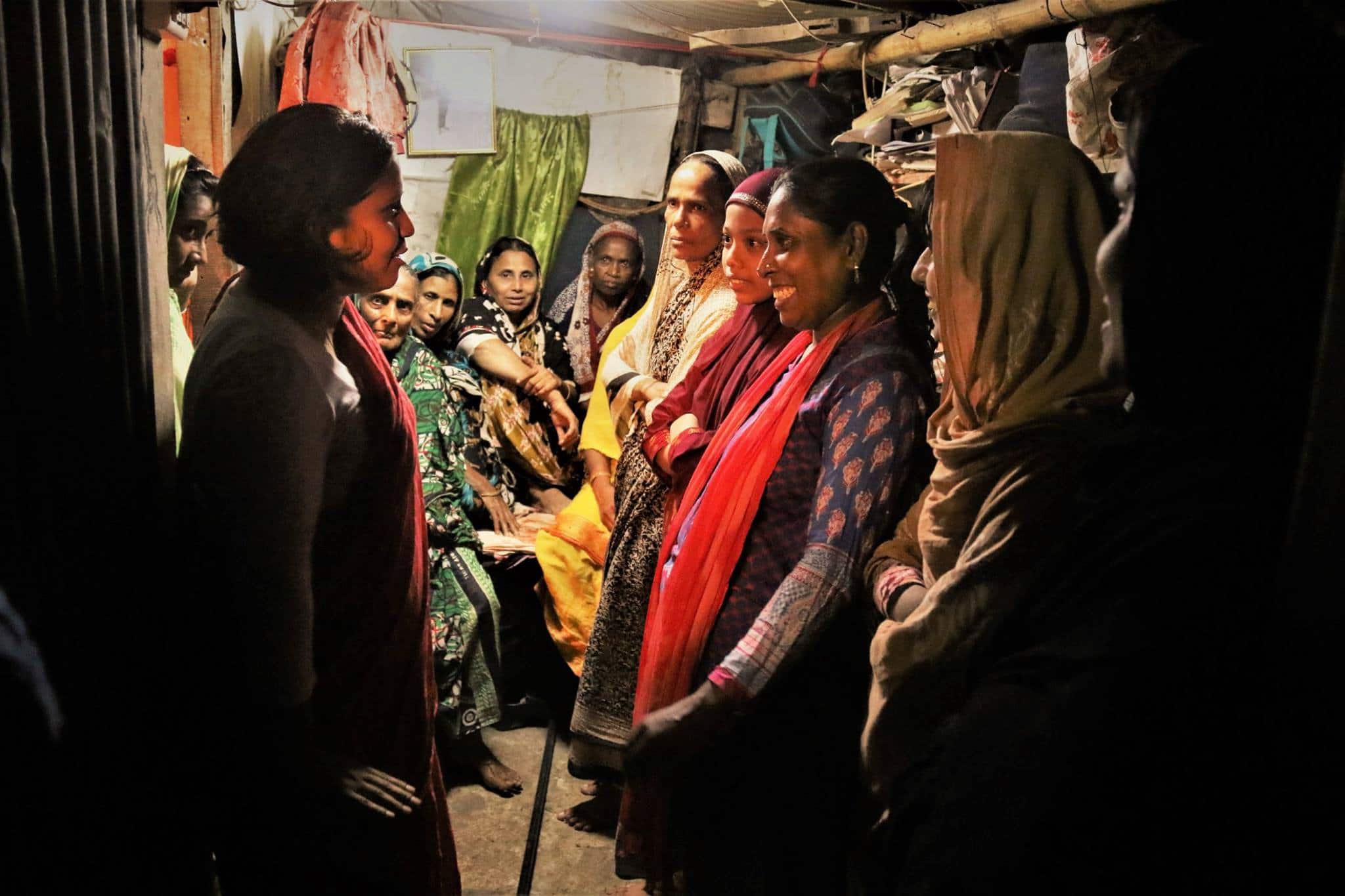
Image 07.04.03 — Huq (left) with women workers and organizers in the apparel industry in Bangladesh, filming for her documentary Sramik Awaaz: Workers Voices (2017).
Tara Asgar
Speaking to the invisibility of a Bangladeshi presence within the Asian American umbrella, Tara Asgar asks, “Who gets to claim that identity?” 3 Born in Bangladesh and considered a bideshi (foreigner) in the United States, Tara identifies, first and foremost, as an artist based in New York. While she cannot—and does not—deny being Bangladeshi, her consciousness is multifaceted and her activism anchored in multiracial formations with African American and Latinx communities.
Tara Asgar was trained as a visual artist at the Charukola Institute in Dhaka. In 2016, she arrived in the US and attended the University of Maine with an Artist Protection Fund Fellowship from the Institute of International Education. She later applied for asylum to continue her stay in the United States, as being a queer artist-activist put her in danger back home. At the Art Institute of Chicago, she earned her Master of Fine Arts (MFA) degree as the only Bangladeshi student in the school’s 150-year history.
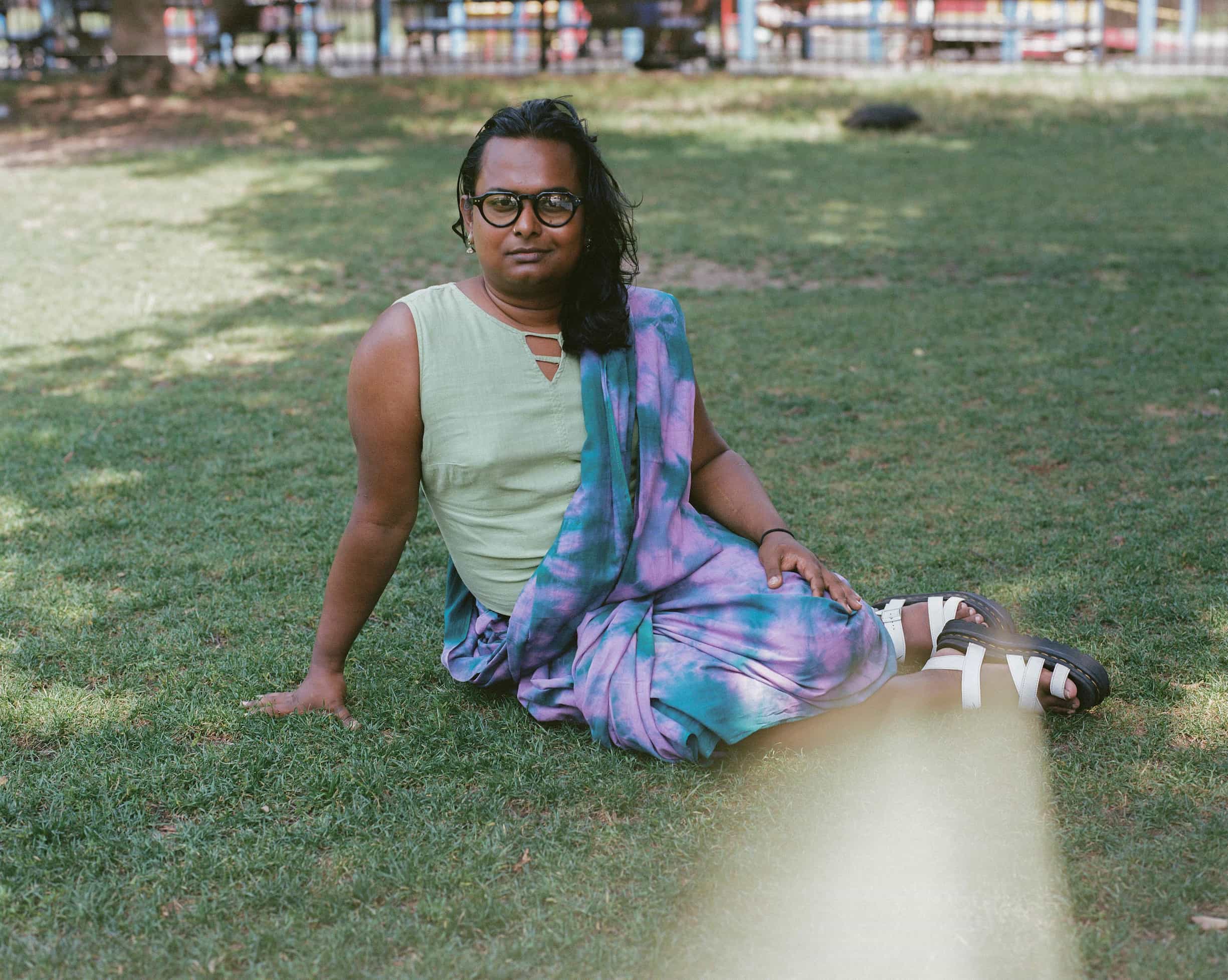
Image 07.04.04 — Tara Asgar, a Bangladeshi artist, is deeply influenced by her connections to African American and Latinx communities in New York.
Later, Asgar received a Mellon Fellowship, which she used to establish a studio space at the Art Loft Space in the DUMBO Art District in Brooklyn. She currently teaches Critical Race Theory and Art at The New School’s Parson School of Design and at Stony Brook University as she continues her art practice with other queer artist-activists to advocate for visibility on issues around sexuality and gender.
For Asgar, art has been a trade and healing escape as well as a tool to increase visibility around and actively engage in cross-border conversations around sexuality and gender. “It was not my plan to come to the US. I did not arrive as an international student,” Asgar says:
“My life plan was different: to live and work in Bangladesh with all the mainstream art institutions. I navigated the space to work with them. Coming to the US was a loss, and I had to start from zero, reshape my work.” 4
Ensconced in the South Asian art scene as well as within regional activist networks Asgar’s interventions point to more radical organizing around sexual rights work in Bangladesh during the 2000s, at a time when Western donor funded projects were on the ground in the country through Non-Government Organizations.
Unlike such interventions by international humanitarian and development organizations, Asgar’s work has emphasized building coalitions that are more inclusive and grassroots, where trans, queer, and hijra (persons who identify as the third gender including intersex, transsexual) identities are not seen in opposition to each other nor pathologized as deviant or disabled, and to have more agency to speak on one’s own behalf.
Through community mutual aid formations, Asgar has been engaged with Bangladesh Queer Liberation (BQL) Canada, a group of trans and nonbinary youth that holds multi-generational forums inclusive of parents and queer youth. The population Asgar works with in Queens and in Brooklyn are not part of the suburban-affluent South Asians who are assimilated to the “model minority” norm, and whose experiences seem to dominate the representations of South Asian communities in the US. Instead, the communities Asgar aligns with and is in solidarity with speak about their experiences as varied and shaped by racial, sexuality/gendered, and class based inequalities.
Having had a secular progressive upbringing in Bangladesh, Asgar feels there is an overemphasis on the Muslim identity in diasporic Bangladeshi circles. A consequence perhaps of post-9/11 racialization of South Asians and Arabs as suspect populations, the pan-Islamic identity is an entry point to political mobilization for many Bangladeshi youth. Yet Asgar feels she wants to break out of the labels and narratives that box her in. Instead, she wants to be recognized beyond a “queer trauma survivor narrative” and rather for her professional identity as an artist-activist interested in multiracial expressions of art. In her own words:
“Because at times I am read as an English-spoken, college-educated brown other. I am a practicing artist and certainly had some kind of privileged upbringing depending on what you compare me with but also at times I am the one with accented English, trauma survivor, [expletive], and trans rejected from my homeland, and in the bottom of the immigration class hierarchy because of my asylum-seeking status. This dual positioning occurs depending on the context in which my work is presented, and consumed, and how it is understood.” 5
While Asgar acknowledges growing up in a Muslim culture, she is not comfortable prioritizing that identity as primary. She finds herself doubly-profiled. Within the Bangladeshi diasporic community, class-based bias from elite families who benefit from their status and name recognition exists. From outside the community, she continues to be profiled as the queer immigrant vulnerable subject. Asgar’s work defies this double-bind to uplift and make space for a more inclusive and authentic representation, shaped by Bengali and Muslim culture but certainly not limited to or defined by it.
Asgar continues to work with queer Bangladeshi communities. First, her advocacy for the Bangladesh Trans Hijra Koti Rights Coalition invests in building partnerships that are more inclusive and grassroots-based. With BLQ Canada, she works with a group of trans and nonbinary youth.
In Queens and Brooklyn, Tara works with communities who transparently speak about inequalities on the basis of race, sex, gender, and class in the Bangladeshi diaspora. For example, alongside the Bangladeshi Ladies Club of Queens, she engages in dialogue using storytelling, art, and poetry about coming out as queer among second-generation Bangladeshis. Through these activities, Asgar works to empower her community.
In this module, we have explored Tara and Huq’s journeys of activism. We have seen how these journeys have been shaped by their experiences across Bangladesh and the US. Both bring an awareness of the complexity of their own identities to their work as progressive activists.
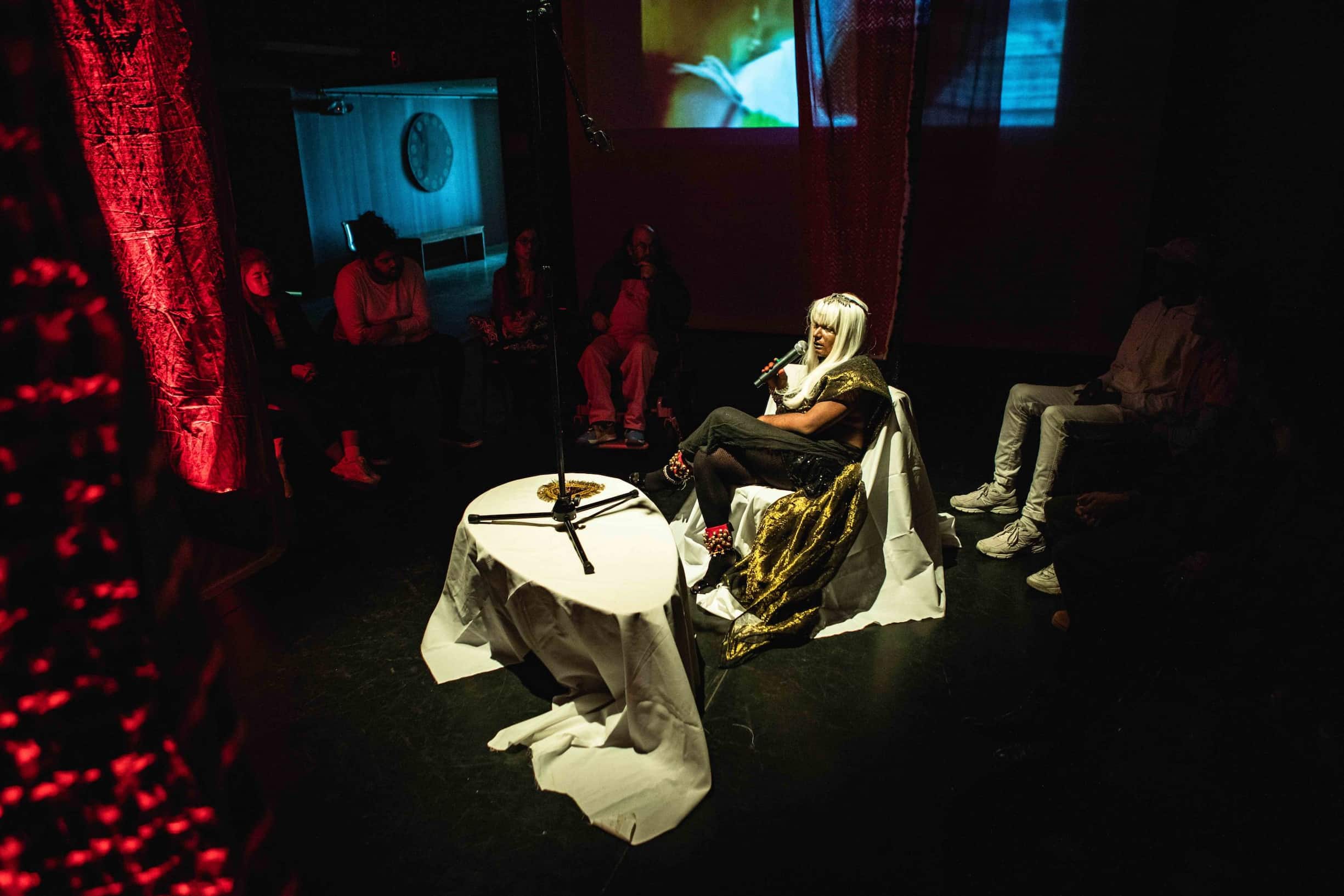
Image 07.04.05 — Tara Asgar during a performance in the US: “Coming to the US was a loss, and I had to start from zero, reshape my work.”
Glossary terms in this module
asylum Where it’s used
The protection granted by a nation to someone who has left their native country as a political refugee.
diaspora Where it’s used
People scattered across different parts of the world who share an identification with a homeland.
intersectional/intersectionality Where it’s used
The idea that there are overlapping identities that people must navigate, such as race, gender, class, sexual orientation, and disability. Intersectionality understands that recognizing these overlapping identities must also mean to address the overlapping systems of oppression that people are subjected to.
solidarity Where it’s used
A political, cultural, and collective stance that recognizes the mutual responsibility and support that is necessary to achieve change. Solidarity taps into the power in numbers and considers the collective interests of communities.
transnational Where it’s used
Crossing, extending or going beyond national borders.