


[highlights]

[share_highlights]

[notes]

[share_notes]

[bookmark]

[share_bookmark]

[read_aloud]

Used in reliance on fair use

This in-copyright item is presented here in accordance with the authors’ fair use rights. Its use in other contexts may require permission from the copyright holder.

Creative Commons

CC0 1.0 Universal

No Copyright

Other Information

CC URL: https://creativecommons.org/publicdomain/zero/1.0/

CC BY 4.0 Attribution 4.0 International
CC BY 3.0 Attribution 3.0 Unported
CC BY 2.0 Attribution 2.0 Generic

This license enables reusers to distribute, remix, adapt, and build upon the material in any medium or format, so long as attribution is given to the creator. The license allows for commercial use. CC BY includes the following elements:

CC URL: https://creativecommons.org/licenses/by/4.0/

CC URL: https://creativecommons.org/licenses/by/3.0/

CC URL: https://creativecommons.org/licenses/by/2.0/

CC BY-SA 4.0 Attribution-ShareAlike 4.0 International
CC BY-SA 3.0 Attribution-ShareAlike 3.0 Unported
CC BY-SA 2.0 Attribution-ShareAlike 2.0 Generic

This license enables reusers to distribute, remix, adapt, and build upon the material in any medium or format, so long as attribution is given to the creator. The license allows for commercial use. If you remix, adapt, or build upon the material, you must license the modified material under  the same or a compatible license. CC BY-SA includes the following elements:

CC URL: https://creativecommons.org/licenses/by-sa/4.0/

CC URL: https://creativecommons.org/licenses/by-sa/3.0/

CC URL: https://creativecommons.org/licenses/by-sa/2.0/

CC BY-ND 4.0 Attribution-NoDerivatives 4.0 International
CC BY-ND 3.0 Attribution-NoDerivatives 3.0 Unported
CC BY-ND 2.0 Attribution-NoDerivatives 2.0 Generic

This license enables reusers to copy and distribute the material in any medium or format in unadapted form only, and only so long as attribution is given to the creator. The license allows for commercial use. CC BY-ND includes the following elements:

CC URL: https://creativecommons.org/licenses/by-nd/4.0/

CC URL: https://creativecommons.org/licenses/by-nd/3.0/

CC URL: https://creativecommons.org/licenses/by-nd/2.0/

CC BY-NC 4.0 Attribution-NonCommercial 4.0 International
CC BY-NC 3.0 Attribution-NonCommercial 3.0 Unported
CC BY-NC 2.0 Attribution-NonCommercial 2.0 Generic

This license enables reusers to distribute, remix, adapt, and build upon the material in any medium or format for noncommercial purposes only, and only so long as attribution is given to the creator. CC BY-NC includes the following elements:

CC URL: https://creativecommons.org/licenses/by-nc/4.0/

CC URL: https://creativecommons.org/licenses/by-nc/3.0/

CC URL: https://creativecommons.org/licenses/by-nc/2.0/

CC BY-NC-SA 4.0 Attribution-NonCommercial-ShareAlike 4.0 International
CC BY-NC-SA 3.0 Attribution-NonCommercial-ShareAlike 3.0 Unported
CC BY-NC-SA 2.0 Attribution-NonCommercial-ShareAlike 2.0 Generic

This license enables reusers to distribute, remix, adapt, and build upon the material in any medium or format for noncommercial purposes only ifattribution is given to the creator. If you remix, adapt, or build upon the material, you must license the modified material under the same or a compatible license. CC BY-NC-SA includes the following elements:

CC URL: https://creativecommons.org/licenses/by-nc-sa/4.0/

CC URL: https://creativecommons.org/licenses/by-nc-sa/3.0/

CC URL: https://creativecommons.org/licenses/by-nc-sa/2.0/

CC BY-NC-ND 4.0 Attribution-NonCommercial-NoDerivatives 4.0 International
CC BY-NC-ND 3.0 Attribution-NonCommercial-NoDerivatives 3.0 Unported
CC BY-NC-ND 2.0 Attribution-NonCommercial-NoDerivatives 2.0 Generic

This license enables reusers to copy and distribute the material in any medium or format in unadapted form only, for noncommercial purposes only, and only if attribution is given to the creator. CC BY-NC-ND includes the following elements:

CC URL: https://creativecommons.org/licenses/by-nc-nd/4.0/

CC URL: https://creativecommons.org/licenses/by-nc-nd/3.0/

CC URL: https://creativecommons.org/licenses/by-nc-nd/2.0/

Unknown Rightsholder

This Item is protected by copyright and/or related rights. However, for this Item, either (a) no rights-holder(s) have been identified or (b) one or more rights-holder(s) have been identified but none have been located. You are free to use this Item in any way that is permitted by the copyright and related rights legislation that applies to your use.

NOTICES

URI for this statement: http://rightsstatements.org/vocab/InC-RUU/1.0/

Educational Use

This Item is protected by copyright and/or related rights. You are free to use this Item in any way that is permitted by the copyright and related rights legislation that applies to your use. In addition, no permission is required from the rights-holder(s) for educational uses. For other uses, you need to obtain permission from the rights-holder(s).

NOTICES

URI for this statement: http://rightsstatements.org/vocab/InC-EDU/1.0/

Yellow bumper sticker with words “Patsy Mink for President” in purple font. “Mink” is stylized in all caps at center of sticker.

Module 2: Opposition to the Vietnam War and US Presidential Campaign

Does having an Asian American in the US House of Representatives positively impact the lives of Asian Americans?copy section URL to clipboard

100/100

Patsy Mink entered the US House of Representatives in 1965 just as the United States committed to a ground war in Vietnam. The US had long been involved in Southeast Asia, helping to fund up to 80 percent of the French military budget to oppose Vietnam’s efforts to become an independent country after World War II. The French had colonized Southeast Asia since the late nineteenth century and fought what is described as the First Indochina War from 1945 to 1954.

This module begins with the US War in Vietnam and explains why Patsy Mink opposed her own party to try to end the war.

Why, how, and when was the United States involved in the war in Southeast Asia?

What are the three reasons that Patsy Mink opposed the war?

Why did Patsy Mink run for the US Presidency?

Challenging Colonialismcopy section URL to clipboard

When Ho Chi Minh wrote Vietnam’s declaration of independence on September 12, 1945, he used the United States Declaration of Independence as a model. He pointed to the US forming to escape British colonization as a reason why it is necessary to challenge tyranny and demand democracy. However, the US opposed Vietnam’s declaration.

Vietnam’s challenge to colonialism was part of a broader movement of African, Asian, and Latin American—or “Third World”—countries seeking independence after European colonial powers declined following World War II.
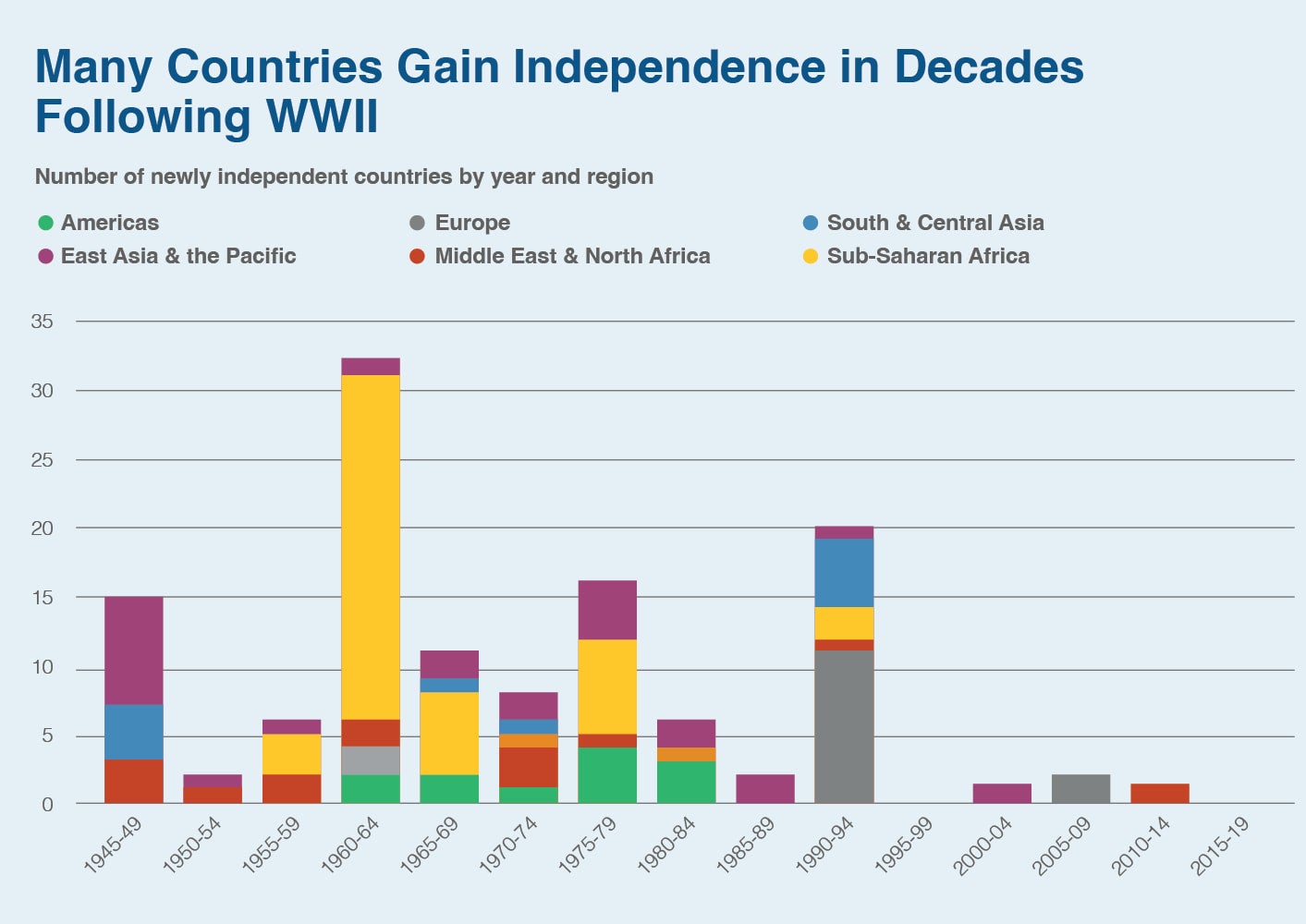
Graph of independent countries in years after World War II. X axis plots five-year intervals. Y axis shows number of countries. Colors show regions.

Image 36.02.01 — With the growing newly independent countries by year and region following World War II, US leaders feared that decolonized nations would ally themselves with other communist nations. (Source: CIA World Factbook; National Government Websites)

Metadata ↗

As the US entered the Cold War era, the government saw Vietnam and these other countries as a threat to capitalism. US leaders feared that political independence, particularly movements by socialist-inspired leaders, would lead these formerly-colonized nations to ally with other Communist nations.

When the war ended between Vietnam and France in 1954, they signed the Geneva Accord, which temporarily divided Vietnam at the 17th parallel and mandated national elections in two years’ time. Had the elections been held then, in 1954, Ho Chi Minh would likely have been the victor given his role in leading the movement against the French. Instead, the US financially, militarily, and politically supported the Republic of Vietnam (RVN), or South Vietnam, in order to prevent the Democratic Republic of Vietnam (DRV), or North Vietnam, from reuniting the country.

The Toll of Warcopy section URL to clipboard

The US opposition to Vietnamese independence would prove costly. The US War in Vietnam, also known as the Second Indochina War, would become the second longest war in US history. Although it is officially dated from 1964 to 1973, scholars debate the start and end dates. Some say it began in 1955, when the US began supporting the Republic of Vietnam, and ended with the unification of Vietnam in 1975. Regardless of the exact years, the war devastated the people and land in Vietnam.

The amount of bombs dropped on Vietnam, a relatively small country, would exceed the total amount dropped by the US during World War II (a global war) by three times. Twice as many fell on the Republic of Vietnam, or South Vietnam, the US ally, in an attempt to root out Communist supporters.

More to explore
Excerpt

Legacies of the US War in Vietnam

In her essay, “Vietnam Revisited: Forty Years after the Paris Peace Accord,” Judy Tzu-Chun Wu digs deeper into the long-term impacts of American military decisions:

The 40th anniversary of the Paris Peace Accord provided an opportunity to not only recognize the past but also assess the ongoing legacies of the U.S. War in Vietnam. The anniversary passed with relatively little notice in the U.S. Even after American officials signed the Paris Peace Accord, presidents Nixon and Ford continued to supply financial and military support to the Republic of Vietnam until Congress finally cut off funding. Even today, Vietnam is a psychological and emotional wound for many Americans, who resent “losing” the war.

“Winning” the war, however, also generates bittersweet emotions. Our delegation visited schools and met children, some of whom are three or four generations removed from the war, but still suffer physical and mental disabilities from Agent Orange….

In addition to this afterlife of Agent Orange, there are unexploded ordnances embedded in the landscape of Vietnam. These bombs and mines continue to be detonated accidentally, sometimes resulting in dismemberment or death. We visited an NGO called Peace Trees, which is trying to refoliate parts of Vietnam and teaching Vietnamese children to recognize and stay away from dangerous objects and potential ordinances. When we visited a U.S. government-funded Agent Orange cleanup site in Danang, our American guides, some of them veterans of the Vietnam War, warned us to stay on well-trodden paths since recent rains might resurface unexploded ordinances.

Explore More Collapse

The US also supported dictatorial political leaders in the Republic of Vietnam in order to secure allies against the Democratic Republic of Vietnam. A final accounting of the war includes over 58,000 American deaths, approximately 200,000–250,000 South Vietnamese soldiers, over a million North Vietnamese and Viet Cong (a term designating Vietnamese Communist guerilla soldiers in the South) fighters, and two million civilians each in the North and the South. The war also extended into other countries that bordered Vietnam, such as Laos and Cambodia, causing an estimated 2.5 million refugees to flee Southeast Asia.

As a Democrat, Patsy Mink allied with the leader of her party, President Lyndon B. Johnson, on domestic policies, such as utilizing government resources to help the poor. However, she pushed back on his international policies. Mink used her position to advocate for the end of US involvement in Vietnam.

Patsy Mink’s Beliefscopy section URL to clipboard

Although many of her political colleagues supported the war, Patsy Mink opposed US involvement in Vietnam. She allied with Asian American and feminist activists with similar views.
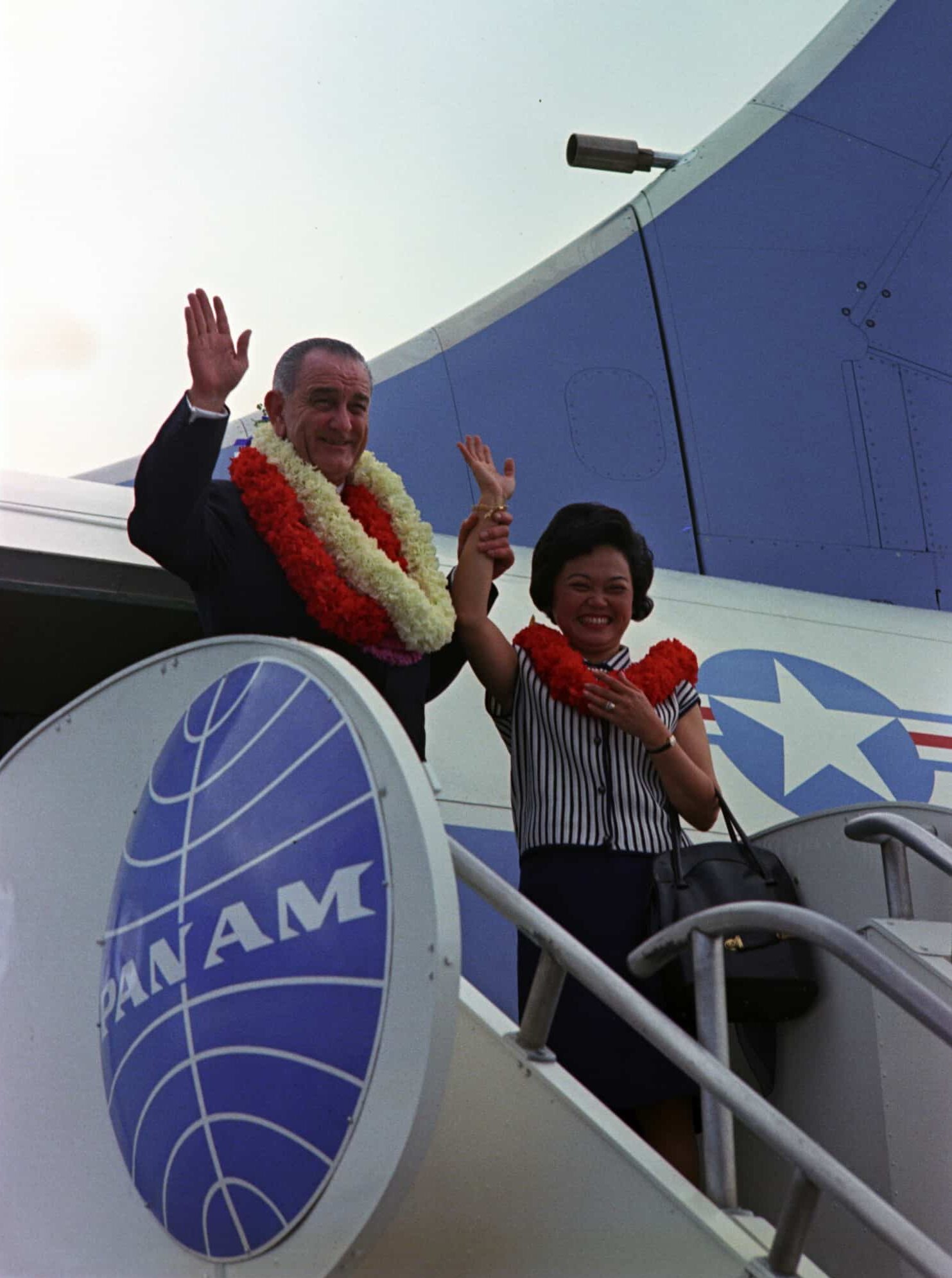
Patsy Mink, wearing striped shirt and red lei, waves to crowd from air stairs of plane. Next to her is President Johnson, in a suit with two lei.

Image 36.02.02 — As a Democrat, Patsy Mink allied with the leader of her party, President Lyndon B. Johnson, on domestic policies such as utilizing government resources to help the poor while pushing back against his international policies.

Metadata ↗

Mink believed that a government based on democratic principles should resolve conflict through negotiations, not violence. She criticized inhumane forms of violence, such as the US military’s use of chemical weapons, which killed and disabled many Vietnamese civilians and destroyed the land.

Even though the US did not explicitly endorse the executions and imprisonment of opposition to the RVN, Mink disliked what she saw as her government’s implicit endorsement of these actions. She also criticized violence committed by the DRV and the Viet Cong.

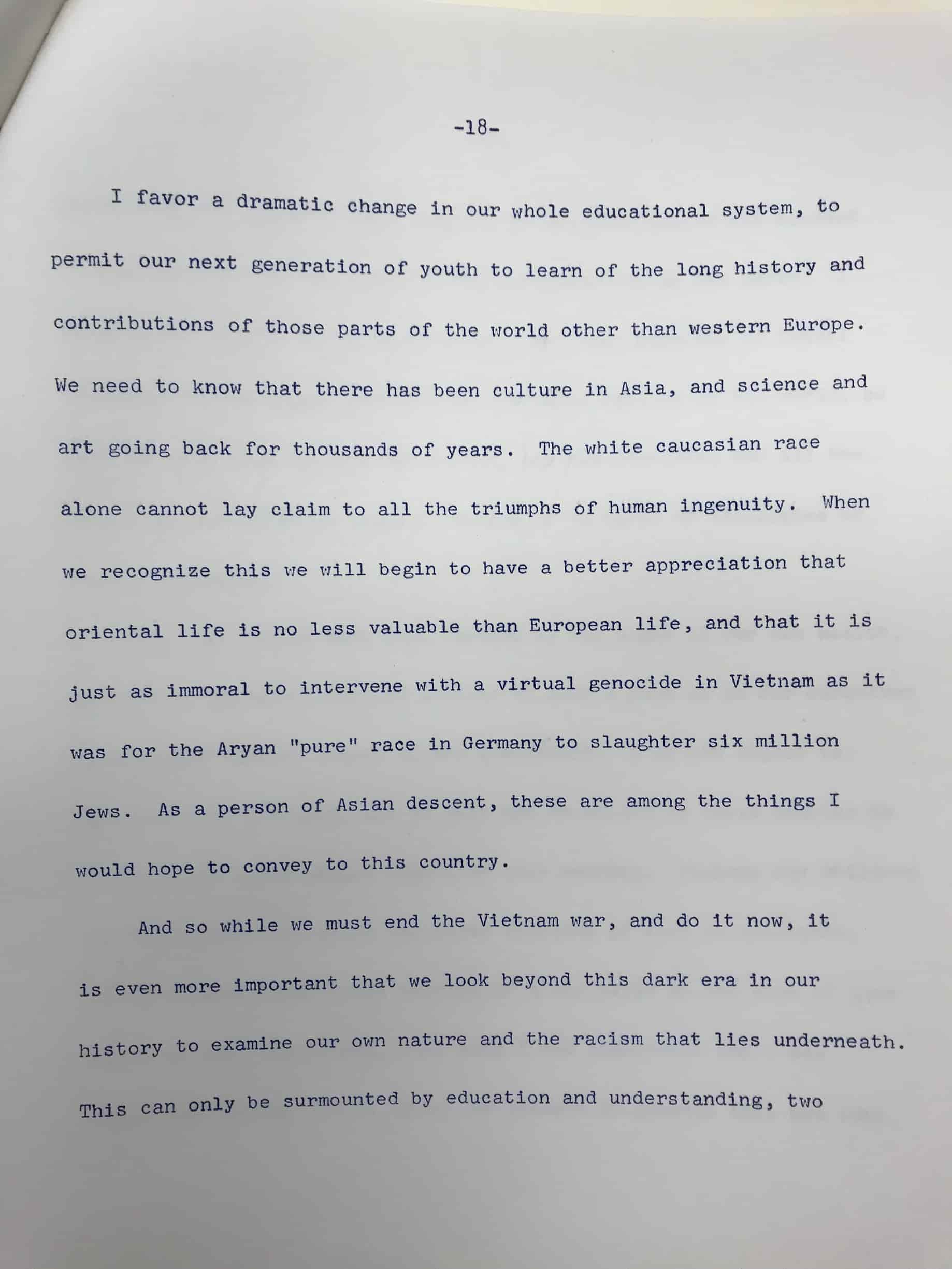
Along with other Asian American movement activists, Mink pointed out how the war in Vietnam perpetuated racism against Asian people generally. In April 1971 she traveled to Los Angeles, California to give a speech at the first national Asian American studies conference. She connected the wrongful incarceration of Japanese Americans during World War II with the My Lai massacre in 1968, in which the US military murdered an entire village of approximately five hundred people based on an erroneous assumption that they were supporters of the Viet Cong.
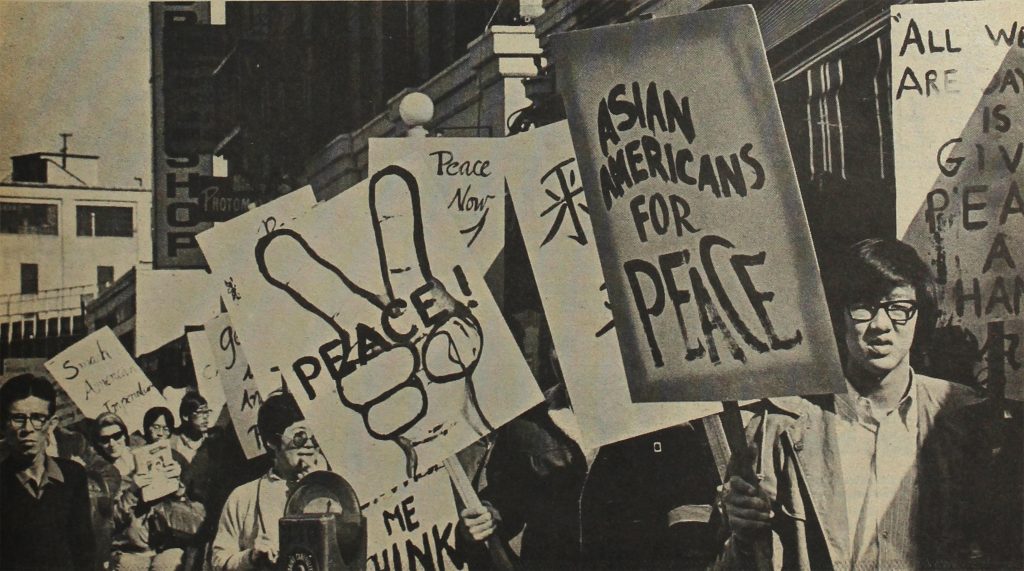
Crowd of protestors with large signs march down the sidewalk of an urban street. Man in glasses holds large sign reading "Asian Americans for Peace."

Image 36.02.03 — Patsy Mink strongly advocated for the end of the Vietnam War, stating: “All Vietnamese stooping in the rice fields are pictured as the enemy, sub-human without emotions and for whom life is less valuable than for us.”

Metadata ↗

She noted that war against Japan was the justification for mass detention, based on “the belief that the ‘inscrutable’ Oriental could not be trusted. . . . The entire population of one national origin overnight became the enemy, stripped of property, rights of citizenship, human dignity and due process of law.” The Vietnam War, in turn, reinforced these views of racial inferiority. In Mink’s words, “All Vietnamese stooping in the rice fields are pictured as the enemy, sub-human without emotions and for whom life is less valuable than for us.” 1

Like other women peace activists, Mink believed that women should have a role in determining international policies. She collaborated with groups like Women Strike for Peace, which emphasized how women’s roles in the private realm (as mothers and housewives) meant that they should also play a crucial role in the public realm of politics. After all, nuclear escalation and war impacted the lives of their families.
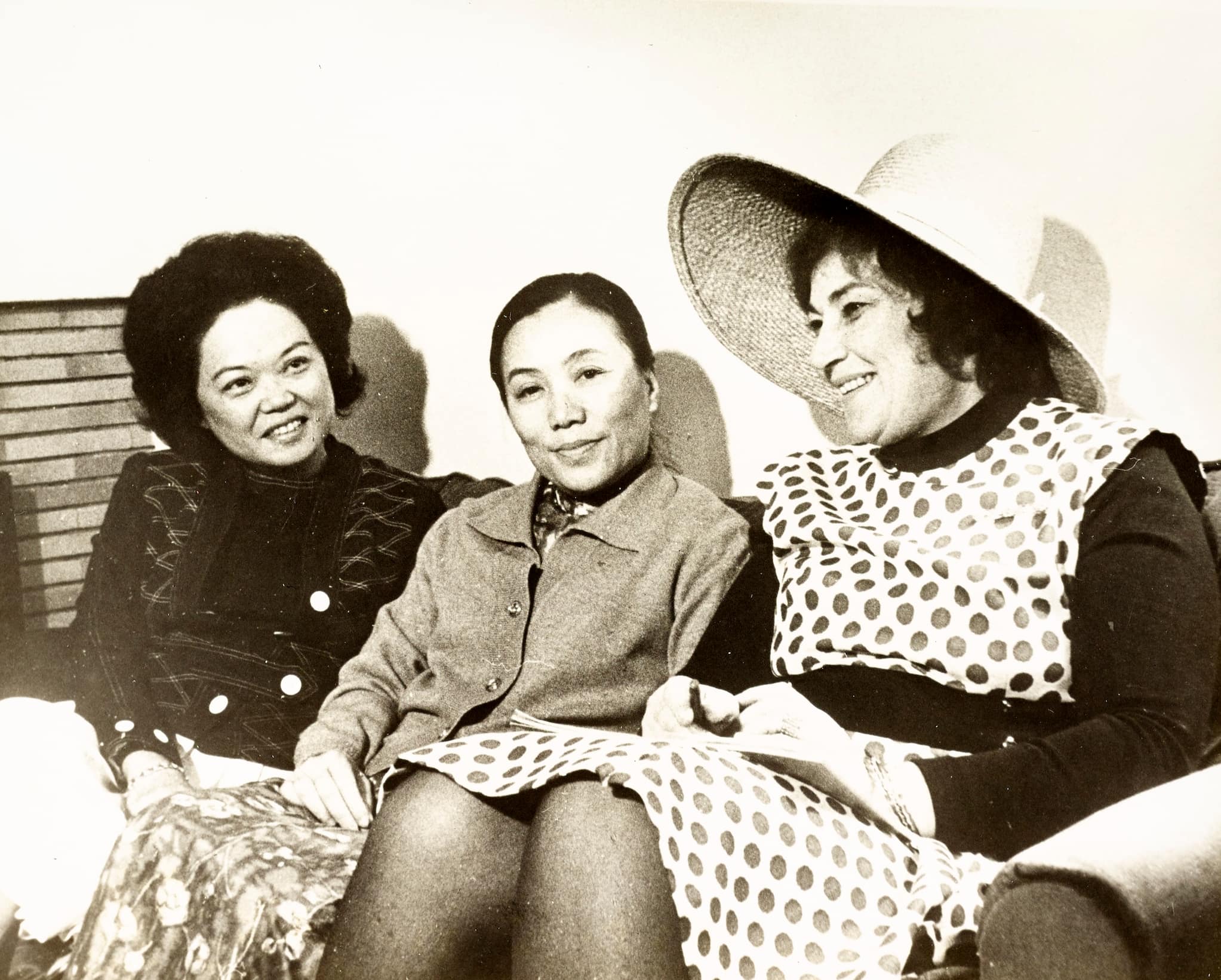
Mink, left, sits with politicians: Nguyen Thi Binh, woman with collared sweater, center, and Bella Abzug, woman in polka dot dress and hat, right.

Image 36.02.04 — Patsy Mink (left) and US representative Bella Abzug (right) traveled to Paris in 1972 to negotiate peace with Madame Nguyen Thi Binh (center), the only Vietnamese female leader who participated in the negotiations for peace with the United States that resulted in the Paris Peace Accords.

Metadata ↗

As a Congressmember, Mink called for a reduction in nuclear arms development, which relied on military testing in the Pacific. She advocated for an end to violence in “hot wars,” like the US War in Vietnam. To do this, Mink traveled to Paris in 1972 with Bella Abzug, a key organizer of Women Strike for Peace and a colleague in Congress. There, they met with Madame Nguyen Thi Binh, the only Vietnamese female leader who participated in the negotiations for peace with the United States, which resulted in the Paris Peace Accords.

Presidential Campaigncopy section URL to clipboard

Also that year, Mink ran as a peace candidate for the US presidency, primarily in the state of Oregon. Although she did not win, she used her campaign to call attention to the growing movement to end the US War in Vietnam.

Yellow bumper sticker with words "Patsy Mink for President" in purple font. "Mink" is stylized in all caps at center of sticker.

Image 36.02.05 — In 1972, Patsy Mink became one of the first women to run for president of the United States. While she did not win, she called attention to the growing movement to end the US war in Vietnam and tend to urgent social needs at home.

Metadata ↗

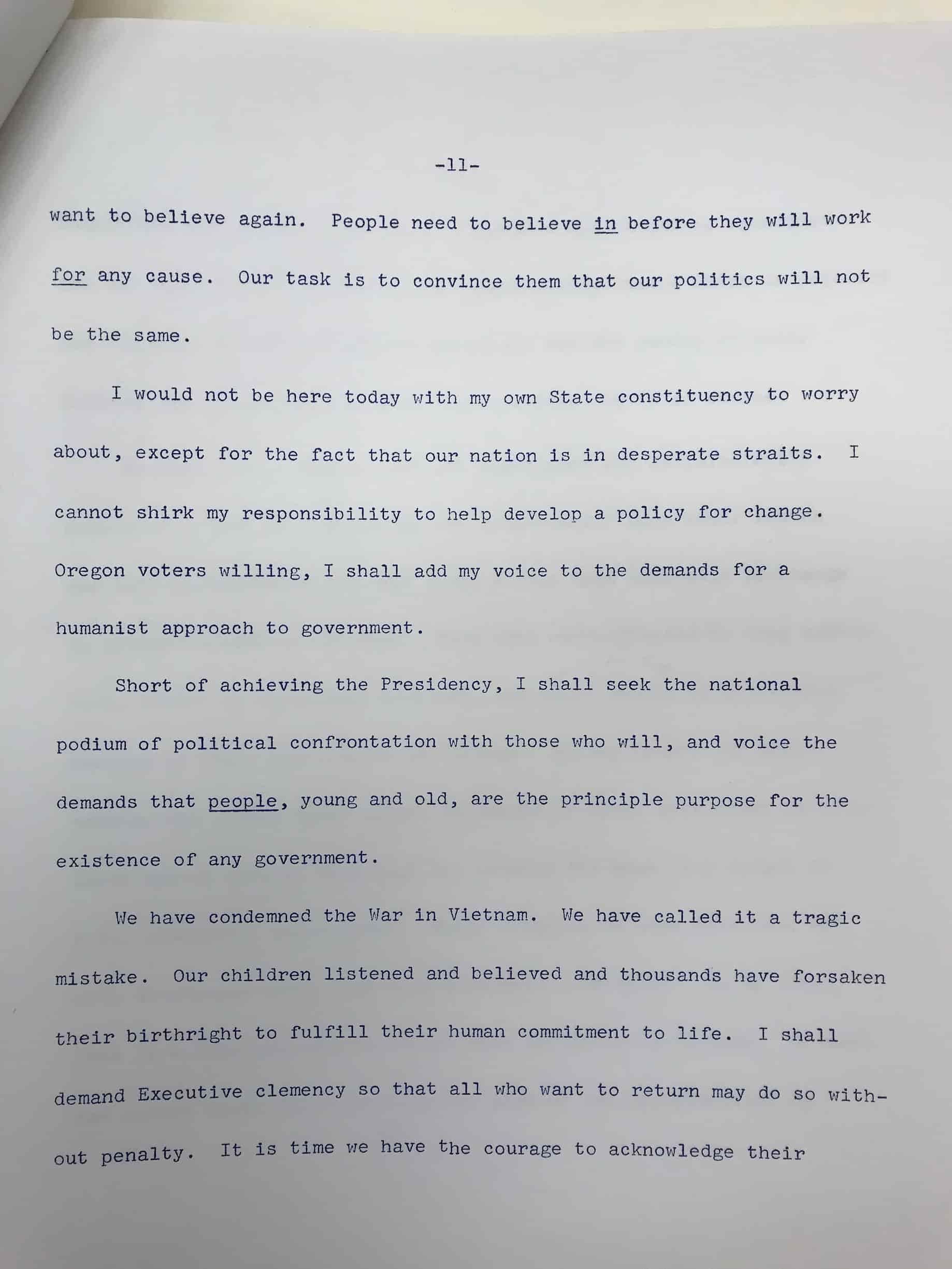
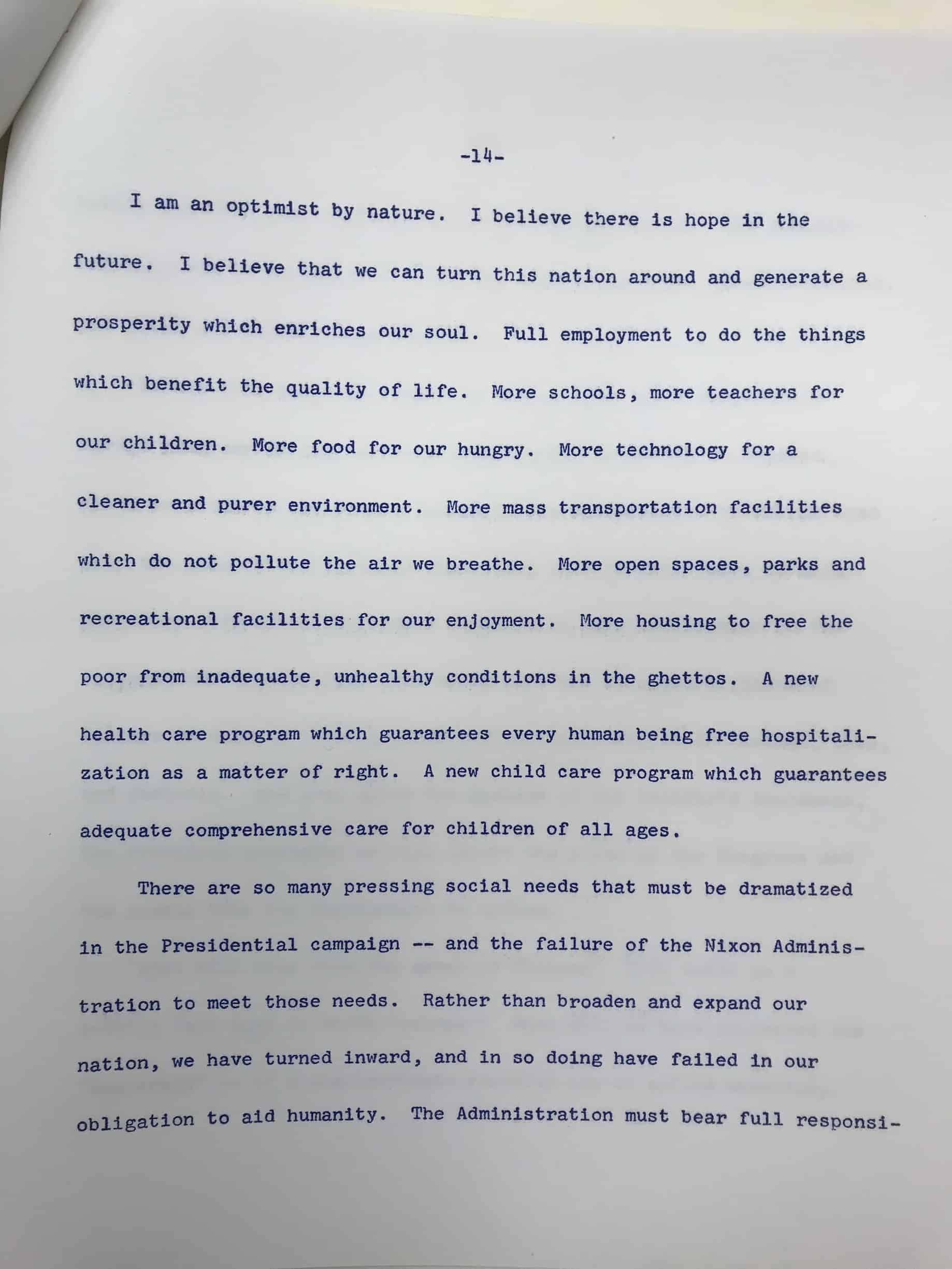
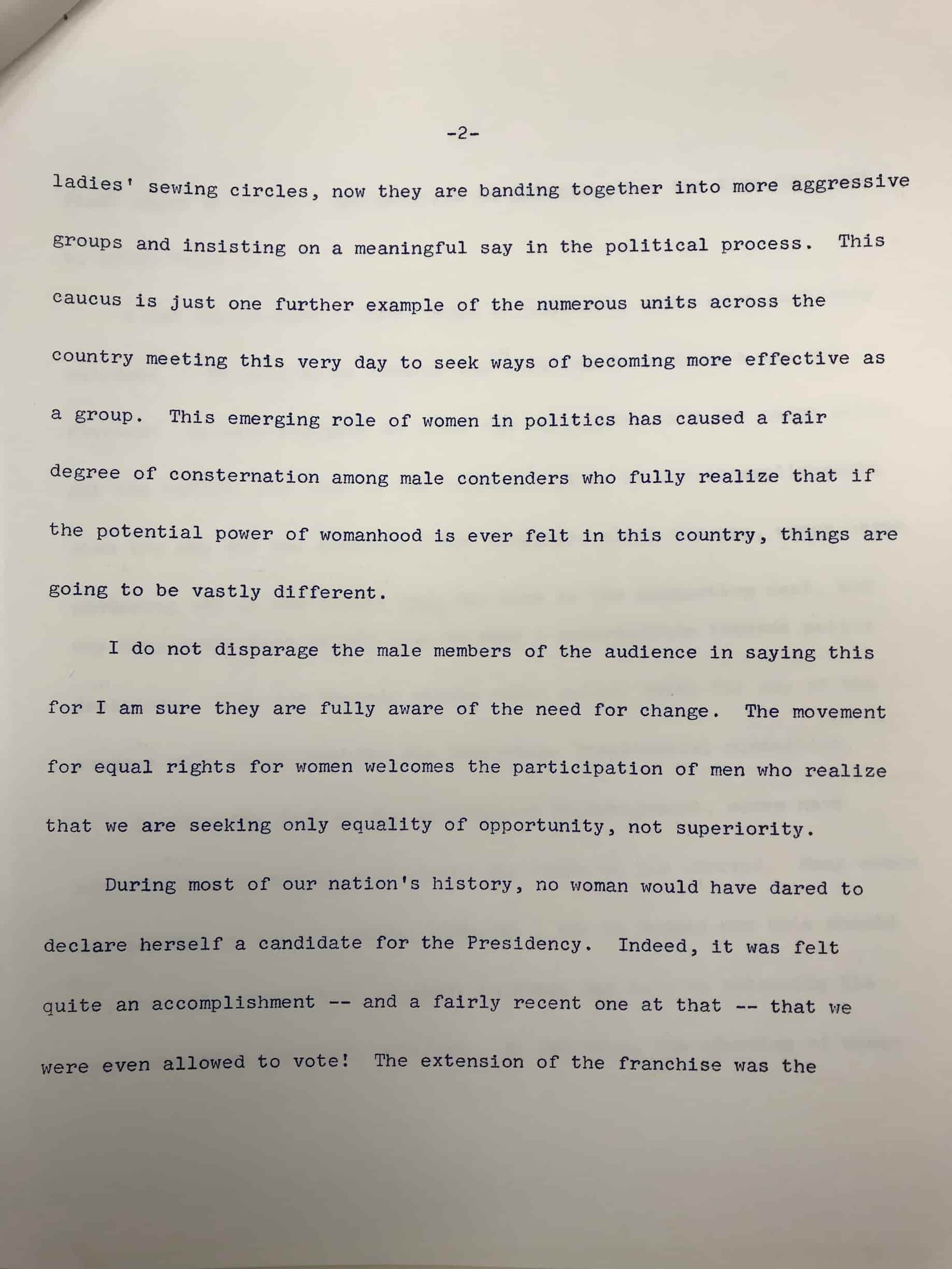
Mink gave a speech at the Oregon Democratic Women’s caucus explaining her motivations to run for President. There, she presented a bold vision for the future:

“More schools, more teachers for our children. More food for our hungry. More technology for a cleaner and purer environment. More mass transportation facilities which do not pollute the air we breathe. More housing to free the poor from inadequate, unhealthy conditions in the ghettos. A new health care program which guarantees every human being free hospitalization as a matter of right. A new childcare program which guarantees adequate comprehensive care for children of all ages.” 2

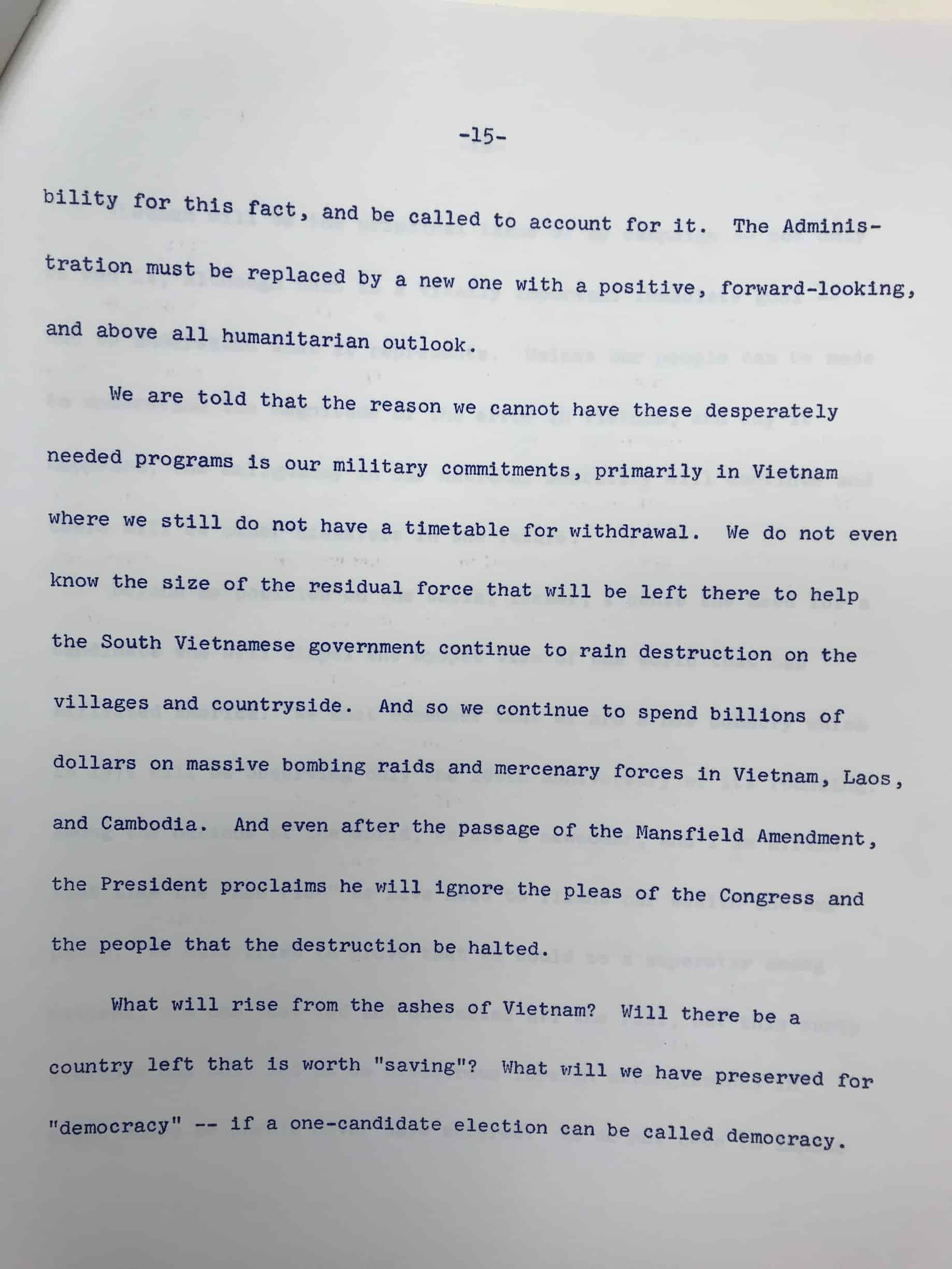
Under her vision of the presidency, Mink wanted to support all people in the US. Mink said President Nixon’s administration favored funding war and not social programs, continuing “to spend billions of dollars on massive bombing raids and mercenary forces in Vietnam, Laos, and Cambodia.” 3

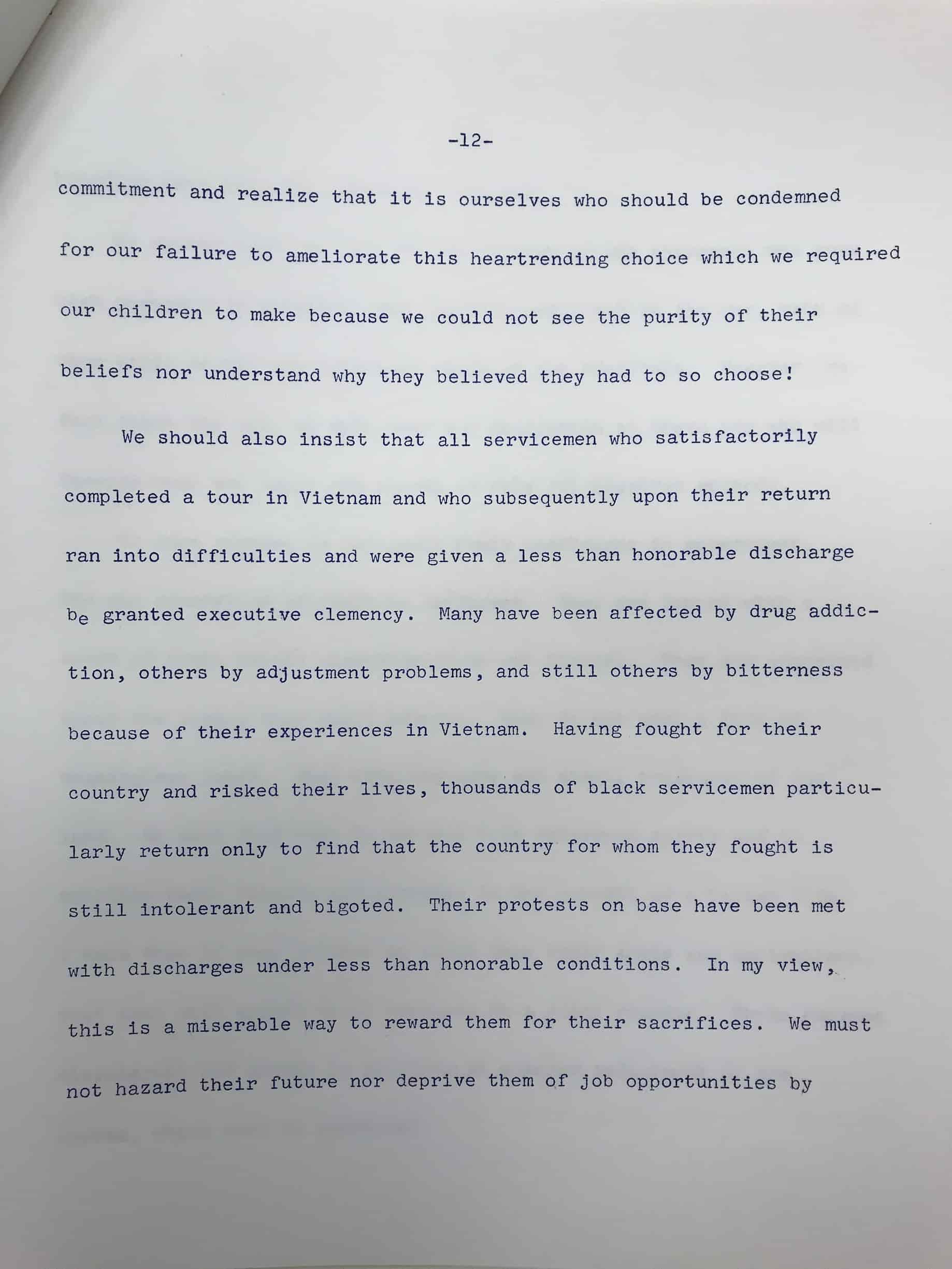
Mink’s speech connected domestic issues to this international policy of foreign war. “Having fought for their country and risked their lives, thousands of Black servicemen particularly return only to find that the country for whom they fought is still intolerant and bigoted,” she observed. Not only did war not resolve anti-Black racism, it perpetuated violence against Asians.

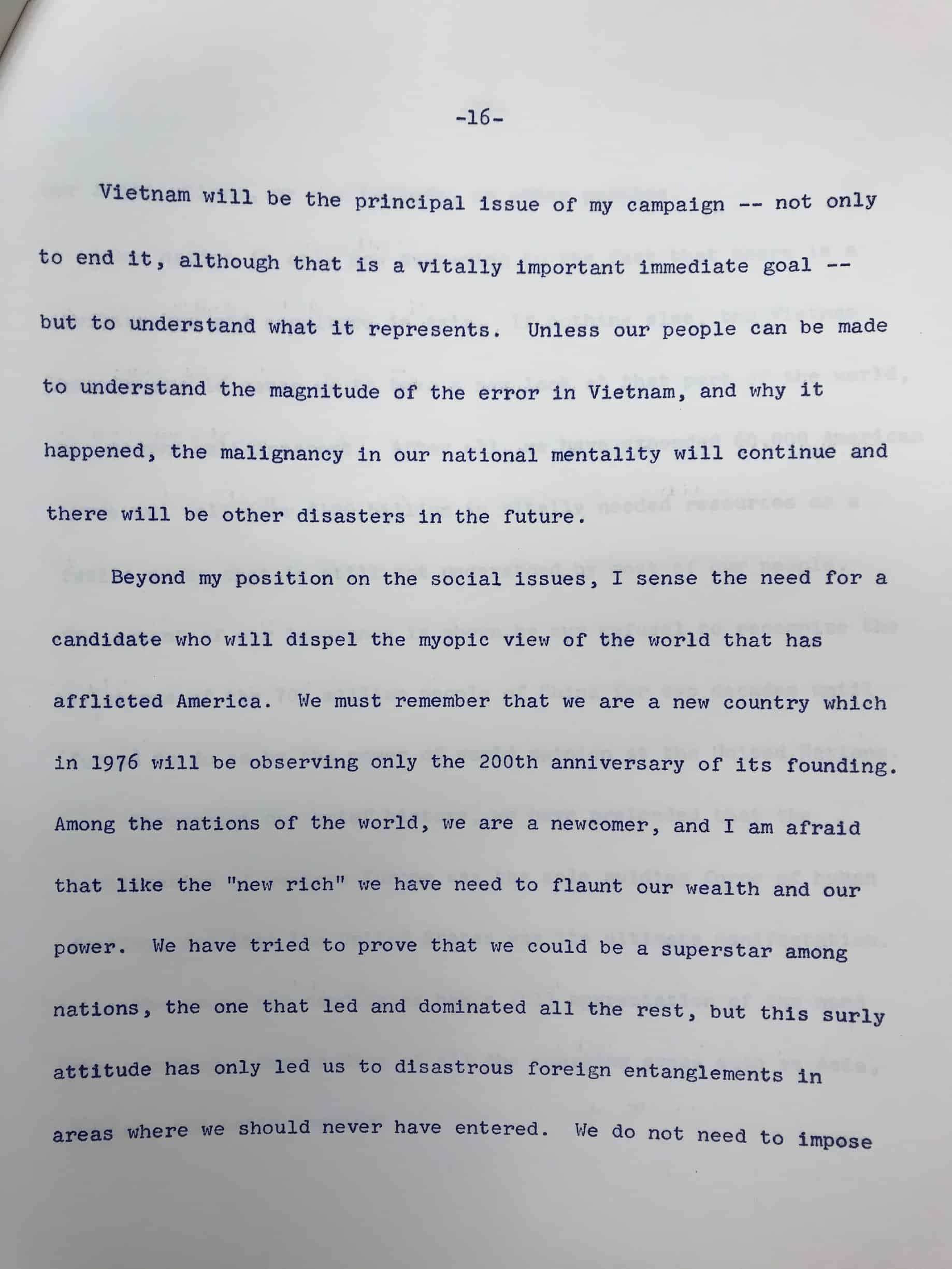
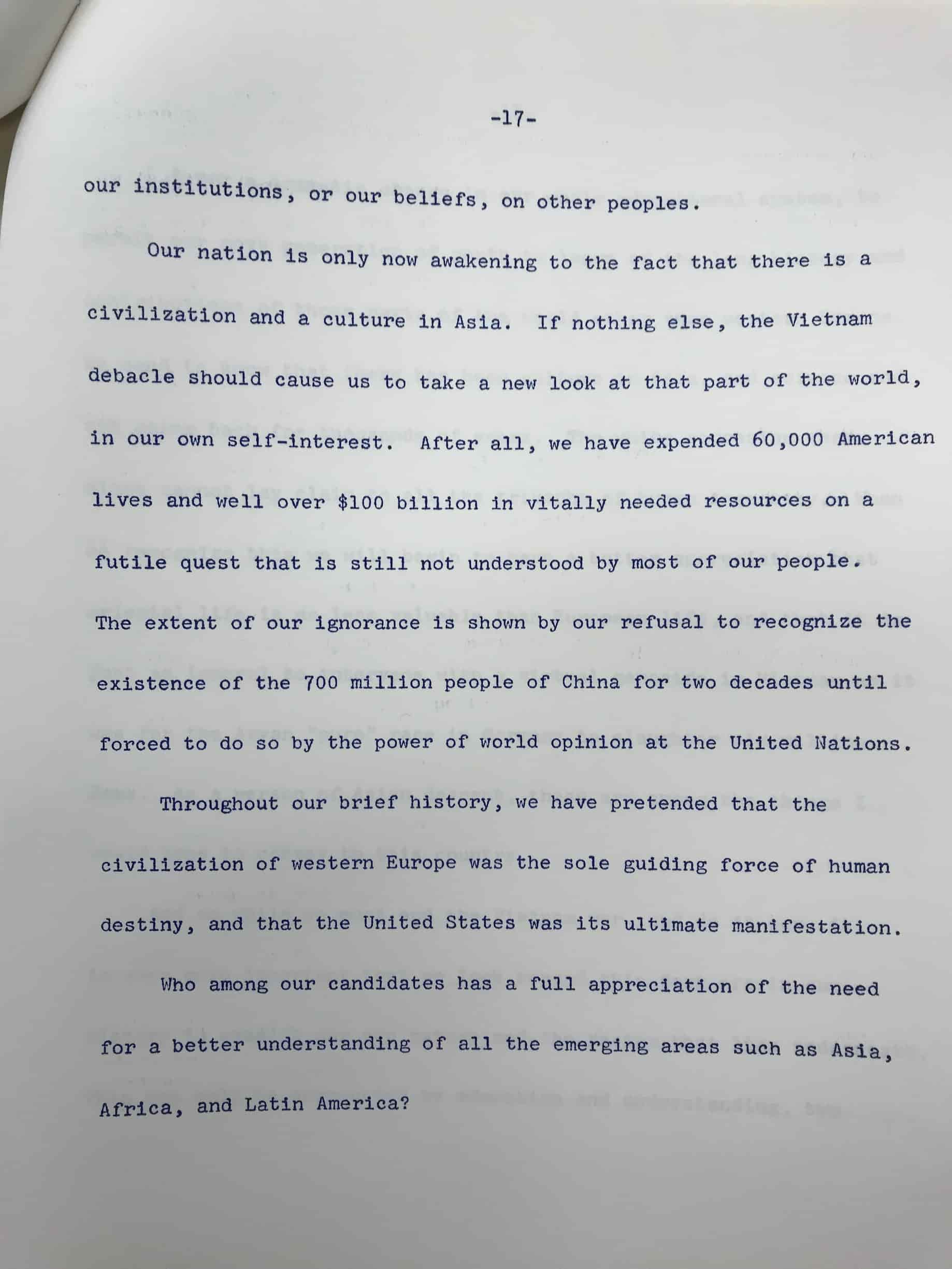
Mink saw the US effort to exert its power in Vietnam, and Asia more broadly, as “[imposing] our institutions, or our beliefs, on other peoples.” She concluded on a note of optimism. “Let us not turn again down the dark alley of racism,” she said, “but pursue the brighter hope of human goodness.” 4

Shirley Chisholm, the first African American woman elected to Congress, also ran for president in 1972. As political allies, they agreed to not directly compete with one another.
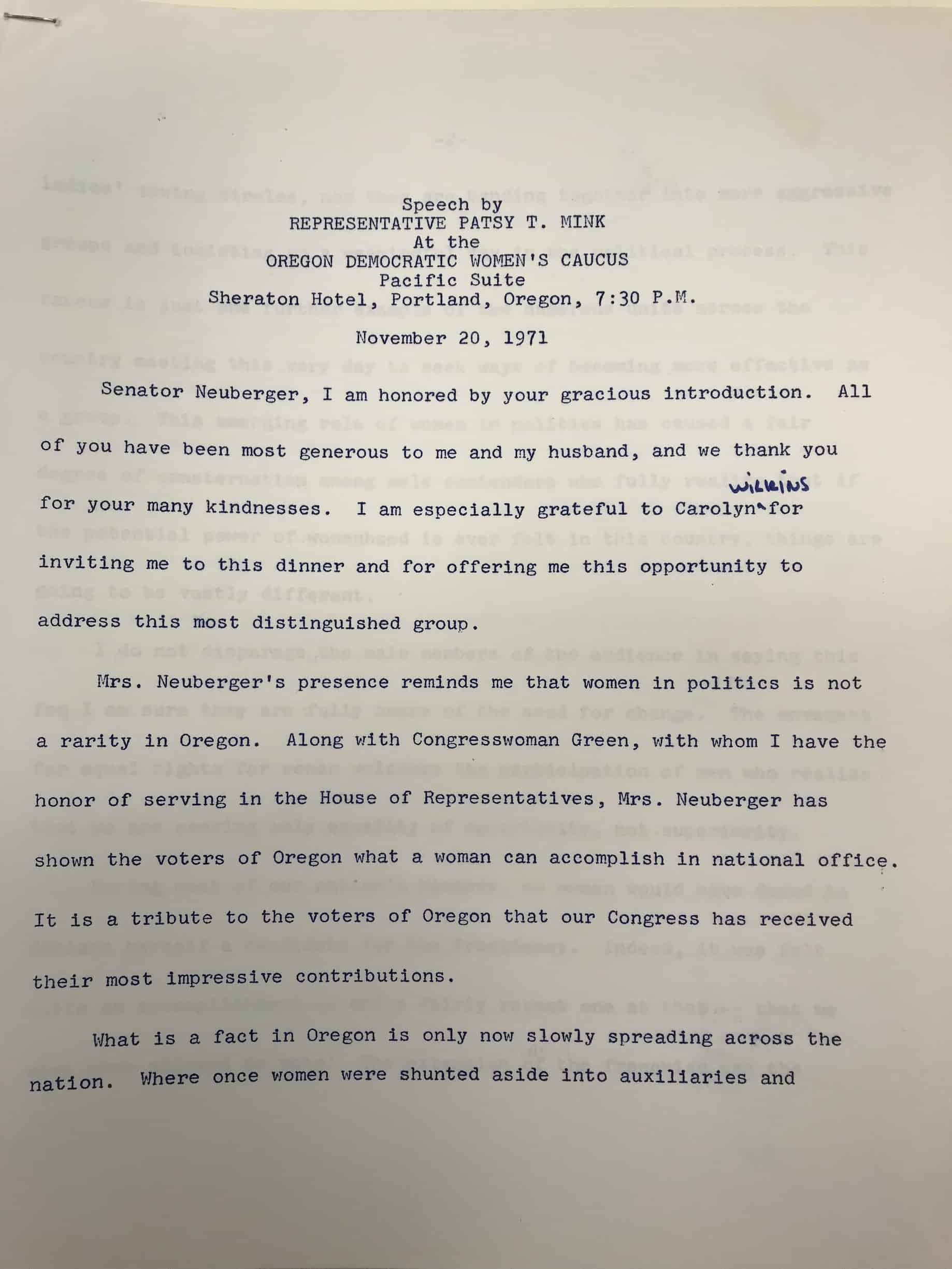
Click for Full Transcript

Speech by 
REPRESENTATIVE PATSY T. MINK
At the
OREGON DEMOCRATIC WOMEN’S CAUCUS
Pacific Suite
Sheraton Hotel, Portland, Oregon, 7:30 P.M.
November 20, 1971

Senator Neuberger, I am honored by your gracious introduction. All of you have been most generous to me and my husband, and we thank you for your many kindnesses. I am especially grateful to Carolyn Wilkins for inviting me to this dinner and for offering me this opportunity to address this most distinguished group.

Mrs. Neuberger’s presence reminds me that women in politics is not a rarity in Oregon. Along with Congresswoman Green, with whom I have the honor of serving in the House of Representatives, Mrs. Neuberger has shown the voters of Oregon what a woman can accomplish in national office. It is a tribute to the voters of Oregon that our Congress has received their most impressive contributions. What is a fact in Oregon is only now slowly spreading across the nation. Where once women were shunted aside into auxiliaries and

– Page 2 –

now they are banding together into more aggressive groups and insisting on a meaningful say in the political process. This caucus is just one further example of the numerous units across the country meeting this very day to seek ways of becoming more effective as a group. This emerging role of women in politics has caused a fair degree of consternation among male contenders who fully realize that if the potential power of womanhood is ever felt in this country, things are going to be vastly different.

I do not disparage the male members of the audience in saying this, for I am sure they are fully aware of the need for change. The movement for equal rights for women welcomes the participation of men who realize that we are seeking only equality of opportunity, not superiority.

During most of our nation’s history, no woman would have dared to declare herself a candidate for the Presidency. Indeed, it was felt quite an accomplishment — and a fairly recent one at that — that we were even allowed to vote! The extension of the franchise was the

– Page 3 –

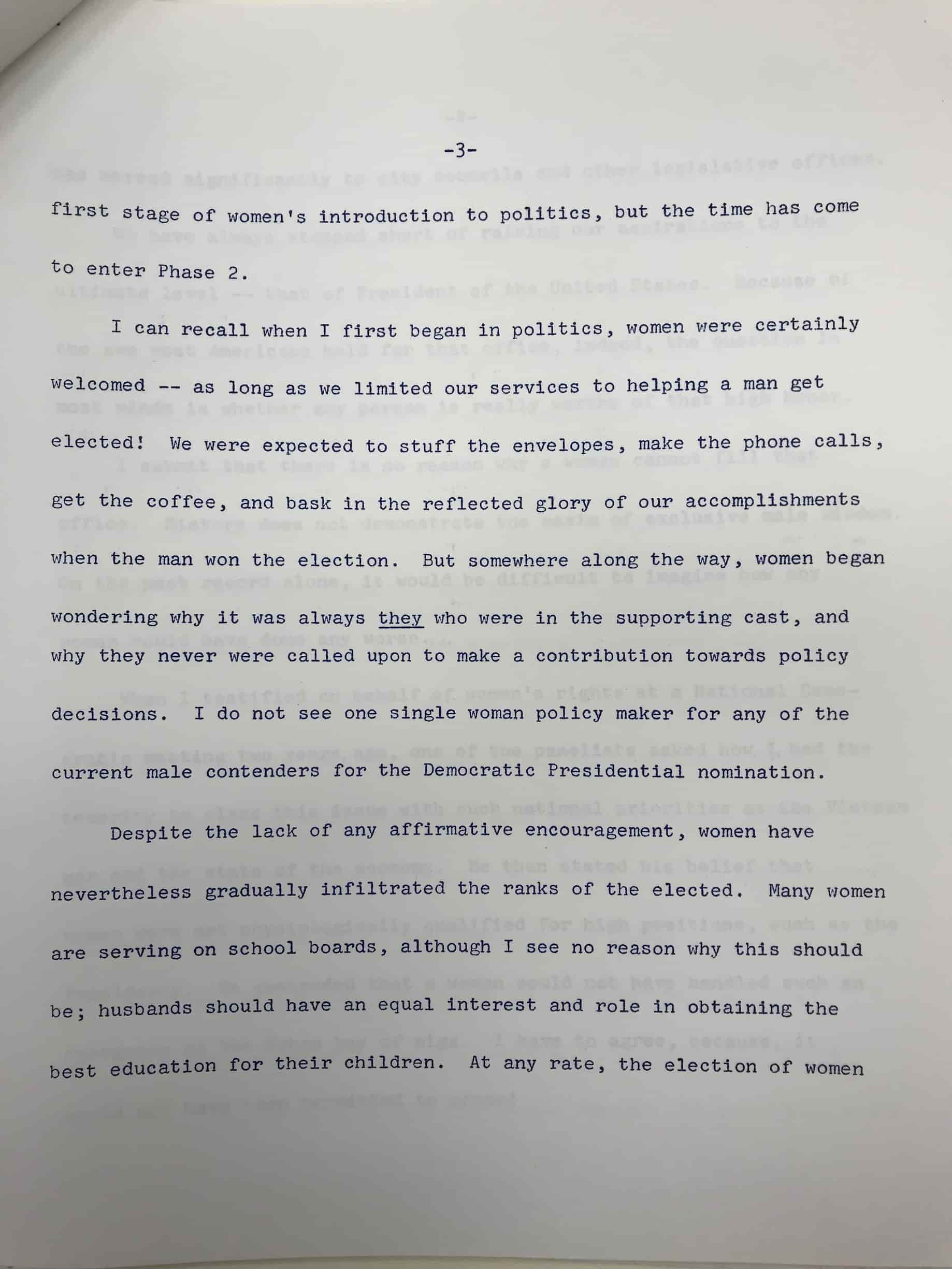
first stage of women’s introduction to politics, but the time has come to enter Phase 2.

I can recall when I first began in politics, women were certainly welcomed — as long as we limited our services to helping a man get elected! We were expected to stuff the envelopes, make the phone calls, get the coffee, and bask in the reflected glory of our accomplishments when the man won the election. But somewhere along the way, women began wondering why it was always they who were in the supporting cast, and why they never were called upon to make a contribution towards policy decisions. I do not see one single woman policy maker for any of the current male contenders for the Democratic Presidential nomination.

Despite the lack of any affirmative encouragement, women have nevertheless gradually infiltrated the ranks of the elected. Many women are serving on school boards, although I see no reason why this should be; husbands should have an equal interest and role in obtaining the best education for their children. At any rate, the election of women

– Page 4 –

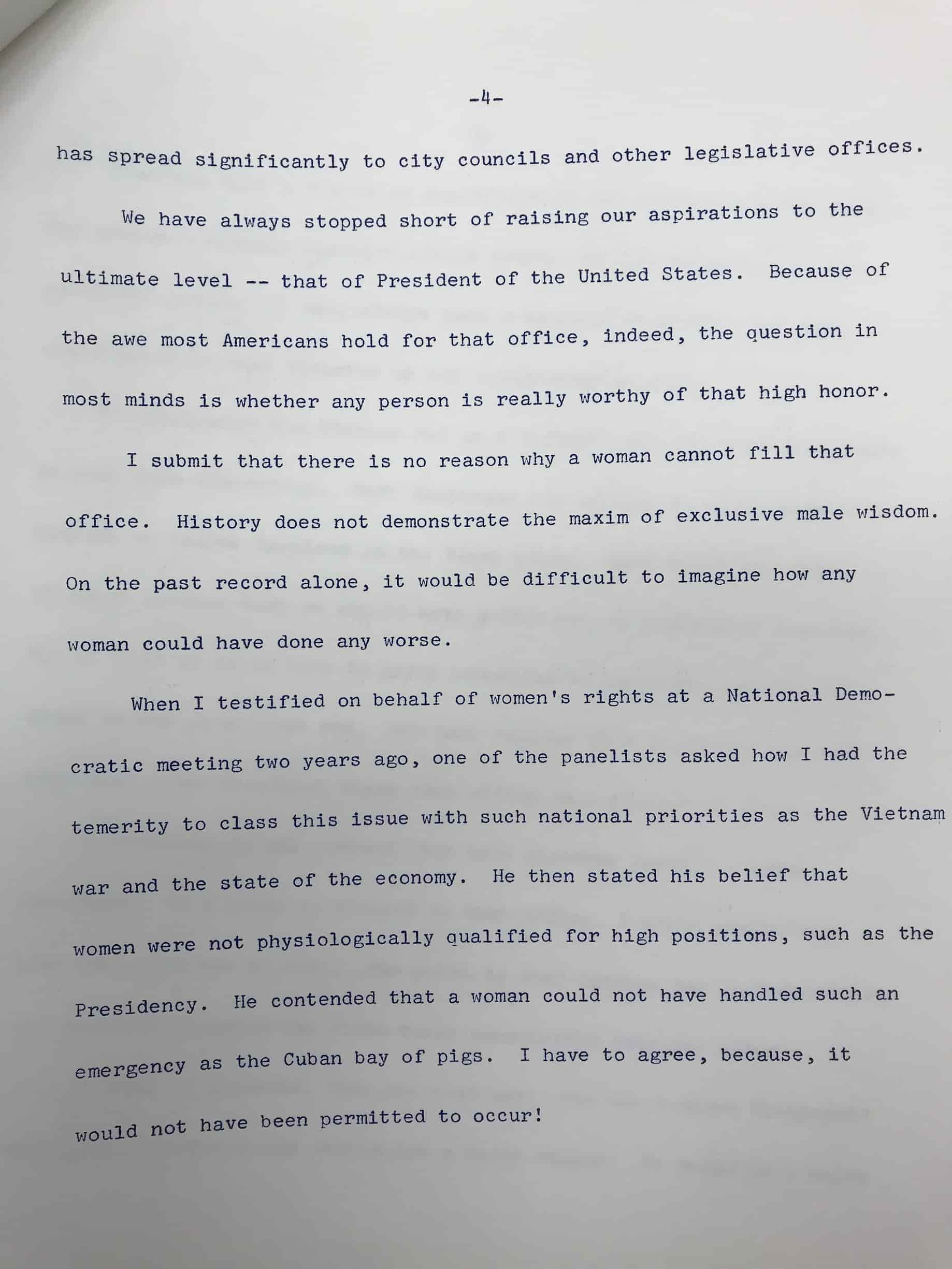
has spread significantly to city councils and other legislative offices.

We have always stopped short of raising our aspirations to the ultimate level — that of President of the United States. Because of the awe most Americans hold for that office, indeed, the question in most minds is whether any person is really worthy of that high honor. I submit that there is no reason why a woman cannot fill that office. History does not demonstrate the maxim of exclusive male wisdom. On the past record alone, it would be difficult to imagine how any woman could have done any worse.

When I testified on behalf of women’s rights at a National Democratic meeting two years ago, one of the panelists asked how I had the temerity to class this issue with such national priorities as the Vietnam war and the state of the economy. He then stated his belief that women were not physiologically qualified for high positions, such as the Presidency. He contended that a woman could not have handled such an emergency as the Cuban Bay of Pigs. I have to agree, because it would not have been permitted to occur!

– Page 5 –

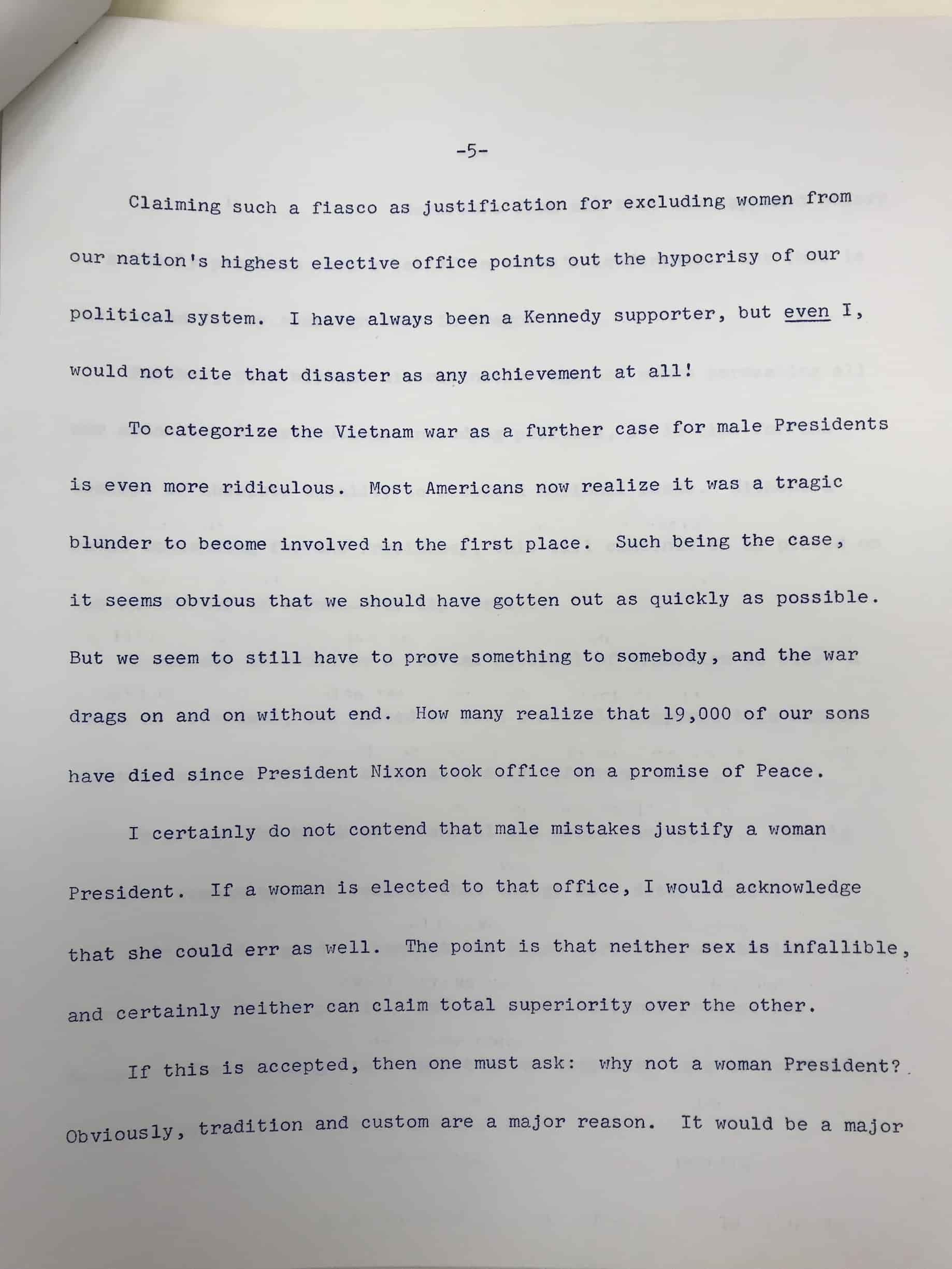
Claiming such a fiasco as justification for excluding women from our nation’s highest elective office points out the hypocrisy of our political system. I have always been a Kennedy supporter, but even I would not cite that disaster as any achievement at all!

To categorize the Vietnam war as a further case for male Presidents is even more ridiculous. Most Americans now realize it was a tragic blunder to become involved in the first place. Such being the case, it seems obvious that we should have gotten out as quickly as possible. But we seem to still have to prove something to somebody, and the war drags on and on without end. How many realize that 19,000 of our sons have died since President Nixon took office on a promise of Peace?

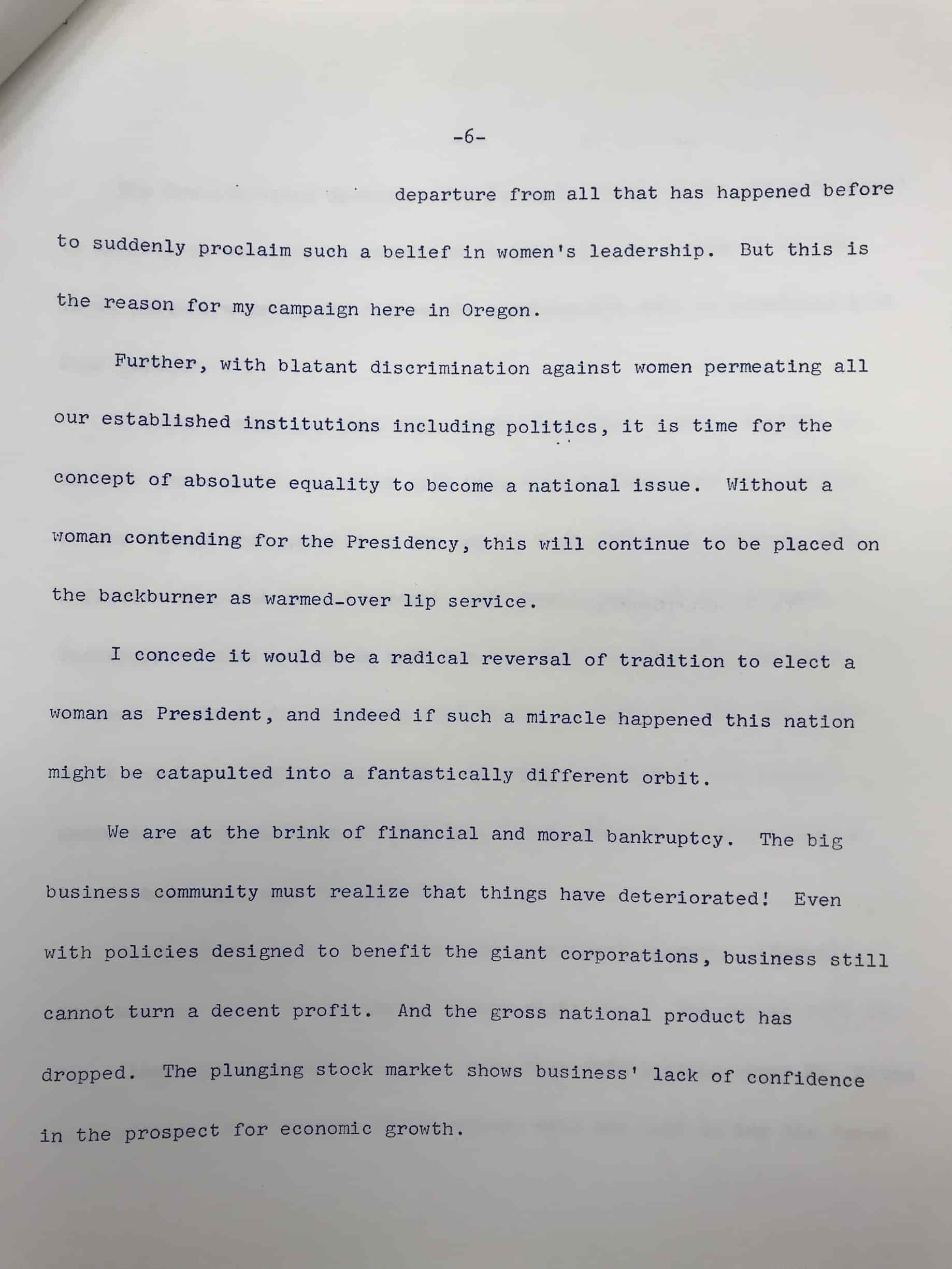
I certainly do not contend that male mistakes justify a woman President. If a woman is elected to that office, I would acknowledge that she could err as well. The point is that neither sex is infallible and certainly neither can claim total superiority over the other. If this is accepted, then one must ask: why not a woman President? Obviously, tradition and custom are a major reason. It would be a major

– Page 6 –

departure from all that has happened before to suddenly proclaim such a belief in women’s leadership. But this is the reason for my campaign here in Oregon.
Further, with blatant discrimination against women permeating all our established institutions including politics, it is time for the concept of absolute equality to become a national issue. Without a woman contending for the Presidency, this will continue to be placed on the backburner as warmed-over lip service.

I concede it would be a radical reversal of tradition to elect a woman as President, and indeed if such a miracle happened this nation might be catapulted into a fantastically different orbit.

We are at the brink of financial and moral bankruptcy. The big business community must realize that things have deteriorated! Even with policies designed to benefit the giant corporations, business still cannot turn a decent profit. And the gross national product has dropped. The plunging stock market shows business’ lack of confidence in the prospect for economic growth.

– Page 7 –

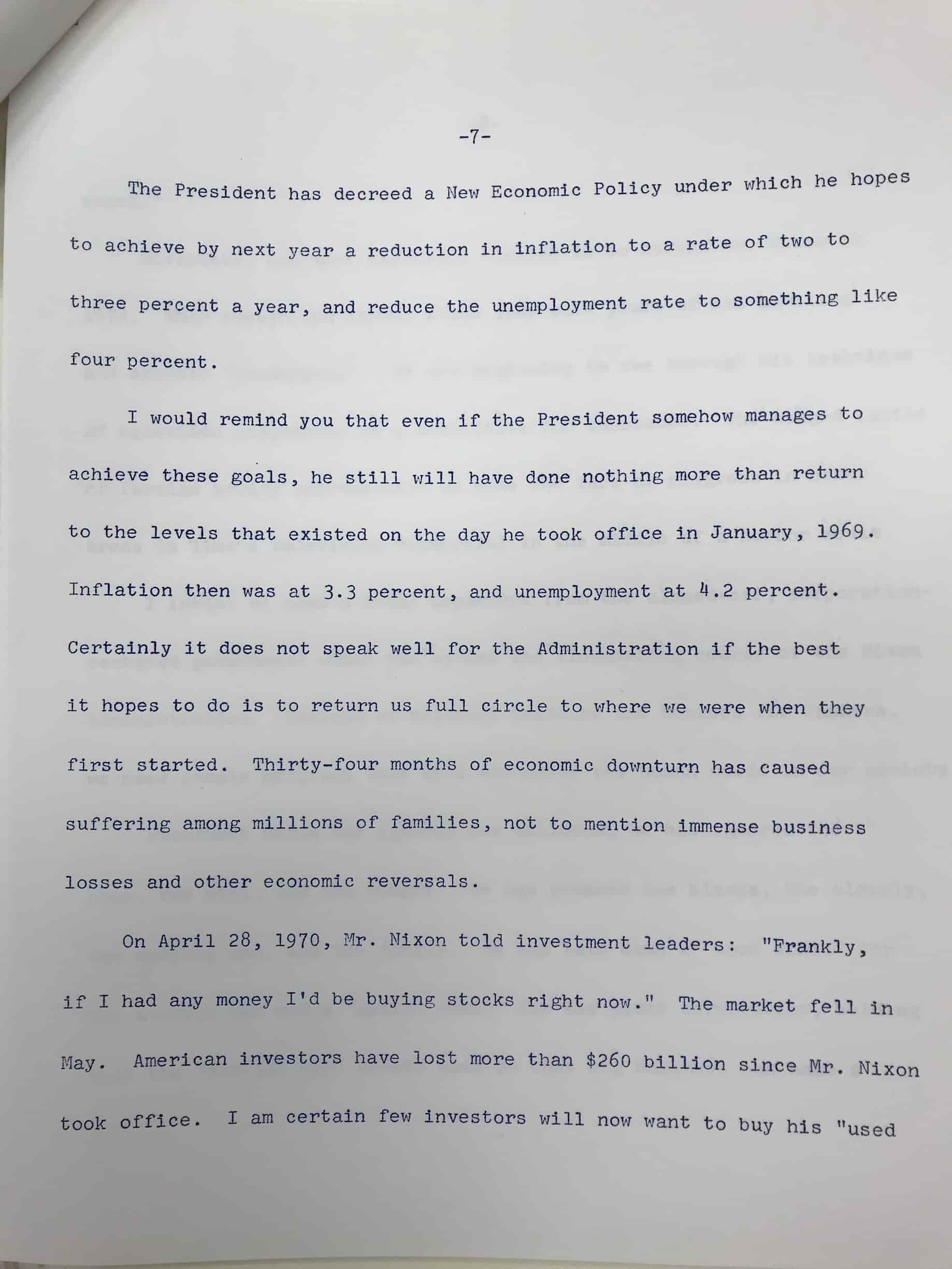
The President has decreed a New Economic Policy under which he hopes to achieve by next year a reduction in inflation to a rate of two to three percent a year, and reduce the unemployment rate to something like four percent.

I would remind you that even if the President somehow manages to achieve these goals, he still will have done nothing more than return to the levels that existed on the day he took office in January, 1969. Inflation then was at 3.3 percent, and unemployment at 4.2 percent. Certainly it does not speak well for the Administration if the best it hopes to do is to return us full circle to where we were when they first started. Thirty-four months of economic downturn has caused suffering among millions of families, not to mention immense business losses and other economic reversals.

On April 28, 1970, Mr. Nixon told investment leaders: “Frankly, if I had any money I’d be buying stocks right now.” The market fell in May. American investors have lost more than $260 billion since Mr. Nixon took office. I am certain few investors will now want to buy his “used

– Page 8 –

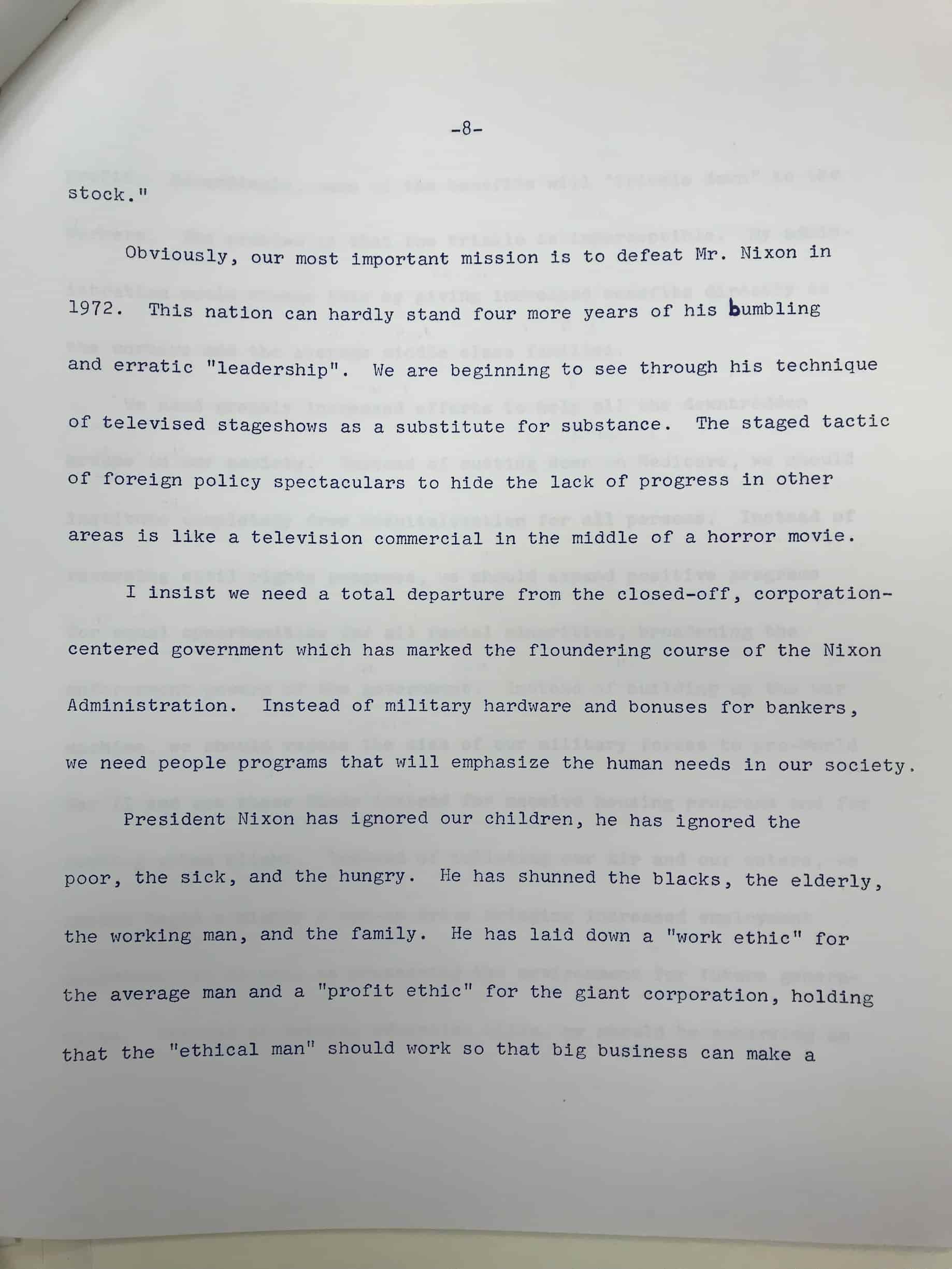
stock.”
Obviously, our most important mission is to defeat Mr. Nixon in 1972. This nation can hardly stand four more years of his bumbling and erratic “leadership”. We are beginning to see through his technique of televised stageshows as a substitute for substance. The staged tactic of foreign policy spectaculars to hide the lack of progress in other areas is like a television commercial in the middle of a horror movie.

I insist we need a total departure from the closed-off, corporation-centered government which has marked the floundering course of the Nixon Administration. Instead of military hardware and bonuses for bankers, we need people programs that will emphasize the human needs in our society.

President Nixon has ignored our children, he has ignored the poor, the sick, and the hungry. He has shunned the blacks, the elderly, the working man, and the family. He has laid down a “work ethic” for the average man and a “profit ethic” for the giant corporation, holding that the “ethical man” should work so that big business can make a

– Page 9 –

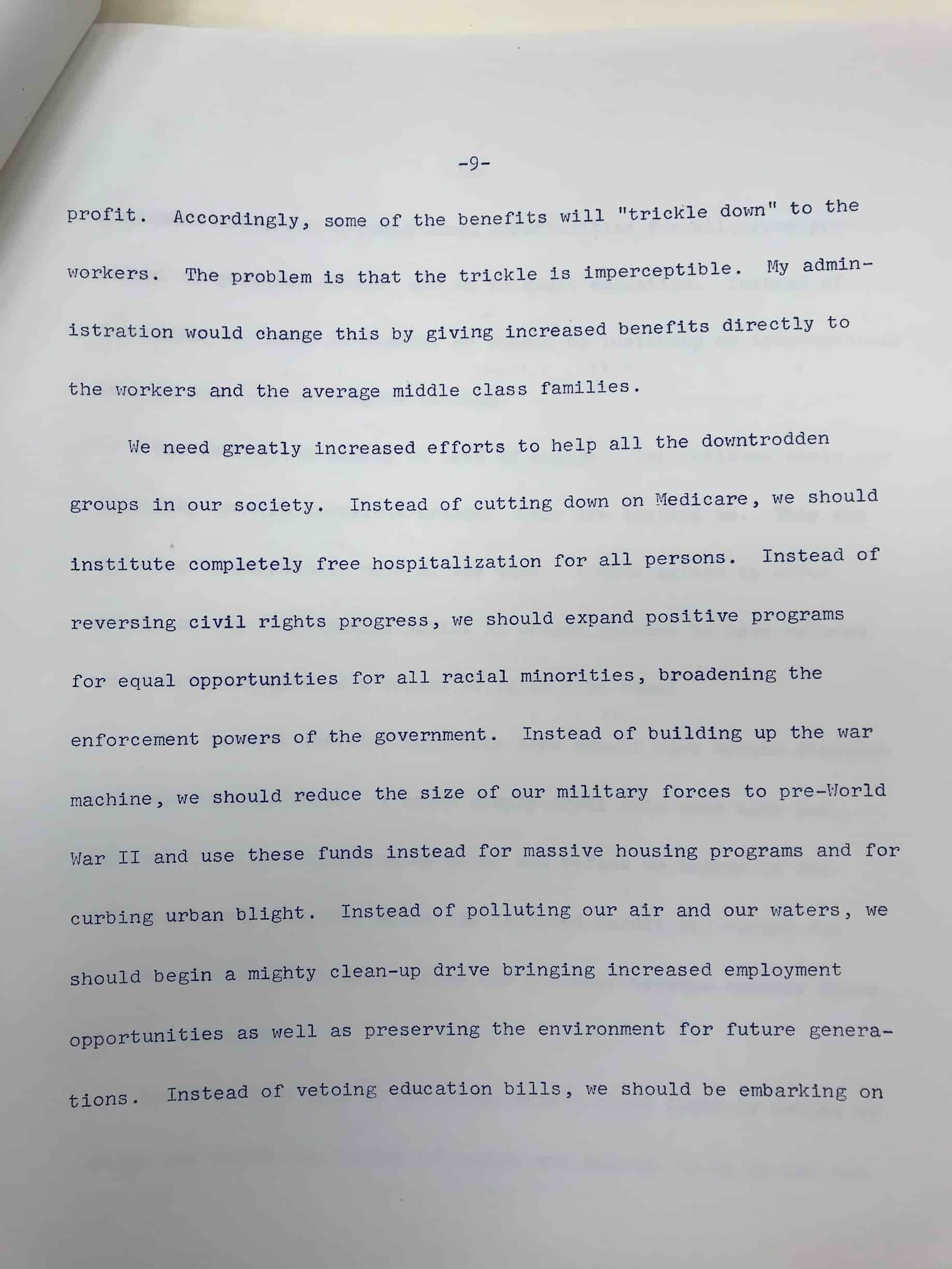
profit. Accordingly, some of the benefits will “trickle down” to the workers. The problem is that the trickle is imperceptible. My administration would change this by giving increased benefits directly to the workers and the average middle class families.

We need greatly increased efforts to help all the downtrodden groups in our society. Instead of cutting down on Medicare, we should institute completely free hospitalization for all persons. Instead of reversing civil rights progress, we should expand positive programs for equal opportunities for all racial minorities, broadening the enforcement powers of the government. Instead of building up the war machine, we should reduce the size of our military forces to pre-World War II and use these funds instead for massive housing programs and for curbing urban blight. Instead of polluting our air and our waters, we should begin a mighty clean-up drive bringing increased employment opportunities as well as preserving the environment for future generations.

Instead of vetoing education bills, we should be embarking on

– Page 10 –

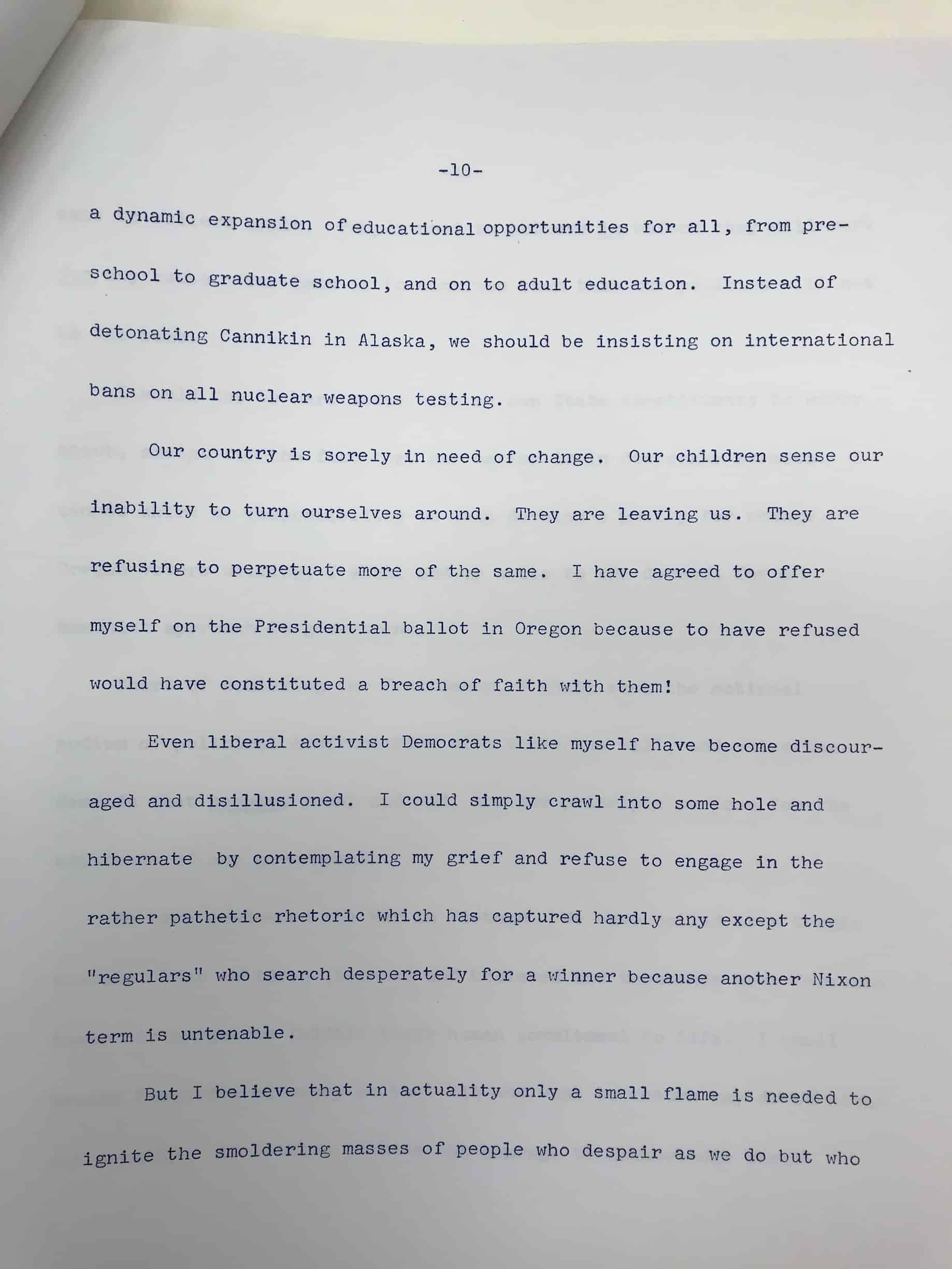
a dynamic expansion of educational opportunities for all, from preschool to graduate school, and on to adult education. Instead of detonating Cannikin in Alaska, we should be insisting on international bans on all nuclear weapons testing.

Our country is sorely in need of change. Our children sense our inability to turn ourselves around. They are leaving us. They are refusing to perpetuate more of the same. I have agreed to offer myself on the Presidential ballot in Oregon because to have refused would have constituted a breach of faith with them!

Even liberal activist Democrats like myself have become discouraged and disillusioned. I could simply crawl into some hole and hibernate by contemplating my grief and refuse to engage in the rather pathetic rhetoric which has captured hardly any except the “regulars” who search desperately for a winner because another Nixon term is untenable.

But I believe that in actuality only a small flame is needed to ignite the smoldering masses of people who despair as we do but who

– Page 11 –

want to believe again. People need to believe in before they will work for any cause. Our task is to convince them that our politics will not be the same.

I would not be here today with my own State constituency to worry about, except for the fact that our nation is in desperate straits. I cannot shirk my responsibility to help develop a policy for change. Oregon voters willing, I shall add my voice to the demands for a humanist approach to government.

Short of achieving the Presidency, I shall seek the national podium of political confrontation with those who will, and voice the demands that people, young and old, are the principle purpose for the existence of any government.

We have condemned the War in Vietnam. We have called it a tragic mistake. Our children listened and believed and thousands have forsaken their birthright to fulfill their human commitment to life. I shall demand Executive clemency so that all who want to return may do so without penalty. It is time we have the courage to acknowledge their

– Page 12 –

commitment and realize that it is ourselves who should be condemned for our failure to ameliorate this heartrending choice which we required our children to make because we could not see the purity of their beliefs nor understand why they believed they had to so choose!

We should also insist that all servicemen who satisfactorily completed a tour in Vietnam and who subsequently upon their return ran into difficulties and were given a less than honorable discharge be granted executive clemency. Many have been affected by drug addiction, others by adjustment problems, and still others by bitterness because of their experiences in Vietnam. Having fought for their country and risked their lives, thousands of black servicemen particularly return only to find that the country for whom they fought is still intolerant and bigoted. Their protests on base have been met with discharges under less than honorable conditions. In my view, this is a miserable way to reward them for their sacrifices. We must not hazard their future nor deprive them of job opportunities by

– Page 13 –

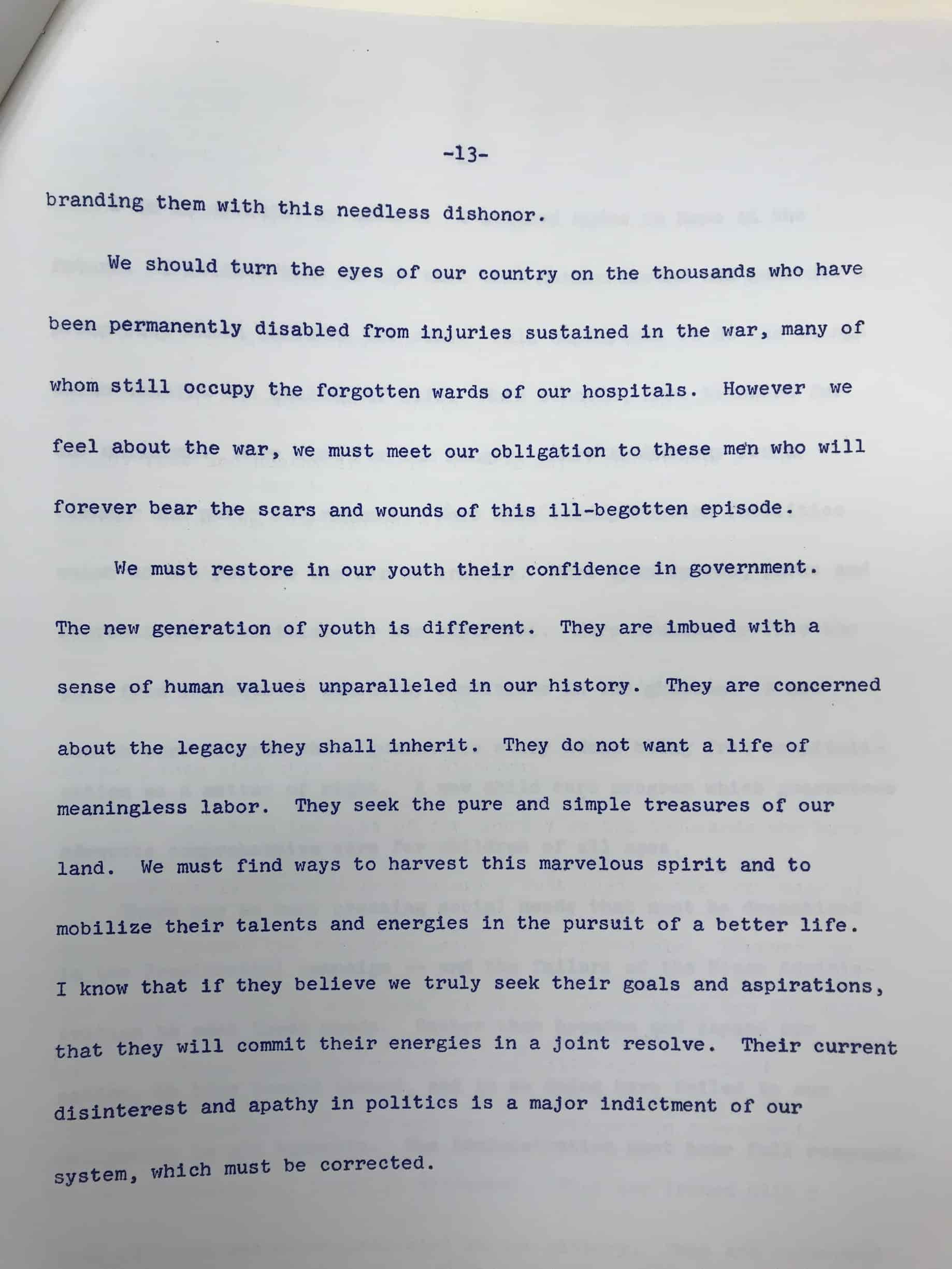
branding them with this needless dishonor.

We should turn the eyes of our country on the thousands who have been permanently disabled from injuries sustained in the war, many of whom still occupy the forgotten wards of our hospitals. However we feel about the war, we must meet our obligation to these men who will forever bear the scars and wounds of this ill-begotten episode.

We must restore in our youth their confidence in government. The new generation of youth is different. They are imbued with a sense of human values unparalleled in our history. They are concerned about the legacy they shall inherit. They do not want a life of meaningless labor. They seek the pure and simple treasures of our land. We must find ways to harvest this marvelous spirit and to mobilize their talents and energies in the pursuit of a better life.

I know that if they believe we truly seek their goals and aspirations, that they will commit their energies in a joint resolve. Their current disinterest and apathy in politics is a major indictment of our system, which must be corrected.

– Page 14 –

I am an optimist by nature. I believe there is hope in the future. I believe that we can turn this nation around and generate a prosperity which enriches our soul. Full employment to do the things which benefit the quality of life. More schools, more teachers for our children. More food for our hungry. More technology for a cleaner and purer environment. More mass transportation facilities which do not pollute the air we breathe. More open spaces, parks and recreational facilities for our enjoyment. More housing to free the poor from inadequate, unhealthy conditions in the ghettos. A new health care program which guarantees every human being free hospitalization as a matter of right. A new child care program which guarantees adequate comprehensive care for children of all ages.

There are so many pressing social needs that must be dramatized in the Presidential campaign and the failure of the Nixon Administration to meet those needs. Rather than broaden and expand our nation, we have turned inward, and in so doing have failed in our obligation to aid humanity. The Administration must bear full responsibility

– Page 15 –

for this fact, and be called to account for it. The Administration must be replaced by a new one with a positive, forward-looking, and above all humanitarian outlook.

We are told that the reason we cannot have these desperately needed programs is our military commitments, primarily in Vietnam where we still do not have a timetable for withdrawal. We do not even know the size of the residual force that will be left there to help the South Vietnamese government continue to rain destruction on the villages and countryside. And so we continue to spend billions of dollars on massive bombing raids and mercenary forces in Vietnam, Laos, and Cambodia. And even after the passage of the Mansfield Amendment, the President proclaims he will ignore the pleas of the Congress and the people that the destruction be halted.

What will rise from the ashes of Vietnam? Will there be a country left that is worth “saving”? What will we have preserved for “democracy” — if a one-candidate election can be called democracy?

– Page 16 –

Vietnam will be the principal issue of my campaign — not only to end it, although that is a vitally important immediate goal — but to understand what it represents. Unless our people can be made to understand the magnitude of the error in Vietnam, and why it happened, the malignancy in our national mentality will continue and there will be other disasters in the future.

Beyond my position on the social issues, I sense the need for a candidate who will dispel the myopic view of the world that has afflicted America. We must remember that we are a new country which in 1976 will be observing only the 200th anniversary of its founding. Among the nations of the world, we are a newcomer, and I am afraid that like the “new rich” we have need to flaunt our wealth and our power. We have tried to prove that we could be a superstar among nations, the one that led and dominated all the rest, but this surly attitude has only led us to disastrous foreign entanglements in areas where we should never have entered. We do not need to impose

– Page 17 –

our institutions, or our beliefs, on other peoples.

Our nation is only now awakening to the fact that there is a civilization and a culture in Asia. If nothing else, the Vietnam debacle should cause us to take a new look at that part of the world, in our own self-interest. After all, we have expended 60,000 American lives and well over $100 billion in vitally needed resources on a futile quest that is still not understood by most of our people. The extent of our ignorance is shown by our refusal to recognize the existence of the 700 million people of China for two decades until forced to do so by the power of world opinion at the United Nations.

Throughout our brief history, we have pretended that the civilization of western Europe was the sole guiding force of human destiny, and that the United States was its ultimate manifestation. Who among our candidates has a full appreciation of the need for a better understanding of all the emerging areas such as Asia, Africa, and Latin America?

– Page 18 –

I favor a dramatic change in our whole educational system, to permit our next generation of youth to learn of the long history and contributions of those parts of the world other than western Europe. We need to know that there has been culture in Asia, and science and art going back for thousands of years. The white Caucasian race alone cannot lay claim to all the triumphs of human ingenuity. When we recognize this we will begin to have a better appreciation that oriental life is no less valuable than European life, and that it is just as immoral to intervene with a virtual genocide in Vietnam as it was for the Aryan “pure” race in Germany to slaughter six million Jews. As a person of Asian descent, these are among the things I would hope to convey to this country.

And so while we must end the Vietnam war, and do it now, it is even more important that we look beyond this dark era in our history to examine our own nature and the racism that lies underneath. This can only be surmounted by education and understanding, two

– Page 19 –

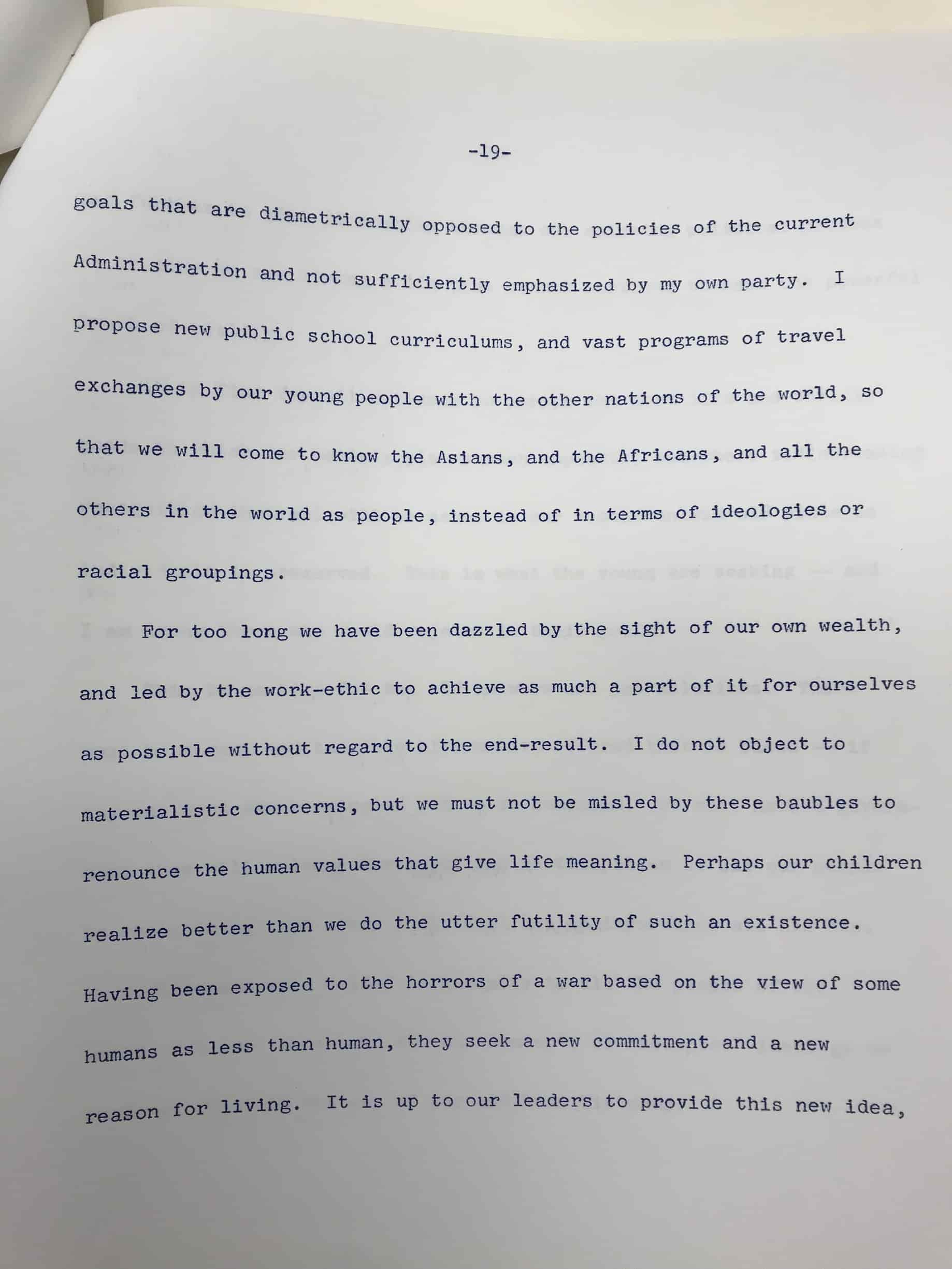
goals that are diametrically opposed to the policies of the current Administration and not sufficiently emphasized by my own party. I propose new public school curriculums, and vast programs of travel exchanges by our young people with the other nations of the world, so that we will come to know the Asians, and the Africans, and all the others in the world as people, instead of in terms of ideologies or racial groupings.

For too long we have been dazzled by the sight of our own wealth, and led by the work ethic to achieve as much a part of it for ourselves as possible without regard to the end result. I do not object to materialistic concerns, but we must not be misled by these baubles to renounce the human values that give life meaning. Perhaps our children realize better than we do the utter futility of such an existence. Having been exposed to the horrors of a war based on the view of some humans as less than human, they seek a new commitment and a new reason for living. It is up to our leaders to provide this new idea,

– Page 20 –

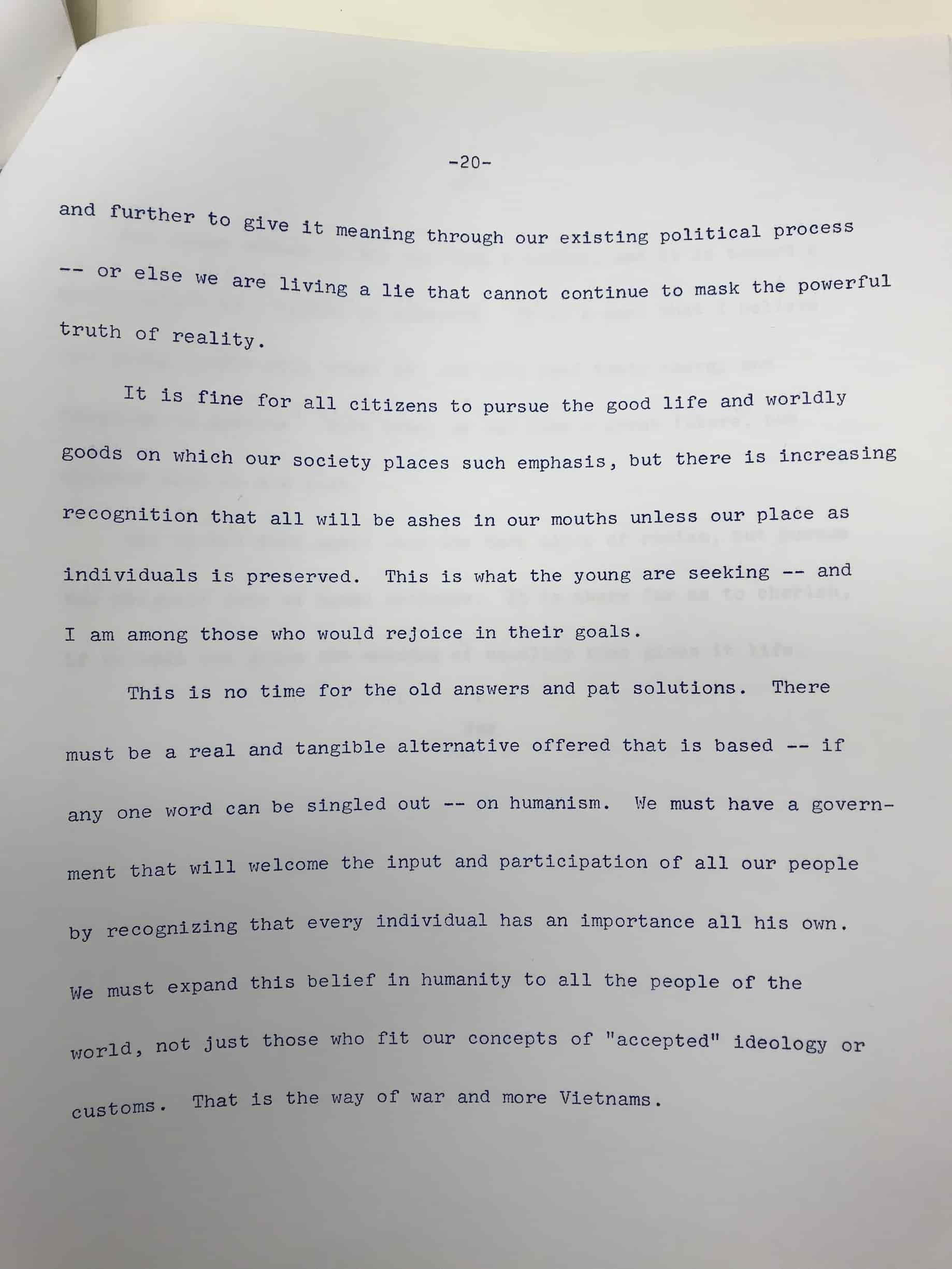
and further to give it meaning through our existing political process — or else we are living a lie that cannot continue to mask the powerful truth of reality.

It is fine for all citizens to pursue the good life and worldly goods on which our society places such emphasis, but there is increasing recognition that all will be ashes in our mouths unless our place as individuals is preserved. This is what the young are seeking — and I am among those who would rejoice in their goals.

This is no time for the old answers and pat solutions. There must be a real and tangible alternative offered that is based — if any one word can be singled out — on humanism. We must have a government that will welcome the input and participation of all our people by recognizing that every individual has an importance all his own.
We must expand this belief in humanity to all the people of the world, not just those who fit our concepts of “accepted” ideology or customs. That is the way of war and more Vietnams.

– Page 21 –

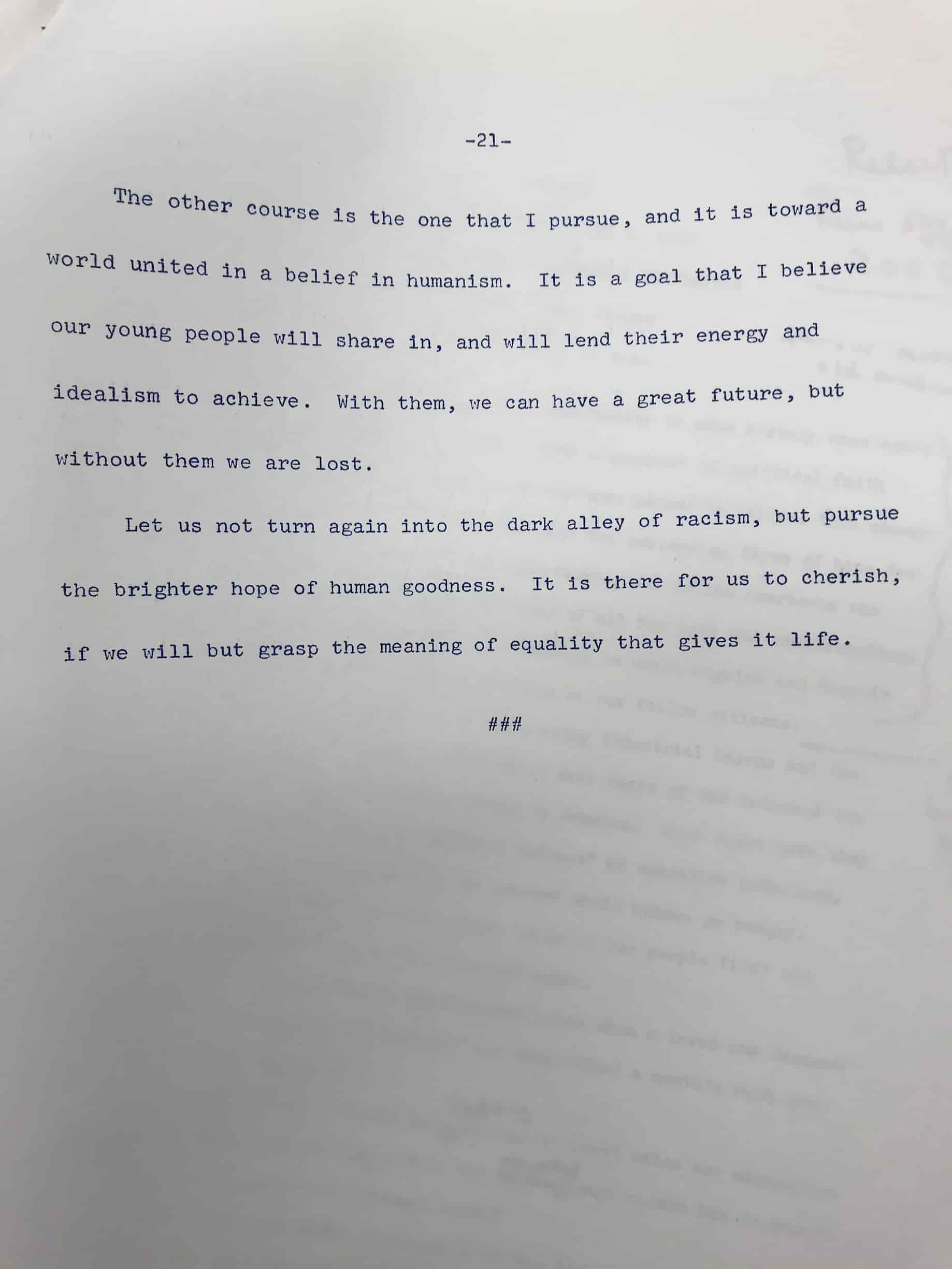
The other course is the one that I pursue, and it is toward a World United in a belief in humanism. It is a goal that I believe our young people will share in, and will lend their energy and idealism to achieve. With them, we can have a great future, but without them we are lost.

Let us not turn again into the dark alley of racism, but pursue the brighter hope of human goodness. It is there for us to cherish, if we will but grasp the meaning of equality that gives it life.

Mink opposed the US War in Vietnam both in Congress and by running for the US Presidency. She sought to offer alternative policies and visions to criticize racism, advocate for women’s involvement in international affairs, and promote democratic methods of resolving conflict. Although Mink did not succeed in winning many votes, she believed in the importance of introducing ideas into political debate.


Reflection Questions

What do you think should be the priority for allocating government resources? What are the connections you see between a country’s international commitments and its domestic policies?

Glossary terms in this module


Cold War Where it’s used

[ kohld wor ]

The decades after World War II when the United States and its allies struggled against the Soviet Union and their allies for global power.

colonialism Where it’s used

[ kuh-loh-nee-uh-liz-uhm ]

When one country takes partial or complete control over another country economically and politically, exploiting its natural resources for profit. The colonizer imposes their beliefs and way of life onto the colonized.

refugee Where it’s used

[ ref-yoo-jee ]

A person who has been forced to leave their country in order to escape war, persecution, or natural disaster.


Endnotes

 1 Patsy T. Mink, “Speech,” in Congressional Record, April 22, 1971, E3357, MP 508/10.

 2 Patsy T. Mink, “Speech,” Oregon Democratic Women’s Caucus, Portland, OR, November 20, 1971.

 3 Mink, “Speech,” Oregon Democratic Women’s Caucus.

 4 Mink, “Speech,” Oregon Democratic Women’s Caucus.

Read Aloud
Notes
Highlighter
Accessibility
Translate