





Module 4: The Fight for Sovereignty in the Pacific Islands Today
Is there still a need to fight for decolonization in the Pacific today?
The world’s largest international organization, the United Nations (UN), has 193 members. These members all recognize each other as independent countries with a seat at the international table. Yet, if one were to look at the number of members in 1950, there were only 60. In a span of seventy years, 133 new members (places recognized as independent countries) were added to the UN. What accounts for this significant increase?
Part of the answer lies in the process of political decolonization, where places once held as colonies largely became independent countries of their own. Some colonies achieved decolonization through violence, while others experienced peaceful transitions of power. For example, in 1962, Sāmoa, a former colony of New Zealand, became the first in the Pacific to gain independence, ultimately joining the United Nations in 1976.
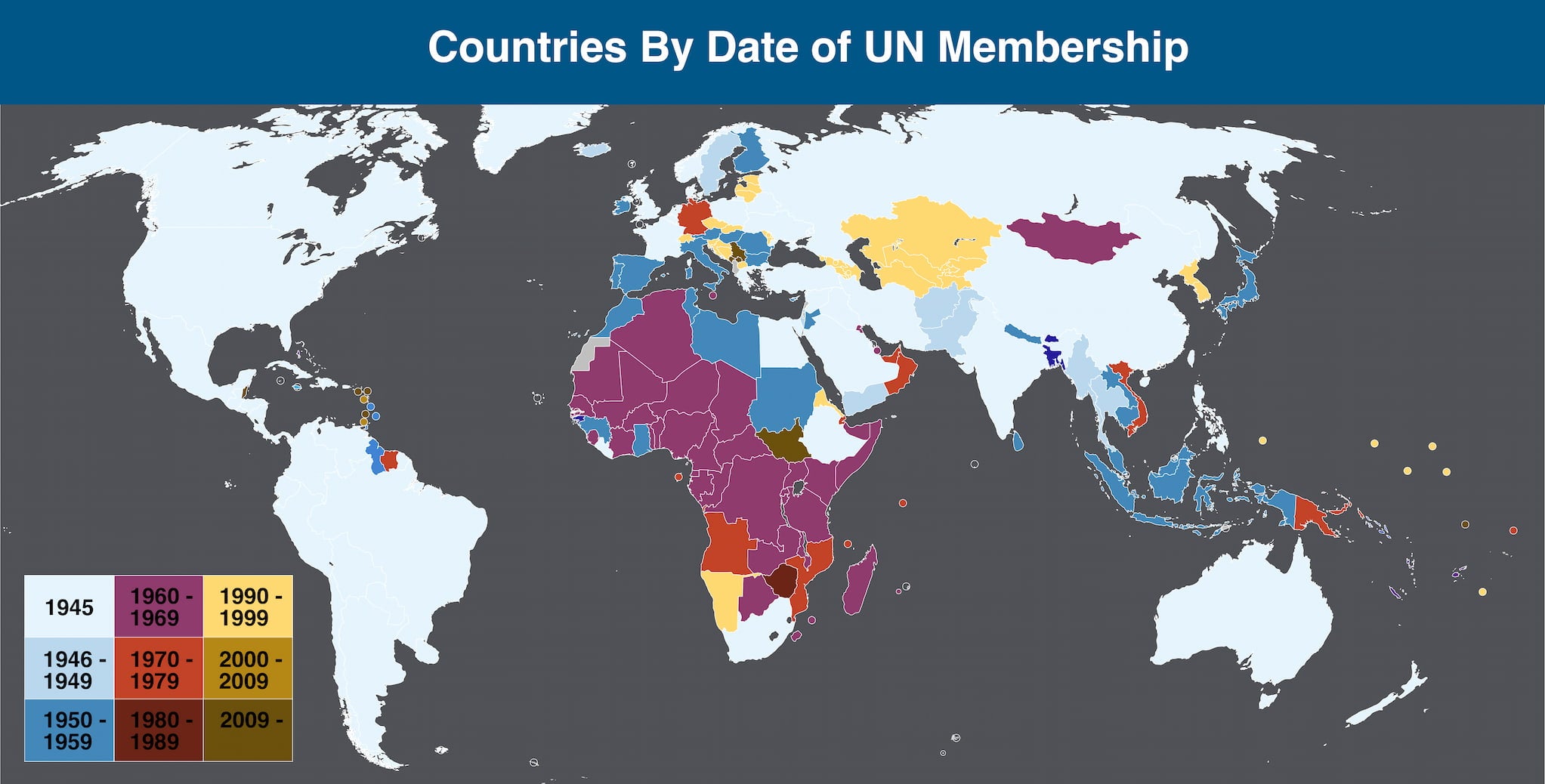
Image 20.04.01 — This map shows when countries joined the United Nations. A major wave of new member states between the 1940s and 1980s reflects an era of global political decolonization, as former colonies gained independence and international recognition.
In this module, we will learn what political decolonization, self-determination, and sovereignty are and how they are important to Pacific Islanders. We will also learn about some obstacles to self-determination, and ultimately get a better understanding of how Pacific Islanders are using political processes to achieve political decolonization.
What is the role of sovereignty in decolonizing the Pacific Islands?
What is the relationship between sovereignty and self-determination?
How do Pacific Islanders use political processes to achieve decolonization?
Self-Determination and Political Decolonization
Prior to World War II, much of the world was divided into places accepted as countries and their colonies. From large landmasses like India to island nations like Tuvalu, colonialism was found across the globe. After World War II, however, the tide of decolonization largely brought by former colonies helped to delegitimize empire as an acceptable form of organizing the world.
Scholars have described decolonization as “one of the four great determinants of geopolitical change in living memory,” 1 along with the world wars, the Cold War, and globalization. This shows decolonization’s role in changing the way the world looked, effectively ushering new countries into existence. This wave of decolonization was often accompanied by self-determination.
According to the first article of the founding document of the United Nations, the Charter, the purpose of the new organization was to “develop friendly relations among nations based on respect for the principle of equal rights and self-determination of peoples.” 2
The term self-determination can also be found in Article 55 and Article 73 of the Charter as well as in Human Rights Covenants. Many people fighting against colonialism have invoked the notion of self-determination. For example, Oscar Temaru, an independence leader in Maohi Nui (commonly known as French Polynesia), which is still colonized by France, says that self-determination is the natural evolution of a people. So, what is this term that many fighting against colonialism have invoked?
In 1960, the UN General Assembly passed Resolution 1514, also known as the “Declaration on the Granting of Independence to Colonial Countries and Peoples.” This resolution states, “All peoples have the right of self-determination; by virtue of that right they freely determine their political status and freely pursue their economic, social and cultural development.”
Self-determination boils down to the right of a people to determine their own destiny. In 1970, the UN General Assembly would also pass Resolution 2625, stating that “all peoples have the right freely to determine, without external interference, their political status.” Today, the right to self-determination is considered a fundamental principle that all countries are expected to uphold and respect. While self-determination is the right, decolonization is the pathway to restore that right. Decolonization is the method by which a place reaches a full measure of self-government.

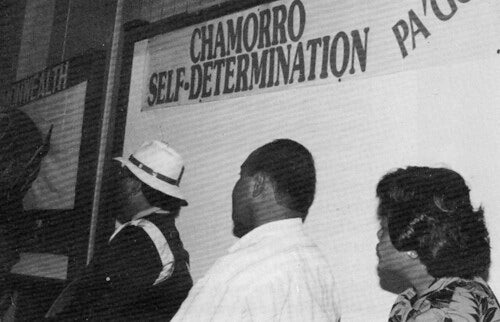
Image 20.04.02 — This 1980s photo shows an educational campaign hosted by Guåhan-based organization OPI-R, which sought to inform CHamorus of their right to self-determination.
Sovereignty and Obstacles
In the Pacific Islands today, there are twelve independent countries in Oceania (excluding Australia and New Zealand). Most of these twelve countries were once colonies of various world powers. Through decolonization, they all became independent and are now sovereign countries. Like self-determination, sovereignty is another word that is often used in international politics.
For example, we see the importance of sovereignty brought up in discussing Russia’s invasion of Ukraine. Former US Secretary of State Anthony Blinken told the Ukrainians that the US would stand by their side until their sovereignty is guaranteed. From Ukraine to Palestine, much blood has been spilled by those seeking to protect the sovereignty of their homeland. What is it about sovereignty that makes people fight to the death?
Traditional sovereignty can be defined as “the ability of a country to have independent freedom of action without external interference,” and “the ability of a country to shape its own destiny within the international arena.” 3 To put it another way, a country has sovereignty when it can make its own laws and rules within its territorial boundaries without external interference. While this is never truly the case, as the world is globalized and different countries are more powerful than others, possessing sovereignty (or having others recognize you as having sovereignty) is important. It helps protect a country’s place in the world and provide obstacles to others exercising unrestrained power over them.
Furthermore, in Indigenous and Pacific Islands studies, sovereignty refers to Indigenous peoples’ ability to govern themselves. Indigenous sovereignty envisions and imagines a different way of living that does not necessarily prioritize becoming one’s own country. Rather, it means having control of their way of life and being able to govern this way of life, free from colonial control.
For example, despite their size difference, a country like China or the US is not supposed to be able to tell other countries how to craft their electoral systems or their education systems. While countries have ways of influencing each other, being recognized as having sovereignty is a buffer against unwanted intrusion. The Pacific Islanders in those twelve countries have exercised their right to self-determination and have become sovereign countries today.
Yet, there are still places in the world, such as the US territories of Guåhan (Guam) and American Sāmoa, that belong to a list of places globally acknowledged as not yet exercising their right to self-determination. According to the United Nations, these kinds of territories are called non-self-governing territories (NSGT). A NSGT can be defined as a territory “whose peoples have not yet attained a full measure of self-government.” 4
In the same year that Resolution 1514 was passed, the UN also passed Resolution 1541, which outlined different methods for a colony to reach a “full measure of self-government.” 5 In doing so, the UN provided various paths for decolonization. These three paths were: emergence as a sovereign state (independence), free association with an independent state, or integration with an independent state (for example, a US territory becoming a full US state). All of these paths were deemed as options that would allow countries to have full political equality as long as they were chosen through democratic processes and represent the expressed wishes of the people of the territory.
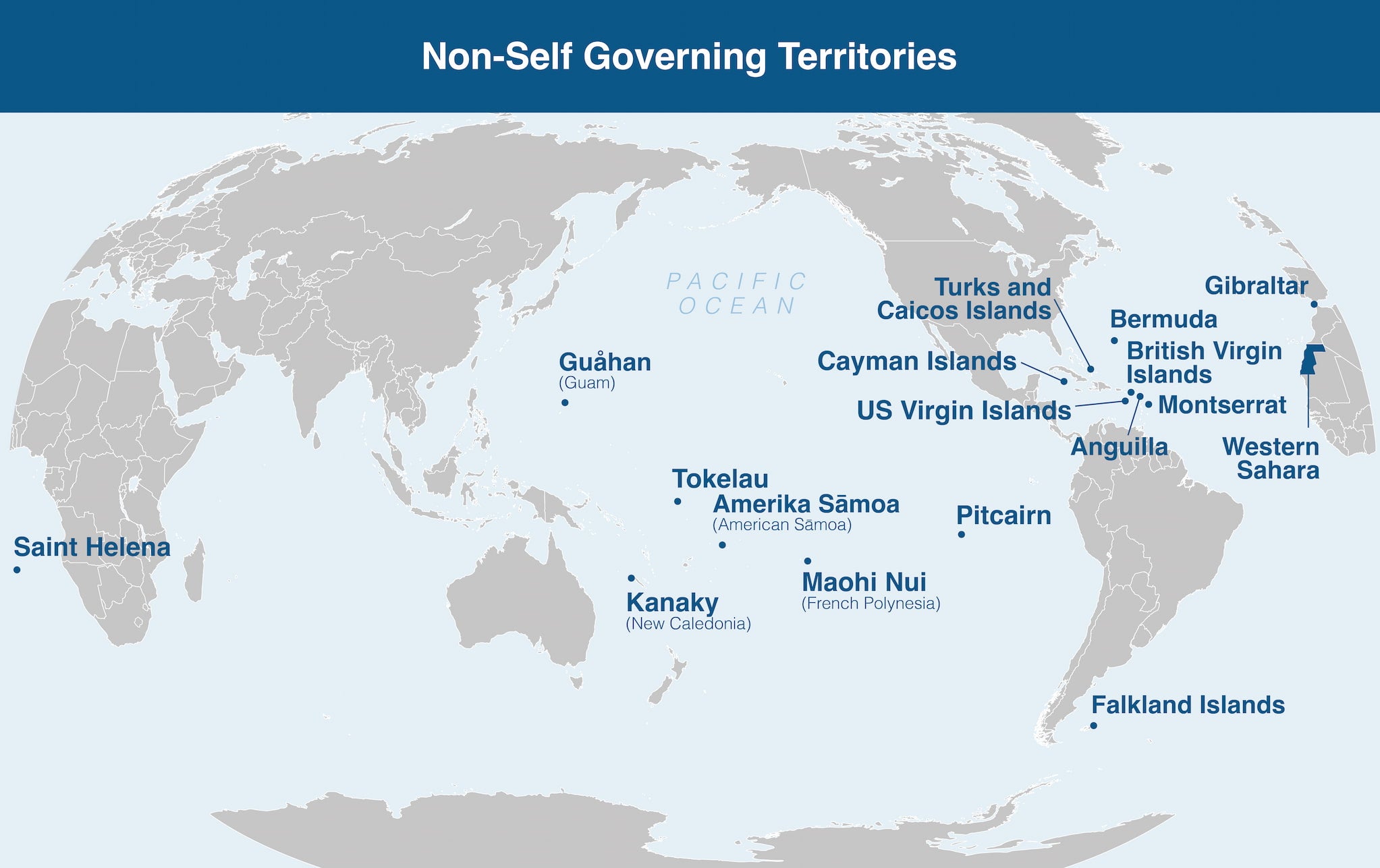
Image 20.04.04 — This map shows the Non-Self-Governing Territories (NSGTs) that have not yet achieved full self-government. There are currently six places in the Pacific that are on this map: 1) Guåhan (Guam), 2) American Sāmoa, 3) French Polynesia, 4) New Caledonia, 5) Pitcairn, and 6) Tokelau.
As of 2025, there are seventeen places left on this list. These non-self-governing territories are controlled by colonial powers, known as “administering powers.” Thus, the remaining countries in the world who the international community recognizes as essentially still having colonies are the US, the United Kingdom, France, and New Zealand.
It is important to note that the places on the list of non-self-governing territories has reduced immensely. While this appears to be a good trend, the problem emerges when one looks at the places that were taken off the NSGT list. For example, in 1960 there were seventy-two NSGTs, by 1970 there were forty-five, and by 1990 there were only roughly eighteen left. From 1990 to the present, only two places have been taken off the list.
Scholars refer to the period from 1990 to the present as the decolonization stagnation period. According to Carlyle Corbin, the present can be defined as the repetition of a process without implementation or accountability, which results in no actions being taken. It is not surprising that most of these remaining seventeen places on the NSGT list are islands located in the Caribbean or the Pacific Islands. Ultimately, this means that the political decolonization process in the Pacific Islands is incomplete. There are multiple reasons for this situation, such as fear of change and geopolitics.
For some NSGTs, there simply is not a coordinated effort or desire to change their political statuses. While many NSGTs will fight for political improvements, not all are united in their quest to become independent, freely associated with, or fully integrated into another country. From worries of economic decline to a lack of belief that they could govern themselves, these territories have what can be called a “dependency legitimation” mindset among some islanders. At the root of this mindset is a fear of change in their status. This will be explored much further in the next module when we talk about decolonization of the mind.
However, for those that desire a change in their political statuses, including active decolonization movements in places like Guåhan, Maohi Nui (French Polynesia), and Kanaky (New Caledonia), efforts are often blocked by colonial powers for multiple reasons. Returning to our last module, geopolitics is a key reason used to halt decolonization efforts.
As historian Stewart Firth once wrote, “Generally, the greater the strategic value of an island territory, the less likely that territory has been able to proceed to sovereign status. The map of Pacific Islands sovereignty has been drawn largely according to the strategic needs of external states.” 6 If Guåhan decolonized, then the US would lose its ability to do what it wants without permission on the island. If Kanaky decolonized, then France would lose a place that produces 25 percent of the world’s nickel. Great powers who deem an island to have strategic value will do what they can to hold onto their control of those places.
The sad reality of incomplete decolonization in the Pacific is that there are places that were either taken off the list of NSGTs too early without full political equality or that were never put on the list to begin with (as putting colonies on the NSGT list was a largely voluntary act).
One such example is West Papua, which was taken off the list in the 1960s. It is located on the eastern half of the island of New Guinea, which also consists of the independent country of Papua New Guinea. Once part of the Netherlands along with Indonesia, it remained part of the Netherlands while the rest of Indonesia became independent. The new country wanted to control West Papua and invaded the territory. In the 1962 New York Agreement, Indonesia would gain control of West Papua, and in 1969 there was an “Act of Free Choice” to determine the future of the territory. Indonesia interfered with this vote and chose only 1022 West Papuans to vote on behalf of their 800,000 people, leading to a vote favoring “integration with Indonesia.”
The reality today is that West Papuans are not only continuing to fight for their independence, but they are also facing a genocide, with nearly 500,000 West Papuans believed to have been killed. West Papuans rightfully argue that the “Act of Free Choice” was not an actual exercise of self-determination.
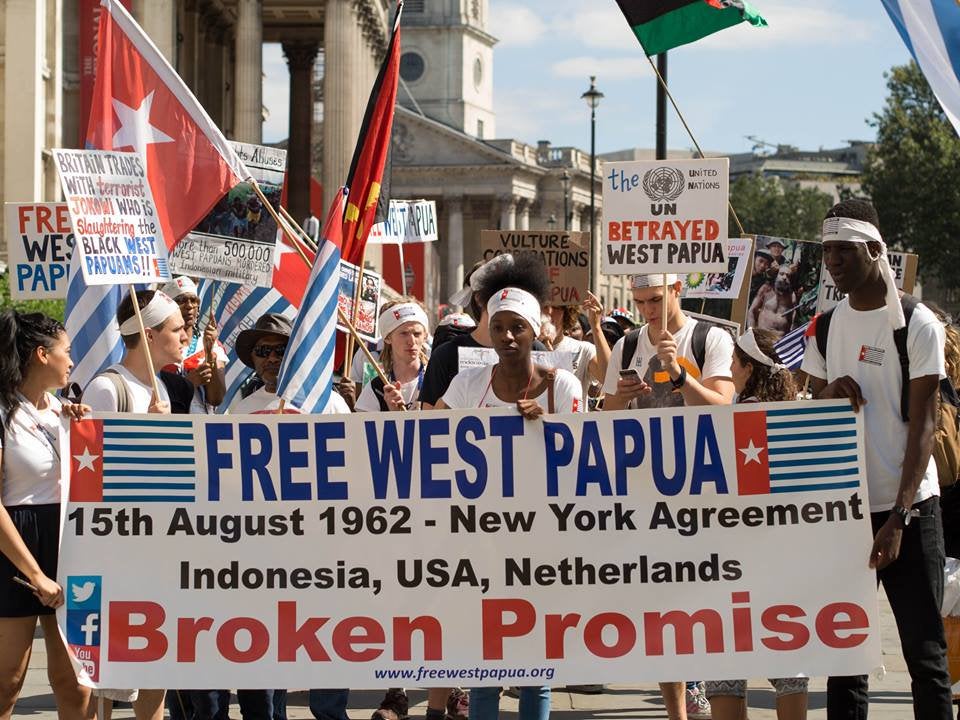
Image 20.04.05 — Protestors march for West Papua’s right to self-determination, raising the Morning Star flag as a symbol of independence. Flying this flag is considered illegal by Indonesian authorities and can result in arrest by the military.
Another example is Maohi Nui. The islands were taken off the list in 1947, as France generally did not want international oversight of their colonies. However, in 2013, the UN passed a resolution to place French Polynesia on the NSGT list. The resolution was largely sponsored by fellow Pacific Islands such as Solomon Islands, Nauru, and Tuvalu. This means that the islands are now recognized as not yet having exercised their right to self-determination and thus can transition to a political status that reaches a full measure of self-government.
Being on this list brings international oversight and international legitimation of a place’s non-self-governing status. As church leaders in Maohi Nui said, “The reinscription of Maohi Nui on this list constitutes one way to protect the people from decisions and initiatives of the French State that are contrary to their interests.” 7 Thus, there is now a pathway for Maohi Nui to move forward that is not yet available to West Papua.
Overall, the future of decolonization in the Pacific is hard to predict. There are many obstacles to decolonization that must be faced. One thing that is clear is that completing decolonization will largely require using the political processes outlined in international law. Even if this system is not perfect, it represents a component of political decolonization that cannot be ignored. Despite the flaws of international law, the Pacific Islands strive to use every process and avenue available to them. In Module Five, we will discuss another critical component to complete decolonization: the revitalization of culture and language.
Glossary terms in this module
colonialism Where it’s used
The process in which one country or people controls another place or people through partial or full political control for an extended period. Colonialism has lasting economic, social, and cultural effects even after the period of formal colonization is over.
empire Where it’s used
A collection of states and countries that is ruled or controlled by a single sovereign state.
free association Where it’s used
A political status in which a sovereign country establishes a special relationship with another country, usually a previous colonial power. This agreement between two countries includes, but is not limited to, economic packages and defense agreements. The Republic of Palau, the Republic of the Marshall Islands, and the Federated States of Micronesia all have separate agreements with the US, known as Compacts of Free Association (COFA).
geopolitics Where it’s used
The changing political and international relations that are tied to a place’s geography.
non-self-governing territory Where it’s used
A territory whose people have not yet attained a full measure of self-government. The United Nations established a list of places that meet this definition.
political decolonization Where it’s used
The process in which colonies form countries and gain control over their land, government, and destinies. Political decolonization breaks down having an empire as a way to govern the world, demanding instead for sovereignty and self-determination.
self-determination Where it’s used
The right of a people to freely determine their political status and freely pursue their economic, social, and cultural development without external interference. This right is recognized by the United Nations and is an important aspect of human rights.
sovereignty Where it’s used
The ability of a country to have independent freedom of action, such as making its own laws and rules without external interference. For Indigenous peoples, sovereignty means having control of their lands and way of life, free from colonial control.
Endnotes
1 Martin Thomas, The End of Empires and a World Remade: A Global History of Decolonization (Princeton University Press, 2024), 3.
2 United Nations, United Nations Charter (June 26, 1945).
3 Stewart Patrick, The Sovereignty Wars: Reconciling America with the World (Brookings Institution Press, 2017).
4 G.A. Res. 1514 (XV), Declaration on the Granting of Independence to Colonial Countries and Peoples (Dec. 14, 1960).
5 G.A. Res. 1514 (XV).
6 Stewart Firth, “Sovereignty and Independence in the Contemporary Pacific,” The Contemporary Pacific 1, no. 1/2 (1989): 75–76.
7 Nic Maclellan, “‘Hijacking Decolonisation’: French Polynesia at the United Nations,” Inside Story, May 31, 2013.