





Module 4: Black Liberation and Afro-Asian Solidarity
Do Yuri Kochiyama’s life experiences explain her political consciousness, solidarity, and activism?
Yuri Kochiyama’s move from midtown New York City to Harlem drew her into Black struggles for justice. Through this work, she met Malcolm X, a pivotal friendship that would transform her political ideas and social practice. This module explores her early work in the Black Liberation Movement, political development and ideas about race and racism, and the meanings and impact of Afro-Asian solidarity.
How did living in Harlem, New York City, shape Yuri Kochiyama’s politics?
How did other people shape Yuri Kochiyama’s views on race and racism?
What did Afro-Asian solidarity look like to Yuri Kochiyama?
Harlem in the 1960s
Yuri Kochiyama found Harlem to be “a university without walls.” Many Black leaders and people lived there, including Rev. Dr. Adam Clayton Powell, Sr. and Madame C.J. Walker. The Black nationalist and Pan-Africanist Marcus Garvey made Harlem the base of operations for his worldwide Universal Negro Improvement Association. Distinguished writers such as Langston Hughes, James Weldon Johnson, and Zora Neal Hurston also made Harlem their home, as well as jazz greats such as Duke Ellington and Ella Fitzgerald.
When the Kochiyamas moved to Harlem in 1960, the area was predominantly Black and poor and alive with protests stemming from its history of Black consciousness and cultural pride. There were rent strikes, citywide school boycotts, labor strikes, and demonstrations against police brutality and against the war in Vietnam. She noted in her 2004 memoir that Harlem was the social, political, and cultural center of Black music, literature, art, and politics in the 1960s.
The Kochiyamas could not have predicted that their new home in Harlem would become a gathering space for countless activist meetings and events. This is the environment that shaped Yuri’s activism and became her home for the next fifty years. She believed that Harlem also shaped her children by exposing them to the heart of the Civil Rights Movement. All six of the Kochiyama children began marching with their parents at civil rights events. Yuri wrote, “I am proud of how much my children have in their own way come to understand the importance of justice and to stand up on behalf of others.” 1 Harlem represented a broad spectrum of backgrounds and peoples who worked toward the common goal of Black liberation, political struggles, and cultural production.
Meeting Malcolm X
Yuri Kochiyama met Malcolm X for the first time at a Brooklyn courthouse on October 16, 1963, where Yuri was among the hundreds of activists charged with disorderly conduct for blocking a construction site. She noticed him encircled by enthusiastic, young, Black activists from the moment he entered. As an older Asian woman, Yuri was hesitant to approach him, but she eventually asked if she could shake his hand. This was the beginning of a deep reflection and expansive growth for her.
At the time, Yuri’s views regarding social justice and Black rights were heavily influenced by the ideas in the Civil Rights Movement. If racial segregation was a major social problem, then would not integration, or the coming together of different groups, seem like the solution? Her views about integration would later change, influenced by Malcolm X.
She heard Malcolm X debating the idea of integration with other Black movement leaders. She was surprised that of all the speakers, she found Malcolm X the most compelling. She was moved to write to him, questioning whether he believes integration may be possible if people of color could gain his trust and earn his confidence. As these words show, Yuri supported integration as an ideal goal with the caveat that required non-Black people to treat Black people with genuine equity and fairness.
Reflection Question
What is the difference between assimilation and integration?
Fannie Lou Hammer and a New Understanding of Racism
Integration is commonly viewed as the social process wherein newcomers or immigrants are incorporated into mainstream society. In the US, such a process is often referred to as a “melting pot” which connotes a one-way process where so-called outsiders assimilate into the dominant society by giving up their cultural identity and adopting the dominant culture. This is categorically different from the meaning of integration or pluralism that means coexistence of minority groups and dominant culture with the preservation of diverse traditions.
In the Brooklyn courtroom on the day Yuri Kochiyama challenged some of Malcolm X’s ideas on integration, Malcolm X invited Yuri to attend his Organization of Afro-American Unity (OAAU) Liberation School in Harlem. She attended every Saturday morning from December 1964 until the school closed in April 1965. Along the way, she gained a new understanding of race, racism, and the world.
On Yuri’s first day at the OAAU Liberation School, she discovered a broad spectrum of Black nationalists who surrounded Malcolm X. Their open-mindedness differed from media depictions that showed narrow Black separatists. She met James Shabazz at the school, who spoke some Japanese, Korean, and Chinese, and discussed the links between Africans and Asians. He suggested that the spirituality at the heart of both Asian martial arts and Islam helped people move to God.
At weekly study sessions, Yuri gradually transformed her ideas from understanding racism as individual bigotry or an unfortunate exception to a systematic and deeply embedded set of ideas within US history and institutions. During her second class at OAAU, she heard a tape-recording of Fannie Lou Hamer, the renowned leader of the Mississippi Freedom Democratic Party, describing the life of poverty that she and other poor Black people experienced in Mississippi. Hamer’s mother earned about eleven cents an hour chopping tree stumps.
While working towards Black voting rights, Hamer was jailed. The prison authorities had two prisoners beat Hamer mercilessly. Yuri further learned about the cross-Atlantic slave trade and the structures that kept Black people subordinate to whites especially after the end of slavery in 1865. This included convict-leasing and sharecropping that created significant barriers to economic self-sufficiency for Black people. Her views were changing rapidly especially in light of Malcolm X’s ideas about the concept of self-determination.
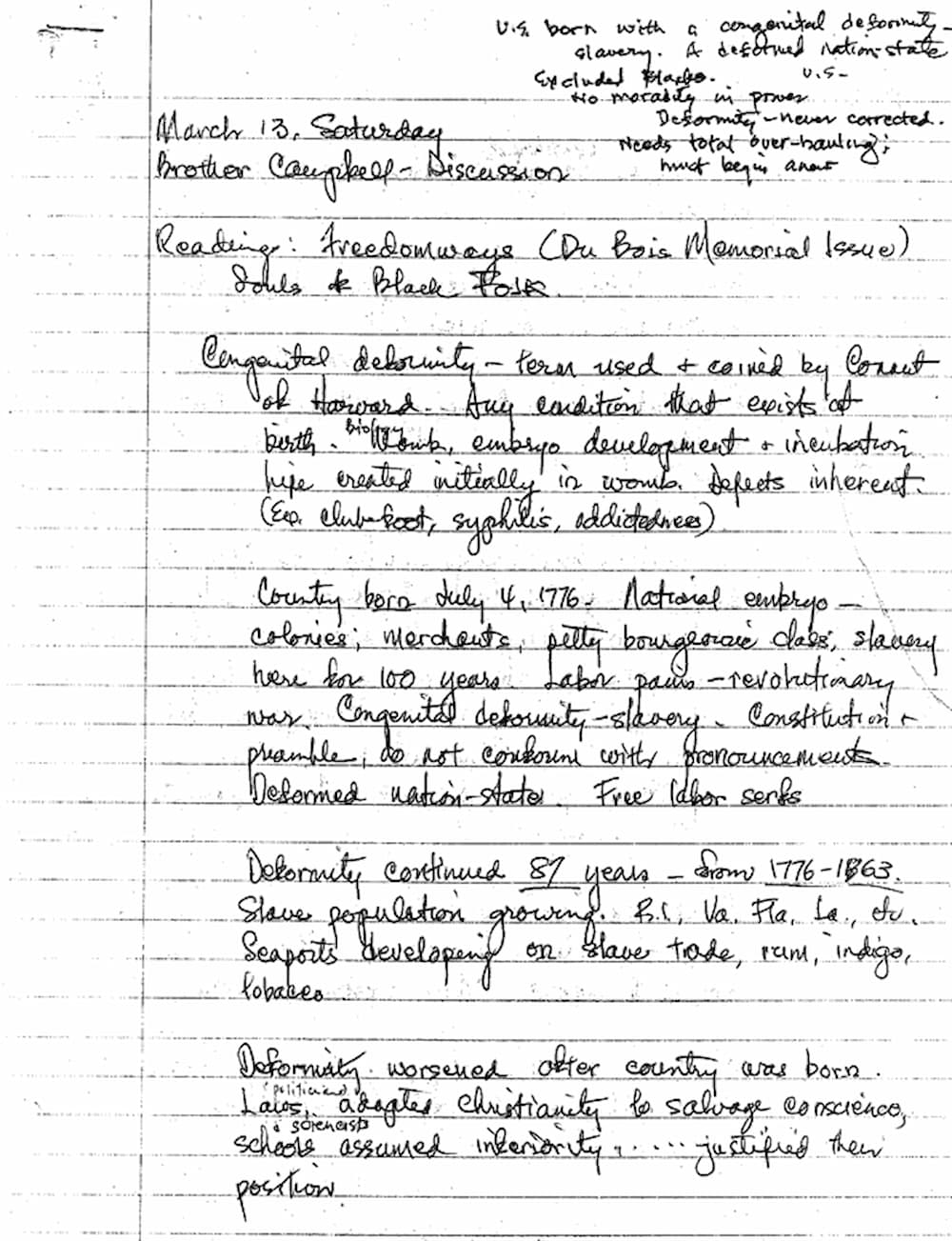
Text 38.04.01 — Yuri Kochiyama’s notes from her attendance at the Organization of Afro-American Unity Liberation School reveal her evolving understanding of race and racism. She writes at the top, “US born with a congenital deformity – slavery.”
Afro-Asian Solidarity
Yuri Kochiyama soon joined the Black Power Movement, listening to and learning from those around her. Her presence as a middle-aged woman of Asian descent and a mother of six elicited several responses from the Black activists around her. Some questioned why she was participating, but most Black activists welcomed her. They came to value her organizing experience, knowledge, and persistence in the face of struggle.
Yuri demonstrated solidarity through her commitment. She attended meetings, programs, and marches. She worked consistently to host meetings at her apartment, write to political prisoners, organize events, and build organizations and campaigns. She framed social problems through structural analyses that centered anti-Black racism, economic exploitation, and national oppression. She promoted Black leadership and yet was also willing to take up leadership positions when needed. She became part of the decision-making and organizing management in Black organizations as Black activists grew to trust her dedication and shared values for Black liberation.
Many in the Black Power Movement also recognized the structural racism and colonialism that impacted Japanese and Asian Americans, and they built common ground with their Asian cohorts and colleagues like Yuri. In this sense, Afro-Asian solidarity was built upon the racist, militarist, and capitalist logic that caused the wartime incarceration of Japanese Americans, US atomic bombings of Hiroshima and Nagasaki, US military presence in Okinawa, and the US wars in Korea and Vietnam. They were not promoting the idea that conditions facing Asian Americans were the same as the conditions impacting Black Americans, but they were acknowledging that these oppressions were linked.
Yuri herself spoke regularly about the particularly brutal conditions affecting Black communities, from slavery and Jim Crow laws to segregation and police brutality. Her activism and political consciousness was based upon a practice and ideology that centered Black liberation and built solidarity against racism and capitalist exploitation. She learned that liberation did not mean one had to choose one fight over others, and that she could support Black liberation at the same time that she worked toward Third World solidarity. Yuri’s activism, thus, demonstrates the expansive practice of Afro-Asian solidarities.
From Hiroshima to Harlem
In June 1964, three Japanese writers traveling the world with the Hiroshima/Nagasaki World Peace Mission Study came to Harlem to witness the segregation and slums that gave rise to Black protests. More than any other person, they wanted to meet Malcolm X. An American peace group, aware of Yuri Kochiyama’s connection with Malcolm X, asked her to arrange a meeting. On Saturday, June 6, 1964, the Kochiyamas’ home was overflowing with Black and white civil rights activists, many from the newly formed Harlem Parents Committee and Harlem Freedom School, along with concerned Japanese Americans. All of a sudden, there was a knock on the door and in walked Malcolm X.
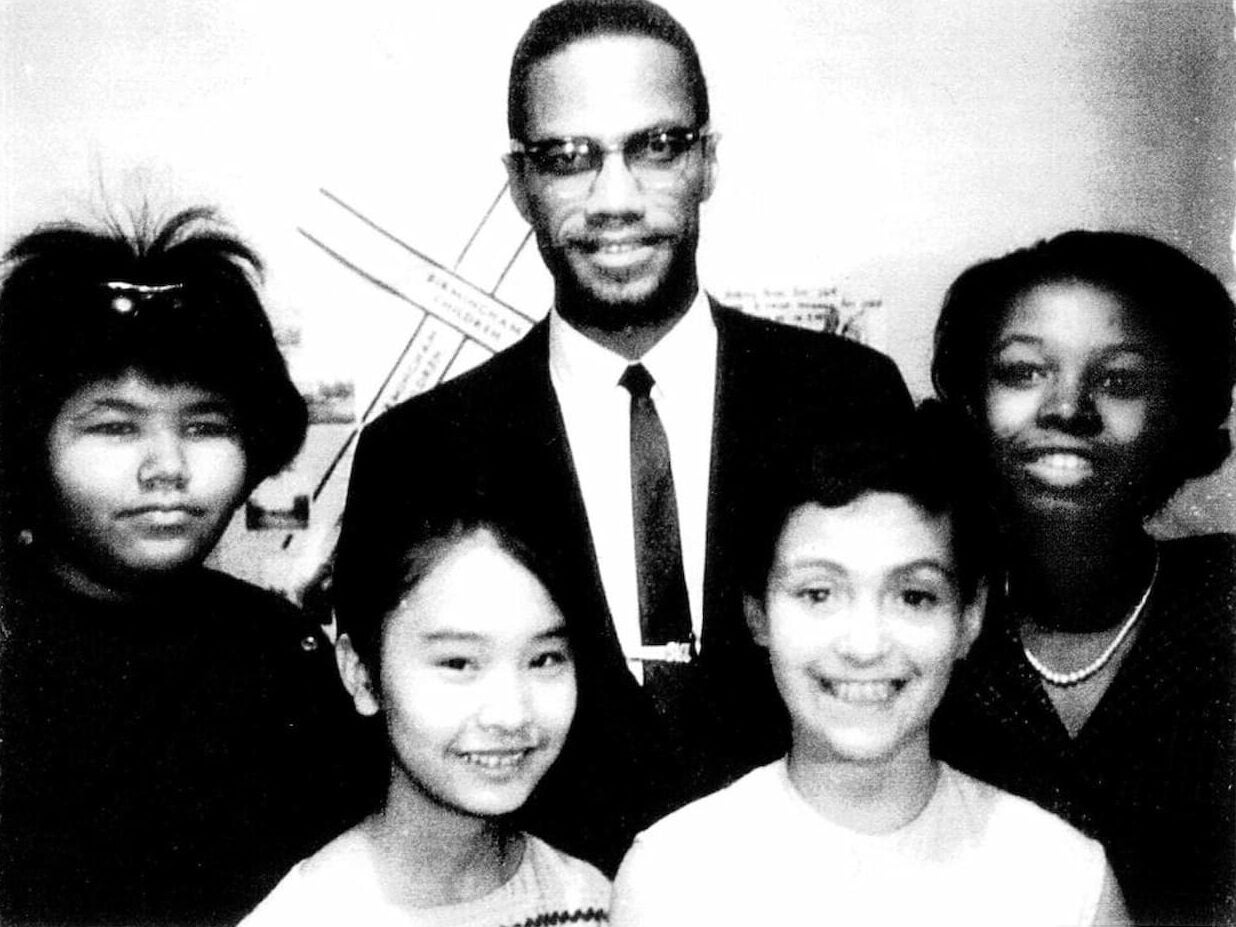
Image 38.04.02 — Malcolm X visited the Kochiyama home in June 1964 to meet hibakusha, or survivors of the US atomic bombing of Hiroshima and Nagasaki, during their world tour. Yuri Kochiyama’s daughter, Audee, is second to left.
Yuri remembered that Malcolm said to the Japanese writers, “You have been scarred by the atom bomb. You just saw that we have also been scarred. The bomb that hit us is racism.” 2 He discussed the time he spent in prison and the effort he took to read everything he could get his hands on, including Asian history. He said that almost all of Asia, like Africa, was colonized except for Japan, which did not have the natural resources like other Asian countries. Thus, Japan was able to develop and remain intact until World War II when she was defeated. He also articulated that the struggle in Vietnam against the US was a struggle against American colonialism, neo-colonialism, and imperialism.
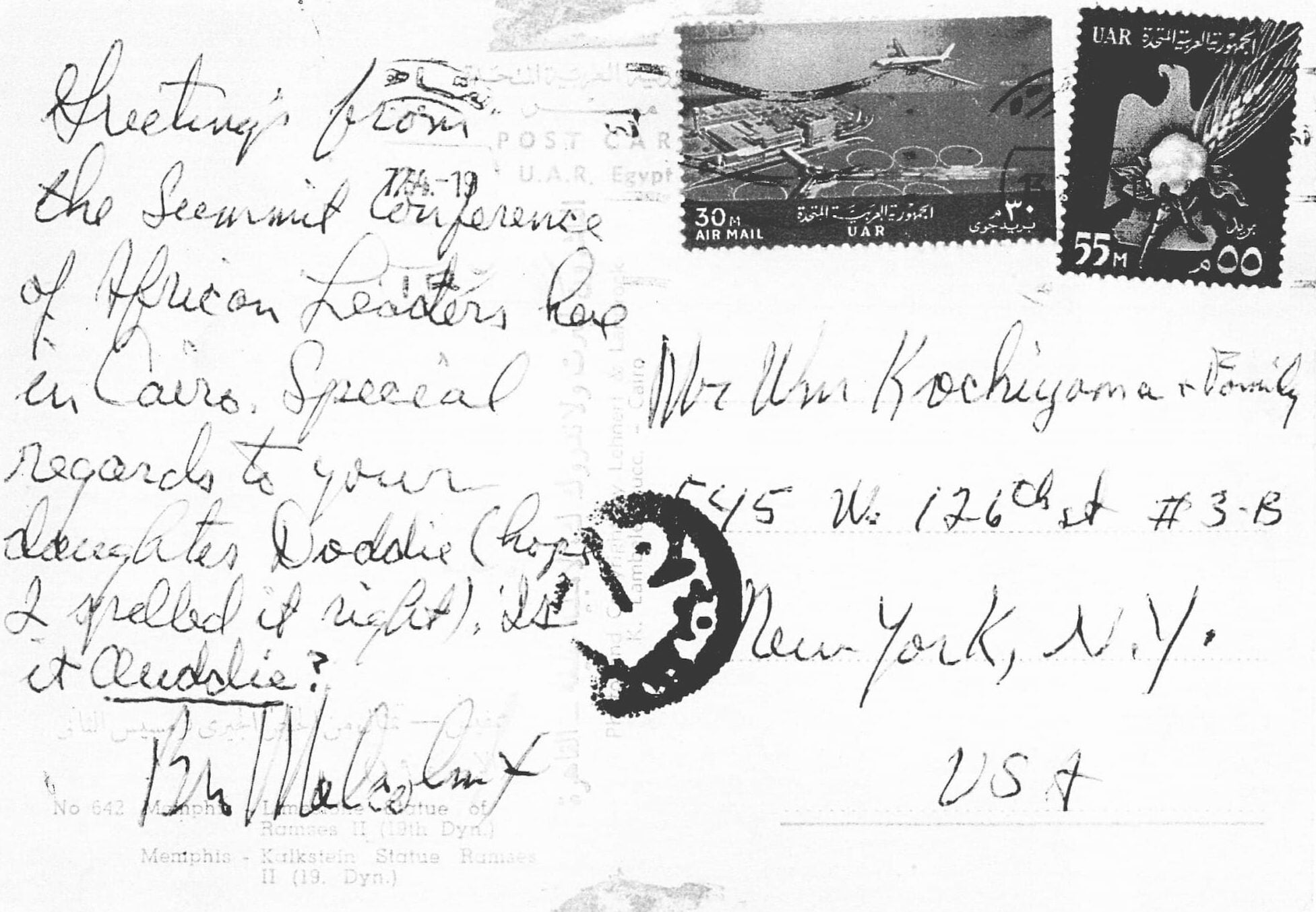
Image 38.04.03 — One of eleven postcards Malcolm X sent to the Kochiyamas from his travels abroad. This one is postmarked from Cairo in 1964.
Yuri knew that Malcolm X was ahead of his time. Though he only lived for one more year after their meeting, he predicted much of his future at the time of their meeting. Indeed, just two months after his visit to the Kochiyamas’ home, the United States began its offensive in Vietnam.
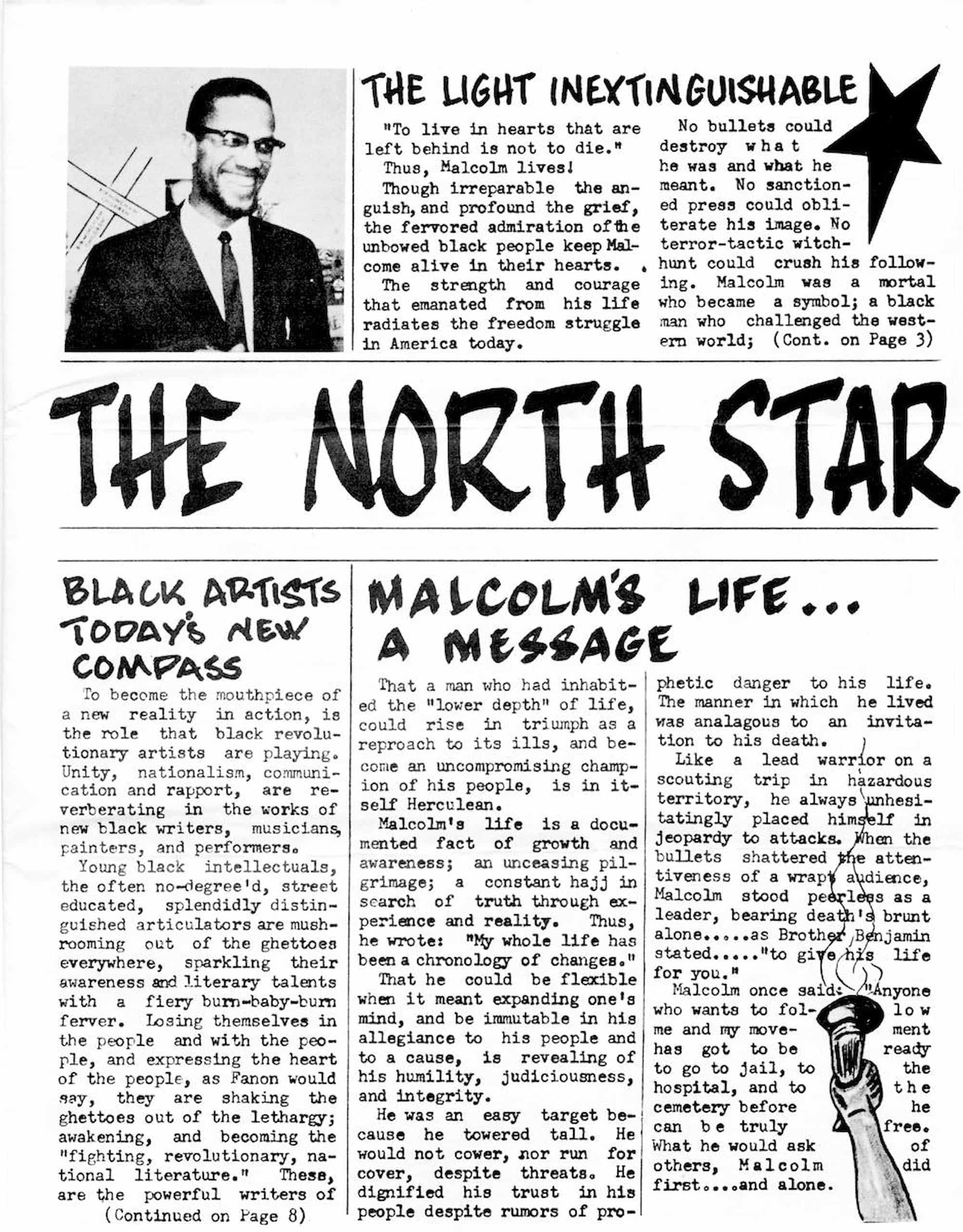
Image 38.04.04 — Kochiyama’s family newsletter The North Star started in December 1965 to honor Malcolm X.
Japanese Americans and Black Reparations
Yuri Kochiyama’s Afro-Asian solidarity also spotlights Black reparations. In the 1980s, as Yuri participated in the movement to gain redress for Japanese Americans like herself who were incarcerated during WWII, she consistently raised the issue of Black reparations for the ongoing impacts of slavery.
While the National Coalition for Redress/Reparations and a few other Japanese Americans advocated for Black reparations, the mainstream Japanese American redress movement did not. Yuri did not want to detract from the strategy for gaining Japanese American reparations, but she believed it was necessary to call for reparations for other oppressed groups as well.
In fact, she believed that if the government were to redress injustices stemming from its racist practices, then the Black community, which has suffered such severe oppression for so long, should be the first to be compensated. This was a position that centered the harshness of anti-Black racism in the United States. Today, Japanese American groups like Tsuru for Solidarity and Nikkei Progressives are still working for Black reparations.
Listen to
An interview with activists Kathy Masaoka and traci kato-kiriyama
Audio 38.04.05 — Hear activist Kathy Masaoka of the Nikkei Progressives discuss Japanese American organizing for Black Reparations on Pay the Tab. Masaoka testified before Congress in 2021 in support of Black Reparations bill HR 40. Artist-activist traci kato-kiriyama asks: Why do we hear so little about Black-Asian solidarity?
Conclusion
The political ideas that Yuri Kochiyama learned in Malcolm X’s OAAU would shape and transform her activism and political consciousness. She was as dedicated to her activities and protests for reclamation and reparations for Japanese Americans’ lives impacted from incarceration, atomic bombings and racist and militarist takeovers as she was toward the Black Power Movement. Her unfailing organizing for and consistent showing-up for Black justice after Malcolm X’s assassination grounds her work toward Afro-Asian solidarity.
Glossary terms in this module
activism Where it’s used
The actions and philosophies that people practice to create positive change in their communities.
Black Power Movement Where it’s used
A revolutionary movement formed in the 1960s and 1970s that stressed self-determination, economic empowerment, the celebration of Black cultural accomplishments, and the creation of political and cultural groups to serve the interests of Black people.
Civil Rights Movement Where it’s used
A mass movement in the 1950s and 1960s calling for an end to segregation and discrimination against Black people, and sought legal protections of civil rights and freedoms. A series of sit-ins, boycotts, and marches were carried out as well in order to accomplish these goals.
political consciousness Where it’s used
One’s understanding and awareness of political issues and ideology, and how these things shape society and one’s life experience.
political prisoners Where it’s used
People who are imprisoned for their political actions, beliefs, or affiliations.
redress Where it’s used
To right a wrong or injustice, often through compensation. During the redress movement, many activist groups fought to gain reparations for Japanese Americans who were wrongfully incarcerated during World War II. These activists sought for the restoration of Japanese Americans’ civil rights, compensation for lost property, and a formal national apology.
reparations Where it’s used
The acknowledgment and making of amends of a group or person who has been wronged, or who has experienced human rights violations, often through paying a sum of money.
solidarity Where it’s used
A political, cultural, and collective stance that recognizes the mutual responsibility and support that is necessary to achieve change. Taps into the power in numbers and considers the collective interests of communities.