




Photo of indoor mural with drawings of Yuri Kochiyama and Malcolm X. A tiger and a panther roaring are placed front of Yuri and Malcolm X.
Module 7: Legacy of Yuri Kochiyama
Do Yuri Kochiyama’s life experiences explain her political consciousness, solidarity, and activism?
Yuri Kochiyama dedicated a lifetime to the struggle for justice from creating solidarity between the African American and Asian American Movements to writing and supporting political prisoners and especially organizing internationalist actions against US militarism. The module concludes by exploring her legacy as one of the most renowned Asian American woman activists in US history that spans multiple movements and numerous decades.
This module examines Yuri Kochiyama’s life after the 1960s and 1970s. Her political efforts included the Japanese American redress movement and mobilizing Asian Americans in California after her move to Oakland.
How did Yuri Kochiyama’s activism and politics evolve over time?
What is Yuri Kochiyama’s legacy?
How can we remember Yuri Kochiyama today?
Japanese American Redress Movement
During World War II, the US government singled out Japanese Americans for forced removal and incarceration. Japanese Americans lost not only their homes and jobs but also their land and rights. They were forced to move into barracks in harsh conditions. Inspired by the Asian American Movement, Japanese Americans launched a movement for redress and attempted to right the wrongs through a demand for reparations in compensation for past injustices and wartime imprisonment. The community began to speak out about the concentration camps, breaking a long silence.
One major event of the redress movement was the establishment of the Congressional Commission on Wartime Relocation and Internment of Civilians (CWRIC) hearings that took place in multiple cities across the US and Canada. However, New York City was not one of the sites. The Commission’s neglect of New York motivated the Kochiyamas and others to form the East Coast Japanese Americans for Redress (ECJAR). It took tremendous organizing for ECJAR activists to gain a CWRIC hearing in their city, educate the community about the incarceration, and reach out to people to testify before the Commission.
When the CWRIC hearings began in 1981, Yuri Kochiyama testified at the first hearing in Washington, DC. Bill Kochiyama chaired ECJAR’s media committee and also testified at the CWRIC hearing in New York City. He spoke about the racism he had faced, the jobs he was denied, and the subjugation to discrimination as a second-class citizen. The East Coast redress activists worked with artist Byron Goto to create large art panels about the concentration camp experience. But the CWRIC refused to allow the poster to be displayed in the lobby of the hotel where the hearings took place. Being stymied, ECJAR activists devised an alternative plan.
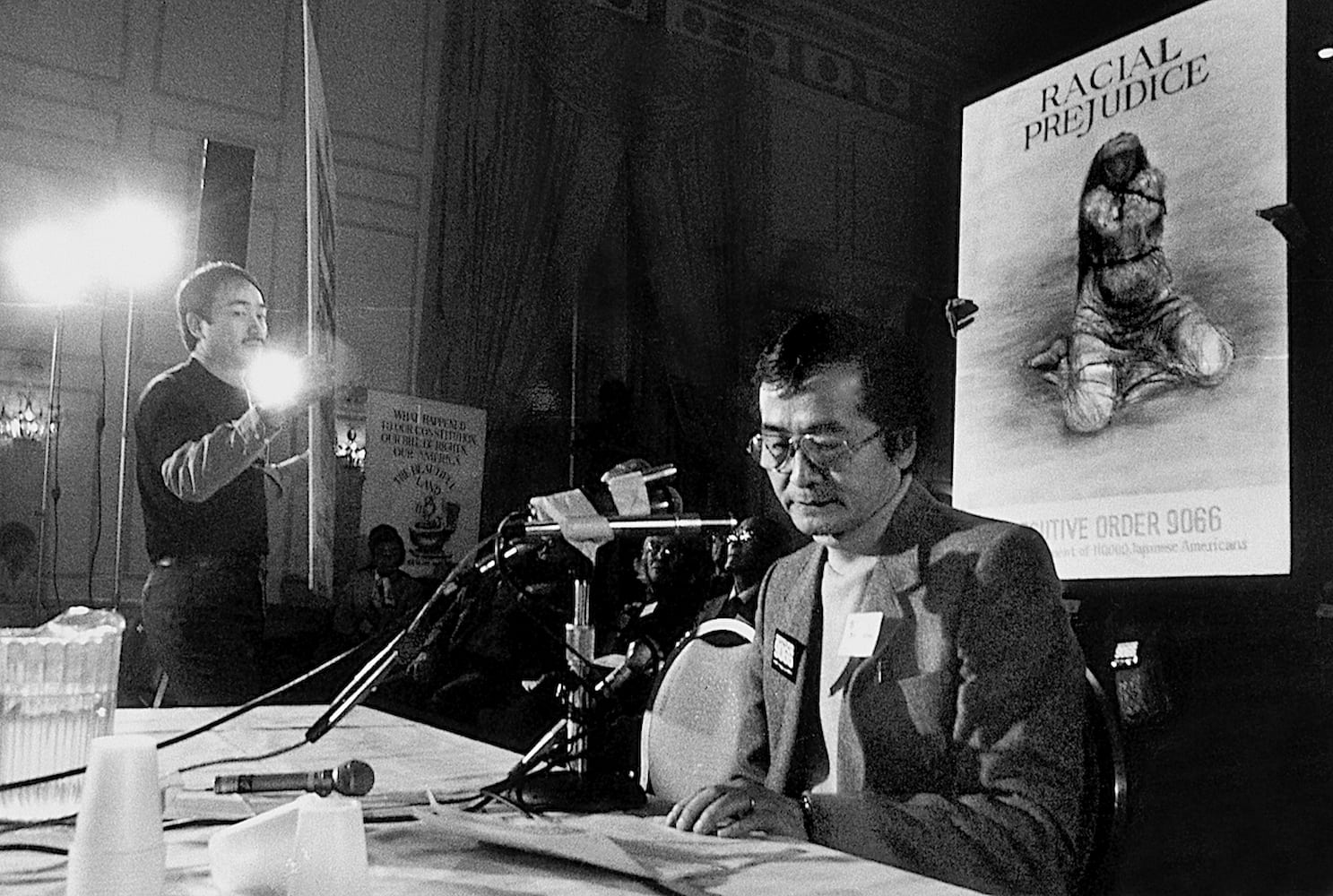
Image 38.07.01 — Bill Kochiyama testifies about his concentration camp experiences at the New York Congressional Commission on Wartime Relocation and Internment of Civilians (CWRIC) hearings, November 23, 1981, with New York activists displaying Bryon Goto’s posters behind him.
During Bill Kochiyama’s testimony, activists marched down the aisle with the political posters and held the posters behind him during his testimony. One poster had the words “concentration camp” across an American flag in the shape of a Nazi swastika and a person behind barbed wire. It read: “My country ‘tis of thee, sweet land of liberty. How come Japanese Americans were imprisoned?” The hearings were widely covered by the media, which then broadcast the posters nationwide and in Japan as well.
In 1988, after nearly two decades of redress struggle and some forty-seven years after Japanese Americans were incarcerated, the US Congress passed the Civil Liberties Act, and President Ronald Reagan signed it into law. This legislation granted a 20,000 dollar payment to each incarceree alive at the time of the bill’s passage, established a public education fund, and offered an official apology from President Reagan.
The redress movement gained reparations as well as a partial healing for the community, moving the shame of and culpability for incarceration from the Japanese American community to the US government. Still, the Civil Liberties Act did not fully right the wrong. The work to right past wrongs was not over as redress activists continued to fight for redress for not only Japanese Americans but also for Black reparations, or action and compensation to address the horrors of slavery and its ongoing effects.
Moving to Oakland
After living in New York City for more than fifty years, including forty in Harlem, Yuri Kochiyama moved to Oakland, California, in 1999. She suffered from poor physical health and depression. As her children were living in California, Yuri made the difficult move, and ultimately came to appreciate the opportunity to work with activists in California, especially in the Bay Area.
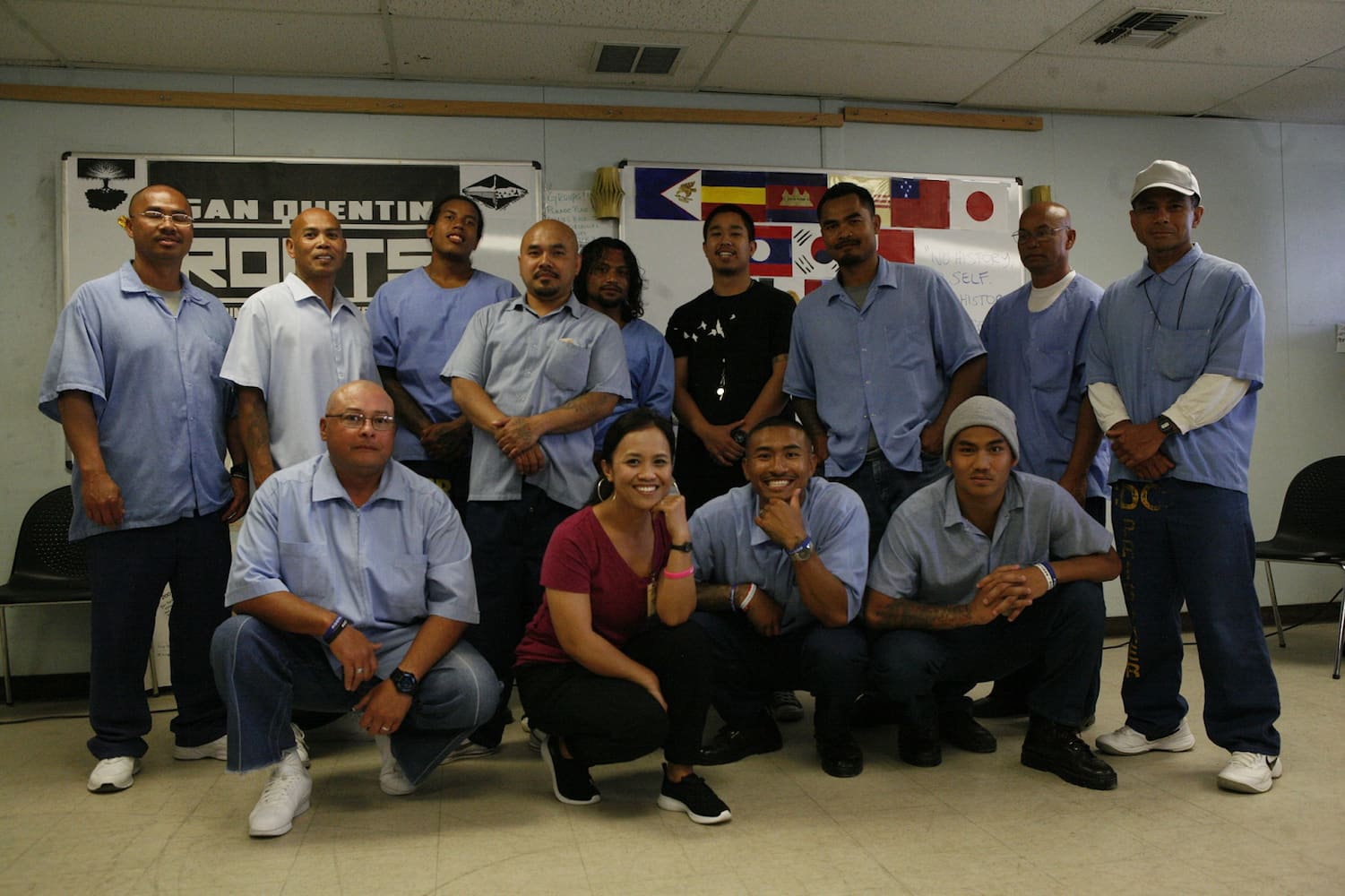
Image 38.07.03 — Yuri Kochiyama inspired the formation of the Asian Prisoner Support Committee (APSC). The APSC, formed in 2002, has organized against Southeast Asian deportation cases, led programs in prisons, and designed culturally relevant reentry programs.
Yuri started writing to Eddy Zheng, a young Chinese immigrant in San Quentin’s prison just north of San Francisco. After Eddy Zheng, Viet Mike Ngo, and Rico Riemedio were put in solitary confinement for working to establish ethnic studies in the San Quentin prison, Yuri helped them form the Asian Prisoner Support Committee (APSC). Indeed, Zheng credits Yuri as a major force behind the APSC and providing him with hope and inspiration while in prison. The experiences of Asian American prisoners and APSC’s work are featured in many anthologies, documentaries, and articles.
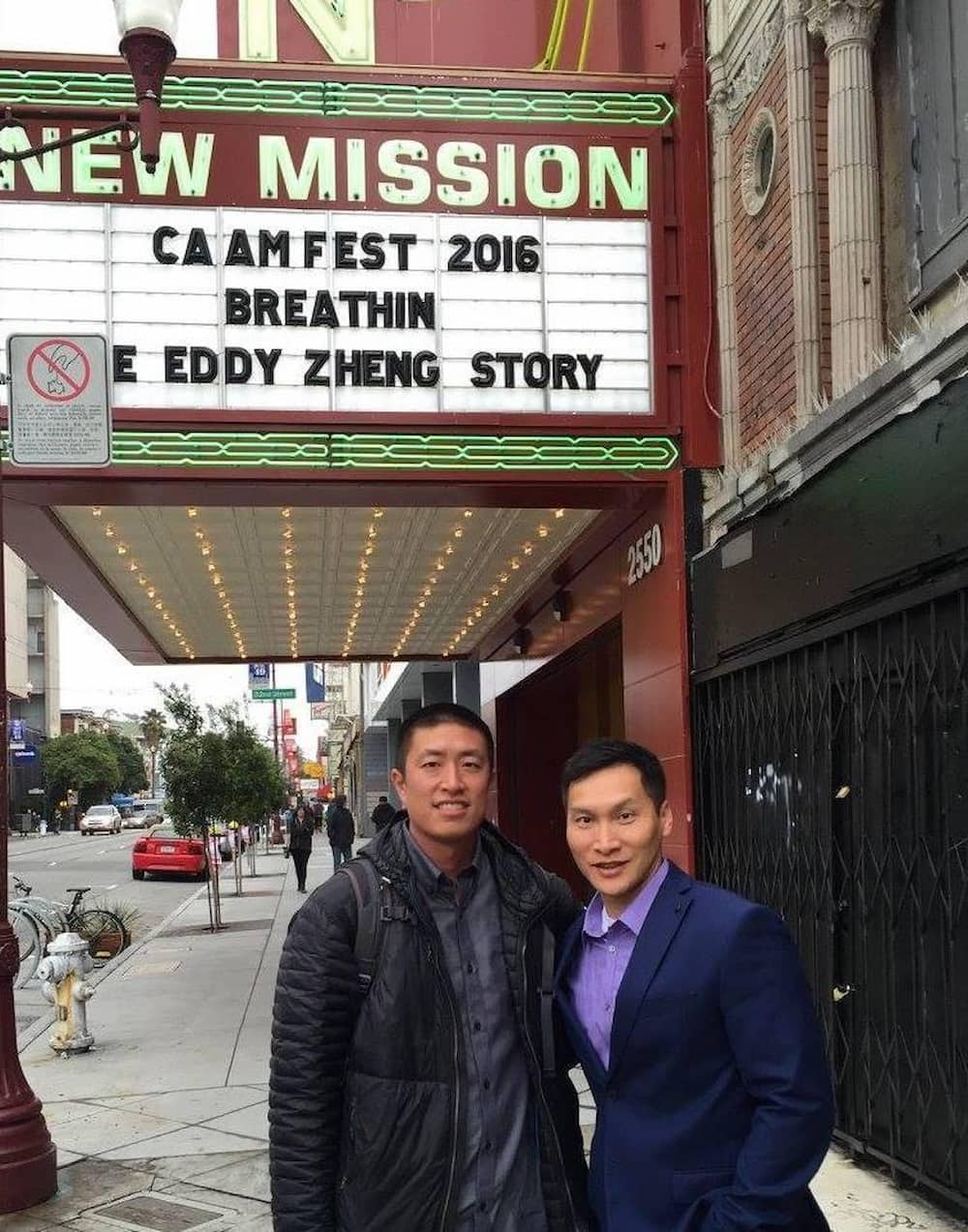
Image 38.07.04 — Eddy Zheng (right) and filmmaker Ben Wang (left) at a screening of the documentary Breathin’: The Eddy Zheng Story (2016) in San Francisco, California.
Living in Northern California also meant that Yuri could visit with people like Kiilu Nyasha, a former Black Panther, journalist, and Black liberation and disability rights activist who lived for nearly forty years in San Francisco’s Chinatown. She also regularly made visits to see Marilyn Buck, a white political prisoner who dedicated her life to Black liberation. California-based activists, whether old friends or new acquaintances, were thrilled to meet Yuri or visit her at her apartment or participate in activist struggles arm-in-arm with Yuri.
Legacy
Yuri Kochiyama worked for decades as a local grassroots activist. She was highly respected by activists nationally in the Asian American, Black, and political prisoner movements as well as in Japan. However, outside of the politically active circles, she was relatively unknown.
That began to slowly change in the 1990s when filmmakers Pat Saunders and Rea Tajiri released the documentary titled Yuri Kochiyama: Passion for Justice (1993) which exposed Yuri’s activism to a broader audience. At this time, Asian American college students invited her to speak on the college circuit.
In the early 2000s, two books focused on her life and politics: UCLA Asian American Studies Center published Yuri’s memoir, Passing It On (2004), and a biography was published about her life titled Heartbeat of Struggle: The Revolutionary Life of Yuri Kochiyama (2005). A second documentary titled Mountains that Take Wings: Angela Davis & Yuri Kochiyama: A Conversation of Life, Struggle, and Liberation (2009) showed Yuri in conversation with the legendary Black feminist Angela Davis.
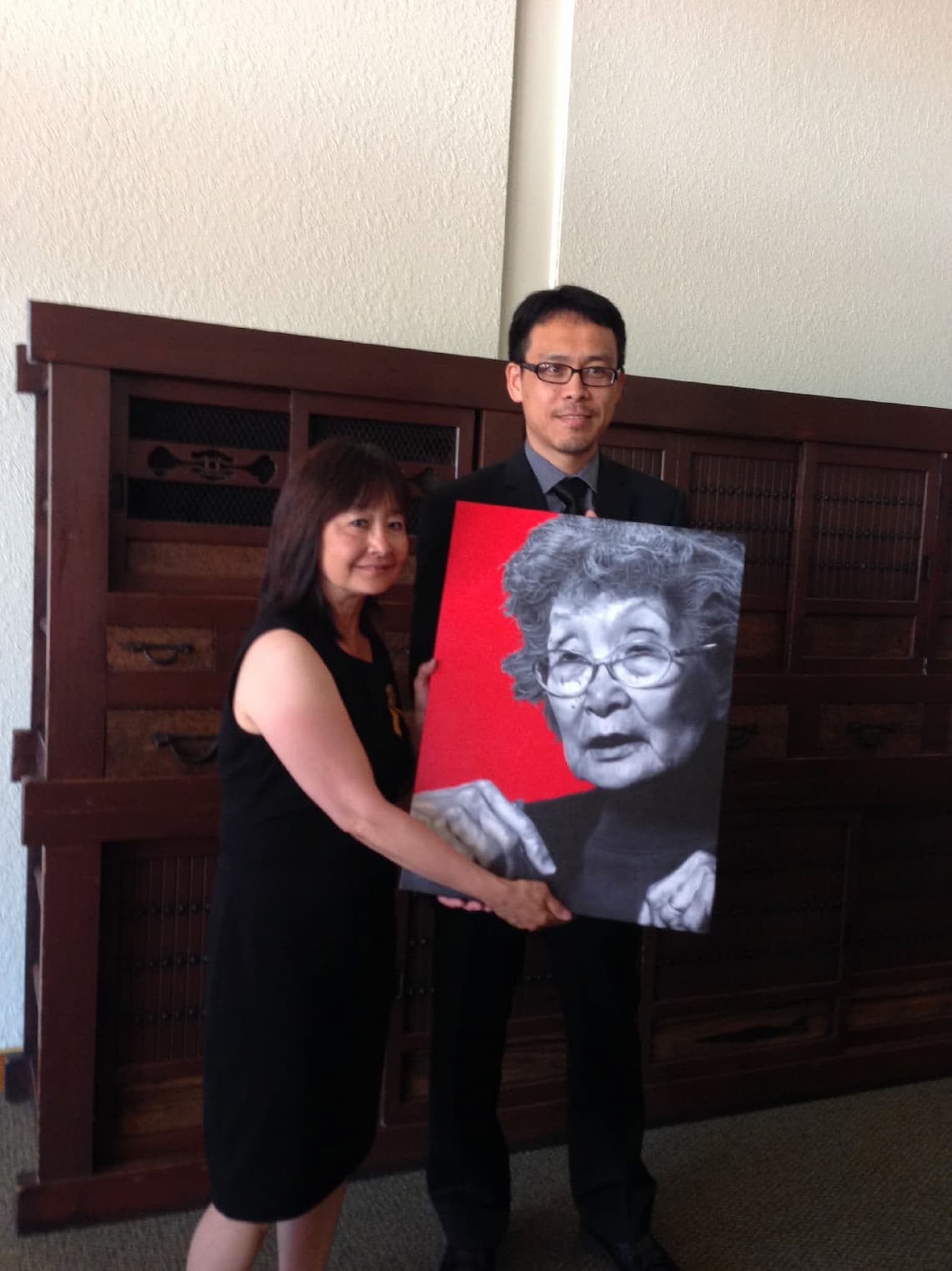
Image 38.07.05 — Artist Shuji Nakamura (right) presents his painting to Audee Kochiyama-Holman (left) at Yuri’s Kochiyama’s Los Angeles memorial in 2014. Nakamura created the portrait for the “RISE: Love. Revolution. The Black Panther Party” exhibit.
After Yuri’s passing in 2014, an outpouring of memorials and ceremonies honored her as one of the most influential Asian American activists. Her impact on political activism and popular culture is undeniable. Working against the ongoing invisibility of Asian Americans and their work to achieve recognition and redress, people across the nation are coming to know more about Yuri’s life of struggle and liberation work.
Yuri teaches us about the history of the Asian American struggles as she lived it, ways to enact Afro-Asian and Third World solidarities, and the importance of social and political mobilization to organize for change. Finally, she never forgets the importance of seemingly ordinary everyday actions such as writing a letter to a political prisoner. Her legacy lives on through a new generation of activists in the Movement for Black Lives and new waves of actions against anti-Asian violence during the COVID-19 pandemic in the early 2020s.
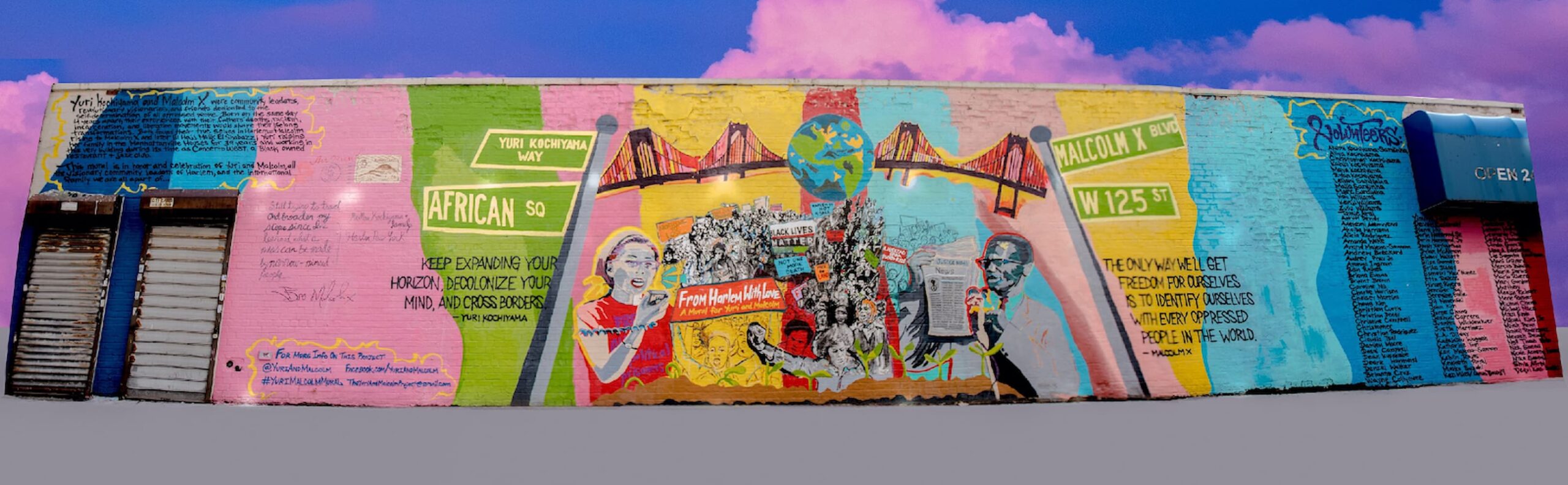
Image 38.07.06a — This “From Harlem With Love” mural is located on the corner of 125th Street and Old Broadway in New York City, a block from where Yuri Kochiyama lived at the Manhattanville House from 1960 to 1999.
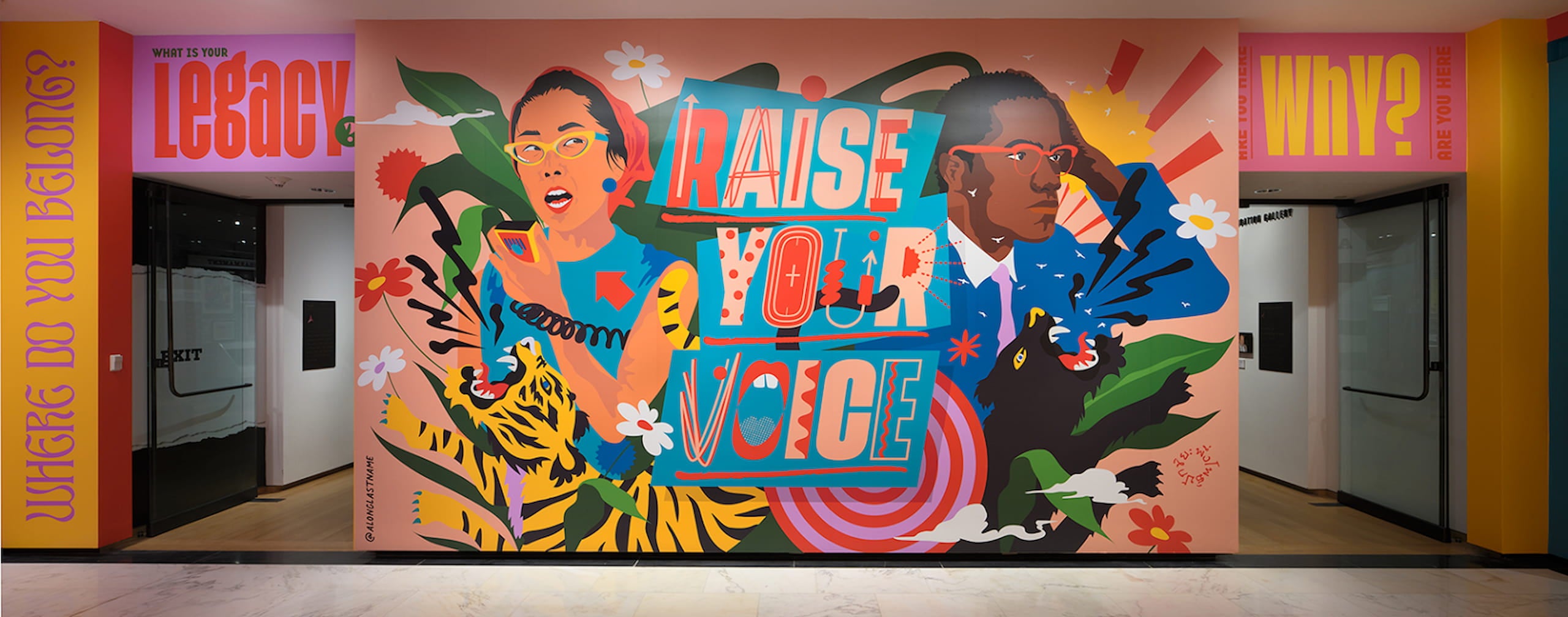
Image 38.07.06b — Amanda Phingbodhipakkiya’s Raise Your Voice mural of Yuri Kochiyama and Malcolm X, at the Museum of the City of New York, 2022.


Glossary terms in this module
activism Where it’s used
The actions and philosophies that people practice to create positive change in their communities.
Asian American Movement Where it’s used
Political and cultural movement inspired by the Black Power Movement and Vietnam War protests launched in the late 1960s, that opposed imperialism and racism and advocated for racial equality by connecting Asian Americans across different ethnic, national, and class backgrounds.
political prisoners Where it’s used
People who are imprisoned for their political actions, beliefs, or affiliations.
redress Where it’s used
To right a wrong or injustice, often through compensation. During the redress movement, many activist groups fought to gain reparations for Japanese Americans who were wrongfully incarcerated during World War II. These activists sought for the restoration of Japanese Americans’ civil rights, compensation for lost property, and a formal national apology.
reparations Where it’s used
The acknowledgment and making of amends of someone who has been wronged, or who has experienced human rights violations, often through paying a sum of money.
solidarity Where it’s used
A political, cultural, and collective stance that recognizes the mutual responsibility and support that is necessary to achieve change. Taps into the power in numbers and considers the collective interests of communities.