





CHamoru youth Tånom stands on a grassy hill, overlooking the ocean, Humåtak Bay, and Fouha Rock in Guåhan.
Module 1: CHamoru Wayfinding Beyond the Mariana Islands
Is CHamoru migration a choice?
And there’ll will be times when we’ll feel adrift, without itinerary
or destination. We’ll wonder: What if we stayed? What if we
return? When the undertow of these questions begins
pulling you out to sea, remember: migration flows through
our blood like the aerial roots of i trongkon nunu. Remember:
our ancestors taught us how to carry our culture in the canoes
of our bodies. Remember: our people, scattered like stars,
form new constellations when we gather. Remember:
home is not simply a house, village, or island; home
is an archipelago of belonging.
– Craig Santos Perez 1
These moving words by CHamoru poet, Craig Santos Perez, touch on the deep connections CHamoru people have to the Mariana Islands, despite the flow of Islanders to, from, between, and away from their ancestral lands over time. Perez’s phrase, “Remember: home is not simply a house … home is an archipelago of belonging,” highlights the complexities of what it means to be a diasporic CHamoru.
Perez’s words bring the diasporic experiences into a CHamoru context, focusing on the outmigration of Islanders from the Mariana Islands and community-making in the United States. This chapter examines the colonial pressures on the Mariana Islands that created pathways for CHamorus to relocate beyond their shores and how connections are maintained to their home islands regardless of physical location.
This module explains who CHamorus are and where they call home. It also lays the foundation for understanding CHamorus and by extension, other Pacific Islanders, as mobile people of the ocean.
Listen to
An excerpt from “Off-Island Chamorros” by Dr. Craig Santos Perez
Craig Santos Perez: And there will be times when we’ll feel adrift, without itinerary or destination. We’ll wonder: What if we stayed? What if we return?
When the undertow of these questions begins pulling you out to sea, remember: migration flows through our blood like the aerial roots of i trongkon nunu.
Remember: our ancestors taught us how to carry our culture in the canoes of our bodies. Remember: our people, scattered like stars, form new constellations when we gather.
Remember, home is not simply a house, village, or island. Home is an archipelago of belonging.
Audio 21.01.01 — Listen to Dr. Craig Santos Perez, CHamoru poet and 2023 US National Book Award Winner, read the above excerpt from his poem, “Off-Island Chamorros.”
Where do CHamorus call home?
What is the role of the ocean in CHamoru movement and identity?
How did the CHamoru diaspora start?
CHamorus and the Mariana Islands
CHamorus are the Indigenous people of the Mariana Islands. The Marianas are an archipelago of fifteen islands located in the northwestern half of the Pacific Ocean in the region known as Micronesia. Micronesia is a collection of 2,100 islands scattered over 2,900,000 square miles of ocean. There are five archipelagos in Micronesia: the Eastern Caroline Islands (Pohnpei, Chuuk, Kosrae), the Western Carolines (Yap and Palau), the Mariana Islands (Guåhan and the Northern Mariana Islands), the Marshall Islands, and the Gilbert Islands (Kiribati). In addition, there are numerous islands not part of an archipelago, including Nauru.
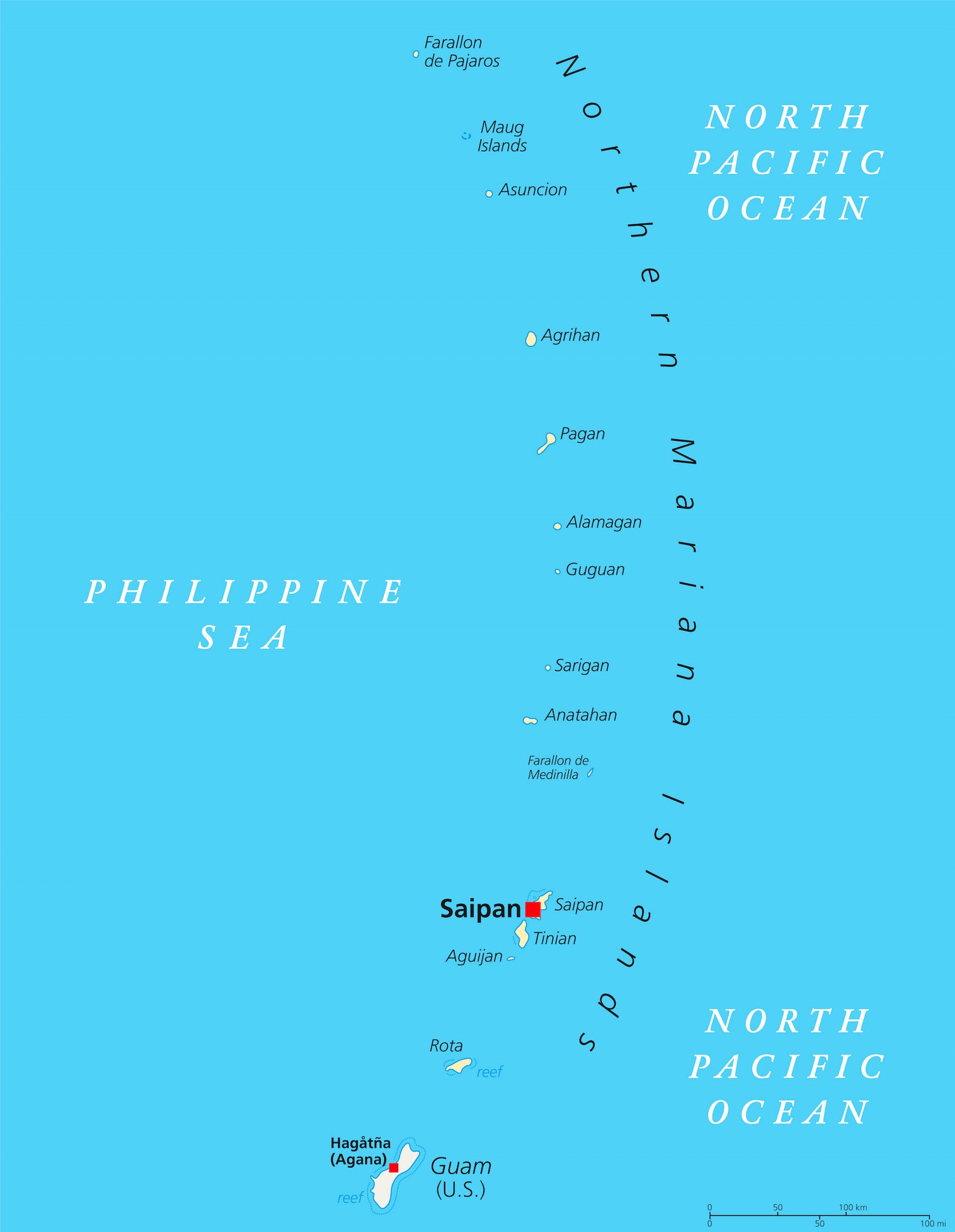
Image 21.01.02 — This map of the Mariana Islands shows the entire archipelago consisting of fifteen islands, four of which are lived on today: Guåhan (Guam), Luta (Rota), Tinian, and Saipan.
To understand CHamoru people and our ancestral roots, it is helpful to look at the CHamoru language. For example, the wider public and English writings use the spelling “Chamorro.” However, “CHamoru” is used when written in their own native language. In 2017, the Guåhan Kumision I Fino Chamorro (Chamorro Language Commission) adopted the spelling “CHamoru” to emphasize that “CH” and “NG” are unique letters to their language and should be capitalized if used at the beginning of a word. This capitalization is specific to Guåhan and not used in the Northern Mariana Islands. Throughout this chapter, “CHamoru” will be used to refer to the indigenous people of the Mariana Islands and “Guåhan” in reference to the island commonly known as Guam.
In spite of the variation in their orthography, or spelling system, CHamorus are one people across their archipelago. Engagement with the CHamoru language in this way shows that they can form an oral tradition and continue to standardize the spelling of their words.
In the CHamoru language, the Mariana Islands are also known as Låguas yan Gåni. Låguas refers to the southern, populated islands and gåni refers to the northern islands in the archipelago. Of these fifteen islands, only Guåhan, Luta (also known as Rota), Tinian, and Saipan are inhabited today. Guam is at the southern end of the archipelago.
CHamorus have a deep history in their ancestral lands. From an anthropological perspective, they journeyed to the Mariana Islands over four thousand years ago. This scientific account of migration is complemented by their rich oral traditions. According to CHamoru creation myths, the islands and our people were created through the bodies of sister and brother gods, Puntan and Fu’una, in Fouha Bay in Guåhan. This long and dual history—spanning both scientific understanding and sacred myth—is central to CHamoru identity.
The Spanish explorer Ferdinand Magellan landed in Guam in 1521, marking the archipelago’s first encounter with Europeans. This makes CHamorus the Pacific Islander community with the longest history of resisting, enduring, and negotiating with colonization. In 1667, Spain formally claimed the islands and named it Las Islas Marianas. The Spanish colonizers brought immense change to the Mariana Islands through the imposition of Catholicism, violence of war, and forced migrations of Islanders.
In 1898, as a result of the Spanish-American War, Guam shifted from being an island controlled by five hundred years of Spanish colonial rule to being politically controlled by the US. As a result, what was once a unified archipelago for thousands of years split into two separate entities: the Northern Mariana Islands and Guam.
The Northern Mariana Islands (NMI) were sold to Germany and later taken by Japan in 1914. Following World War II, the US maintained possession of Guam as a colony and designated it as a non-self-governing territory (NSGT). In 1978, the NMI was made into a commonwealth of the US. Most studies of Guam and the Northern Mariana Islands focus on the issues that arise due to them being considered different political entities of the US.
CHamorus: United by Culture
In spite of the political designations that divide the Mariana archipelago, CHamorus see themselves as one people bound by their cultural roots. Throughout this chapter, CHamorus will be viewed as one people, encompassing both Guam and the Northern Mariana Islands.
Reflection Question
How might the political separation of the Mariana Islands due to US colonialism change the way CHamorus relate to one another across their islands and wider communities?
Migration in Oceania is not a recent phenomenon, but rather a fundamental part of Oceanic identities and histories. Thousands of years before Europeans and Americans dared to sail beyond their shores, Micronesians were comfortably navigating the Pacific. These skilled navigators had a deep understanding of the ocean and stars that allowed them to take long voyages throughout Oceania. These navigational practices connected the islands of Micronesia, binding its five archipelagoes.
Today CHamorus retain their relationships to one another through new forms of transportation and technology. Contemporary mobility is redefining what it means to be from this region and to live abroad. For CHamorus, the US military has been a major conduit for migration and mobility. Large CHamoru communities are concentrated in several cities neighboring major military facilities across North America. For example, San Diego, California, has one of the oldest and largest CHamoru communities, with Islanders moving there as early as the 1950s.
To understand CHamoru mobility, it is best to start from within the region. From an archeological lens, the Pacific was populated by people from Southeast Asia around four thousand years ago. There have been many waves of migration into the Pacific over centuries; with routes starting in Indonesia and the Philippines moving through Micronesia and Melanesia, and later journeying south, east, and north through Polynesia.
Similarities among people throughout Oceania can be seen through the dispersal of Lapita-style pottery, Austronesian languages, cultural practices, and historical accounts through oral traditions. These migrations of people were intentional, and wayfinders opened up Oceania through a sophisticated system of navigation that enabled them to find new islands, return to their home islands, and venture out again to other lands.
As ocean people, waterways are an extension of their islands’ surroundings rather than an obstacle of isolation. The islands themselves might be limited in size; however, the ocean is integrated into the larger environment, making for an expansive blue continent. Short trips were used to search for new islands, trade goods, learn new ideas and technologies, and acquire resources. Longer voyages helped expand social networks, as well as strengthen relationships with other island groups.
Pohnpeian-Filipino scholar Vicente Diaz uses Austronesian seafaring practices to challenge ideas about Oceanic identities and how Pacific Islander mobility is a historical process that is deeply ingrained in our genealogies. He argues that, “Austronesian seafarers would fan out and settle roughly four fifths of the globe’s southern oceanic hemisphere. The diaspora has been underway for at least four thousand years now.” 2
Today’s vast migration of Islanders beyond Oceania is simply a new iteration of what their ancestors have always done.
Seafaring, Wayfinding, and Migration
Like other Pacific Islander communities, CHamorus have a long history of migration throughout Oceania and expanding their global reach. My ancestors were skilled navigators that observed wave patterns, the rising and setting of stars, changes in the ocean’s color, and noted the presence of birds and sea life that enabled their mobility.
CHamorus constructed diverse canoes that were used for a variety of tasks, such as fishing and a means of transportation. “Swift, light, and graceful, the proa of the CHamoru was one of the highest state-of-the-art expressions of that most essential instrument of all traditional Pacific Islanders, the ocean-going sailing canoe.” 3
CHamoru workmanship can be observed in the small paddling galaide’ (canoes) used within the reefs, and sakman (larger canoes) needed for interisland journeys. Much of what is known about CHamoru canoes, such as the proa, come from the written observations of Europeans in the region. They reported how the canoes were steered with paddle-like rudders and by sail manipulation, both of which could be moved from one end to the other so that the front and back were interchangeable if adjustment in direction was required.
The large triangular sails were woven from pandanus palm leaves, making for a light yet durable sail. Not only was the canoes’ maneuverability impressive to Europeans, but also their speed. Descriptions likened the canoes to dolphins jumping from wave to wave or that they seemed to glide over the water, hence the nickname “flying proa.”
In 1737 George Anson, an officer in the British Navy, embarked on a worldwide voyage to attack and seize Spanish territories in South America and the Pacific. While anchored off the shore of Tinian, Anson observed CHamoru canoes and noted that, “… for their flying proas in particular, which have been for ages the only vessels used by them, are so singular and extraordinary an invention that it would do honor to any nation, however dexterous and acute.” CHamoru ingenuity kept us close to our ocean and helped in our growth in the science of wayfinding. 4
Although navigational skills and advanced vessels were important to early CHamoru mobility, Islanders’ relationship to their ancestors also gave them the necessary confidence to traverse their waterways with assurance of their safety. Lawrence Cunningham in Ancient Chamorro Society explains that:
“The ancient Chamorros were willing to take risks. Their migrating ancestors had always found land before. If unsuccessful in their search for land, they would always use their knowledge to return home … The Chamorros trusted nature. The spirits of their ancestors were their “backers.” Animistic beliefs probably assured the Chamorros that their sakman, the sea, and the land they sought had spirits. The ancient Chamorros believed that if they treated those spirits, and especially the ante of their ancestors, with respect, everything would turn out right.” 5
The challenges of celestial navigation were overcome because CHamorus were never alone on the open ocean. CHamorus practiced ancestor worship, believing the world around them was full of the spirits of ancestors and those who recently passed. These spirits take on new obligations and keep close relationships with the living. Ancestors’ souls are forever (taifinakpo’), and a trusted connection to past CHamoru wayfinders.
Recognized seafaring routes were commonplace among the various island groups, keeping ties to one another for trading goods, strengthening kinship ties, and exchanging ideas. CHamoru mobility was part of daily life and a cultural marker that others recognized them for.
CHamorus today continue to stay rooted in their home islands despite the various decisions or conditions that may have led them to migrate. Colonial routes have led many CHamorus to extend the reach of the Mariana Islands to places far beyond their shores. They continue to build communities in new geographic spaces. These new “villages” such as San Diego, California, are composed of CHamorus that stay connected to the Mariana Islands through festivals, barbecues, rosaries, and other social gatherings despite living far from home.
Even though colonialism, especially under American rule, still shapes our migration routes and diasporic communities, CHamorus continue to express and celebrate their island ancestry. This rootedness adds another layer of survival and colonial negotiations that begs for further consideration in a time of substantial migration.
Glossary terms in this module
colonialism Where it’s used
The process in which one country or people controls another place or people through partial or full political control for an extended period. Colonialism has lasting economic, social, and cultural effects even after the period of formal colonization is over.
commonwealth Where it’s used
A self-governing unit voluntarily grouped with the US, such as the Northern Mariana Islands.
diaspora Where it’s used
The dispersal, movement, migration, or scattering of a people from their established or ancestral homeland.
non-self-governing territory (NSGT) Where it’s used
Territory whose people have not yet attained a full measure of self-government.
Oceania Where it’s used
Region made up of thousands of islands throughout the Central and South Pacific Ocean, including Australasia, Melanesia, Micronesia, and Polynesia.
oral tradition Where it’s used
The knowledge, culture, art, and history that are passed down through speech from one generation to the other.
proa Where it’s used
A type of CHamoru voyaging canoe.
wayfinding Where it’s used
The process of orienting and traveling from place to place.
Endnotes
1 Craig Santos Perez, “Off-Island Chamorros,” March 2, 2024, craigsantosperez.wordpress.com/2017/07/25/off-island-chamorros/.
2 Vicente Diaz, “No Island Is an Island,” in Native Studies Keywords, ed. by Stephanie Nohelani Teves, Andrea Smith, and Michelle Raheja (University of Arizona Press, 2015), 93.
3 Robert Rogers, Destiny’s Landfall: A History of Guam (University of Hawaiʻi Press, 1995), 31.
4 Scott Russell, Tiempon I Manmopo’na: Ancient Chamorro Culture and History of the Northern Mariana Islands (Division of Historic Preservation, 1998), 198.
5 Lawrence Cunningham, Ancient Chamorro Society (Bess Press, 1992), 17.