




Module 1: If You Want to Know What We Are
Can everyday objects tell us something important about Filipinx American history or lives?
This chapter is an overview of Filipino American histories, emphasizing the events from the Philippine Revolution against Spain (1896–1898), war with the United States (1899–1913), and labor migration to the United States. We will explore how, why, and when Filipinos came to the United States, and under what conditions they participated in and led movements for social change throughout the twentieth century.
Filipino experiences in the United States are not singular. Many have experienced poverty and hardship, while others have enjoyed comfort and fortune. Some have organized for better working conditions with their colleagues, while others have taken advantage of their fellow Filipinos. In his poem “Conditions (an unrestricted list),” Napoleon Lustre captures the diversity of Filipinos in the US when he wrote:
“You are Pilipino
if your mother is Pilipina
if your father is Pilipino
if you are from ‘pinas
if you have one drop of Pilipino blood” 2
Lustre’s poem goes on to describe how Filipino American identity contains many different experiences.
Writer and activist Carlos Bulosan said, “Our history has many strands of fear and hope that snarl and converge at several points in time and space.” 3 The idea of strands can feel fragile, and sometimes these connections between the vast number of Filipinos and Filipino American experiences can seem that way. Letters, calls, texts, or balikbayan boxes (corrugated boxes that contain items sent to the Philippines by overseas Filipinos) can help sustain connections, but those thin strands can also break at any moment with a dropped call or a lost letter. There are times when strands of Filipino culture weave together into something strong and inspiring. By following all these strands, we might see patterns emerge throughout history, with powerful examples of solidarity, resistance, and mutual care.
This chapter follows the “strands” offered by five museum objects from the Smithsonian Institution. The Smithsonian, the world’s largest museum, education, and research complex, has collected important artifacts of Philippine history, but not without controversy. While some items were donated or given with permission from Filipinos, many objects in the Smithsonian collection were taken without agreement. Thus, the history of the Philippines is deeply embedded in the history of the Smithsonian and the United States.
Who are Filipino Americans?
What are some objects at the Smithsonian related to Filipino American histories?
How can objects help us think about the relationship between biography and history?
Beginnings, Not Origins
Beginnings are numerous, offering the opportunity to restart countless times, with multiple stories to be created, learned, and passed on. In contrast, origins can appear quite singular, as if there is only one moment in the distant past to look back on. Similarly, research, reports, and data can provide important information about Filipino American history, but they also have limitations. This information should be treated as part of a larger arc, not the whole story or even the origin of Filipino migration to the US.
For example, Census data documents some Filipino migration to the US, but there is some missing information. In 1910, the Census had very limited race categories for Asian communities, counting only Chinese and Japanese populations separately, and used a broad “All Other” category for additional Asian groups. Filipino migrants, however, are referenced in the 1910 Census’s analysis of foreign-born population from “All Other” Asian countries. The 1950 Census reported Filipino populations of 2,500 or more in California, Washington, and New York. Given only this information, it may seem like Filipino migration began in 1910, but they migrated to the US and its territories earlier than that. Filipinos migrated to Hawaiʻi to work on large, segregated plantations as early as 1906, but there is no census data from this period because Hawaiʻi was considered a US territory and did not become a state until 1959. Using only Census data, we would miss this important history.
The Pew Research Center reported that in 2019 the top ten largest metropolitan areas where Filipinos live included five locations in California. Filipinos also represented the largest Asian group in New Mexico, Nevada, Idaho, Montana, the Dakotas, West Virginia, Alaska, and Hawaiʻi. But states with smaller populations also have vibrant Filipino communities, such as in Jacksonville, Florida; Houston, Texas; Atlanta, Georgia; and Boston, Massachusetts.
Filipinos in the US are members of the global diaspora, a scattering of people throughout the world with historical roots in the Philippines. They are also an Asian ethnic group within a larger racial formation of Asian Americans—the fastest growing segment of the US population. Of the top ten languages most commonly spoken in US homes other than English or Spanish, Filipino languages—such as Filipino/Tagalog, Ilokano, and Cebuano—rank fourth. What information does this give us about Filipinos in the US? What information is still missing?
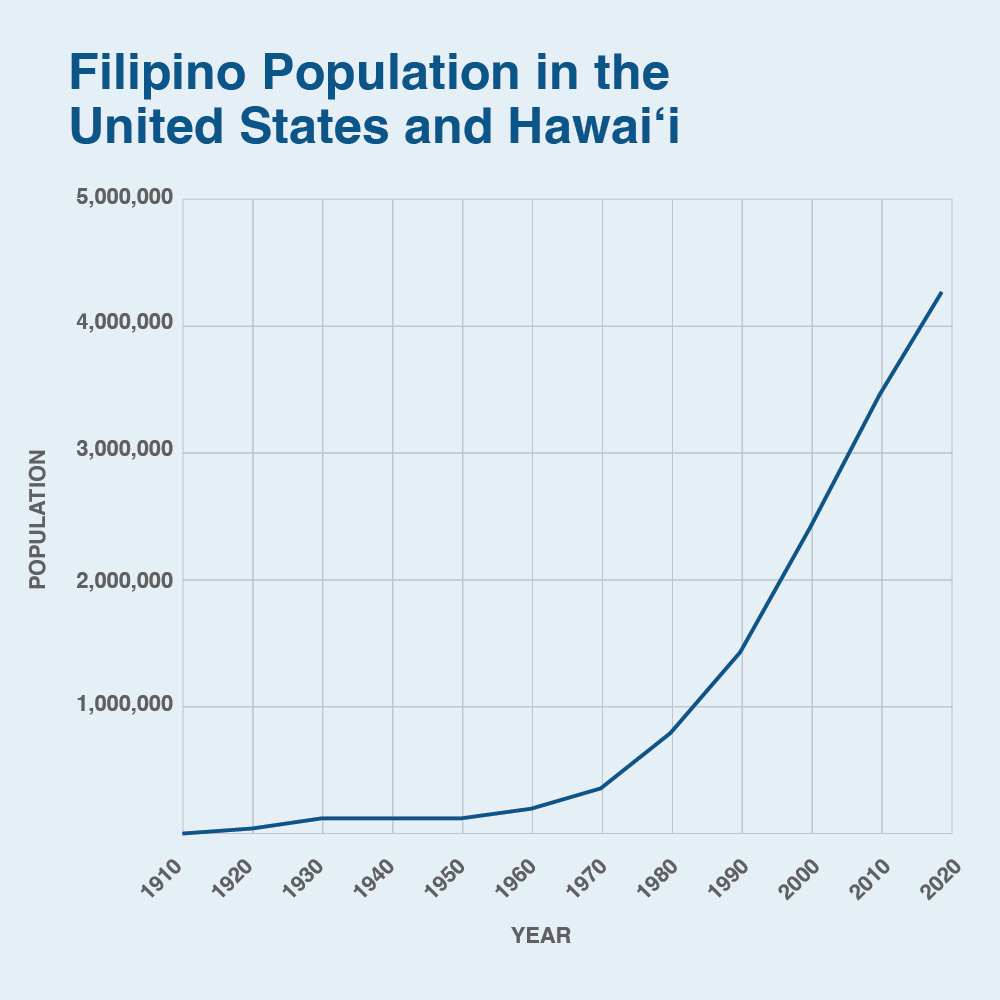
Image 10.01.01 — US census data on Filipino populations in Hawaiʻi, combined with Filipino populations on the continental United States. (Source: 2002 US Census)
Tracing Routes and Taking Root
Filipinos are not new to the Americas. During Spanish colonization of the Philippines between 1521 and 1898, ships called galleons transported goods between the Philippines and Mexico, another Spanish colony. The Manila Galleon Trade (1565–1815) played a significant role in the global circulation of persons and property for centuries. For most of this time period, galleons sailed between Acapulco, Mexico, and Manila, Philippines, which was an important trading post in Asia. Goods sent to Manila were then transported to other parts of Asia, and those sent to Acapulco were transported to other parts of the Americas and Europe. Filipinos crossed the planet aboard trading ships and earned a well-deserved reputation as skilled seafarers. Anyone looking to assemble a seasoned crew—whether in Liverpool, Baltimore, Acapulco, or Manila—would have done well to include Filipinos.
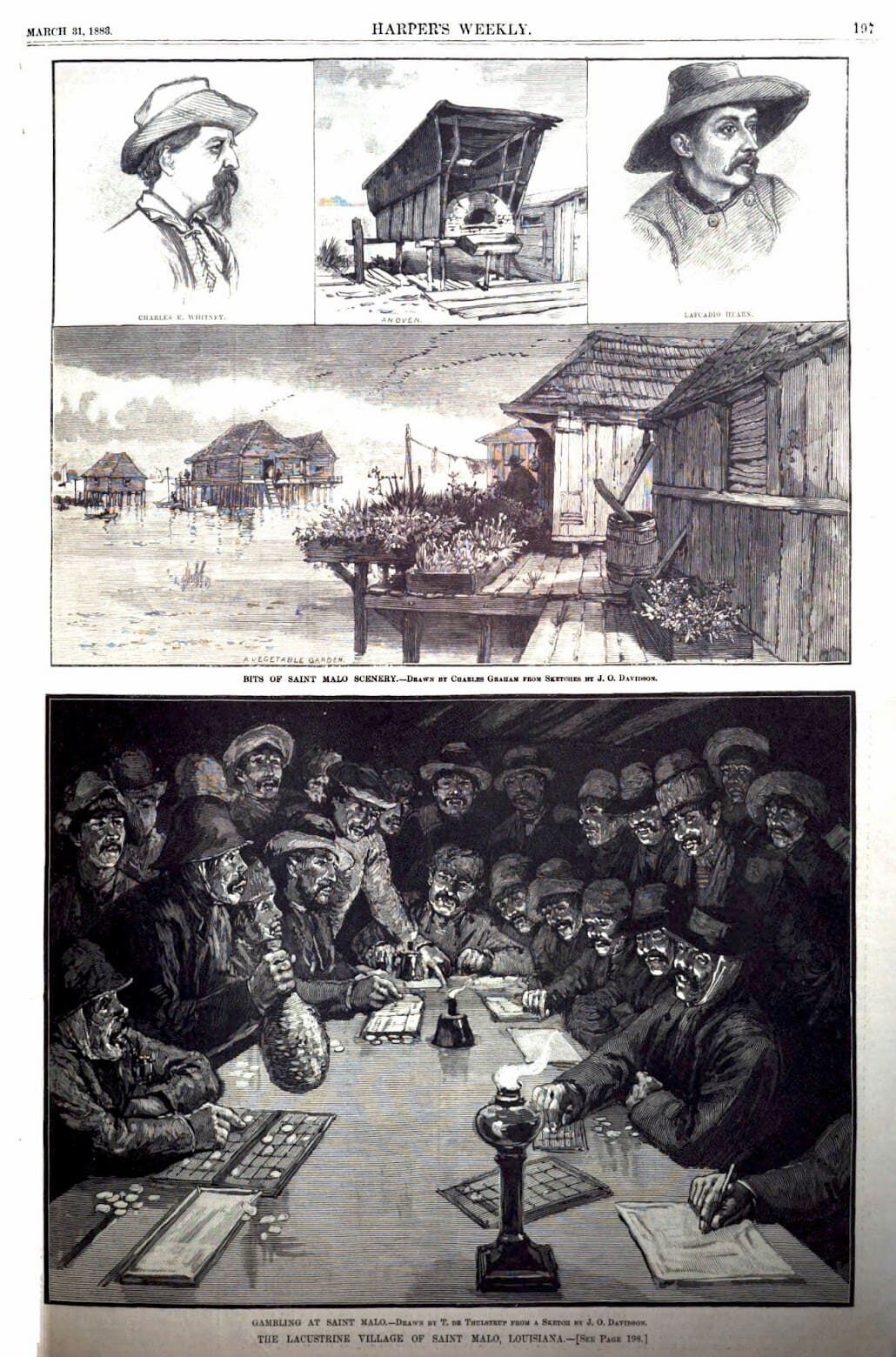
It is not known exactly when Filipinos arrived in North America. Many claim 1763 as the year Filipinos first arrived, but there is no reliable evidence to support that date. An early written account of Filipino communities in the US is from an 1883 Harper’s Weekly article about the village of St. Malo in Louisiana. In that article, writer Lafcadio Hearn described “a certain strange settlement of Malay fishermen—Tagalas from the Philippine islands” that had existed for fifty years, which matched the time of global Filipino seafaring to the Americas. 4 Descendants of St. Malo’s inhabitants have made oral histories that also provide more insights. As many as fifteen generations of families are still going strong to this day.

Image 10.01.02 — Drawings of the first permanent Asian settlement in the Americas, circa 1883. These illustrations represent rare depictions of an Asian Pacific American community outside of more familiar locations such as the Chinatowns of New York and San Francisco.
African and Asian Laborers in the Americas
The histories of African and Asian laborers have been entwined for many centuries. Enslaved people from Africa developed port cities and harvested crops. They created the foundation for the wealth of others. As slavery was formally abolished throughout Europe and the United States beginning in the early 1800s, the importation of labor migrants from Asia increased.
Capitalists initially welcomed groups from Asia for their cheap labor, but it did not take long for those who had narrow definitions for who should be in the country to block immigration from Asia. While the interests of these capitalists and xenophobes were distinct, members of these groups often overlapped. From the 1840s to the 1940s, these groups influenced laws and policies for Asians coming to the United States. For example, in the 1860s, Chinese people mined gold in California and built the United States’ Transcontinental Railroad. But starting in 1875, federal immigration laws formally excluded Chinese people from emigrating. People from India and other parts of South Asia arrived as agricultural workers in the early 1900s, and by 1917, Congress passed an exclusion law against them too. Japanese people arrived to work on plantations throughout Hawaiʻi and the West Coast, only to face a similar federal ban in 1924.
Filipino revolutionaries fought against the Spanish and declared their independence from Madrid in 1898. Both the United States and Spain refused to recognize Filipino sovereignty. When the United States acquired the Philippines as a colony from Spain in 1899, Filipinos became “US nationals.” Neither citizen nor alien, this meant Filipinos could travel to the United States and the territory of Hawaiʻi without a passport. As a result, the Filipino population in the United States jumped. Many journeyed to Hawaiʻi in 1906, and even more arrived in the 1920s for jobs in fishing, farming, and factories. Thousands of Filipinos coming to Hawaii and the United States faced narrow job choices and a segregated US society. The Tydings-McDuffie Act of 1934 was passed by the US Congress to grant the Philippines its eventual independence; this also meant that Filipinos who were residing in the United States at the time became aliens.
Despite these obstacles, Filipino communities made major contributions to US history. Labor organizers like Philip Vera Cruz, Larry Itliong, and Pablo Manlapit fought for better working conditions and higher wages from Seattle to Salinas, and from Honolulu to Delano.
More to explore
Slideshow
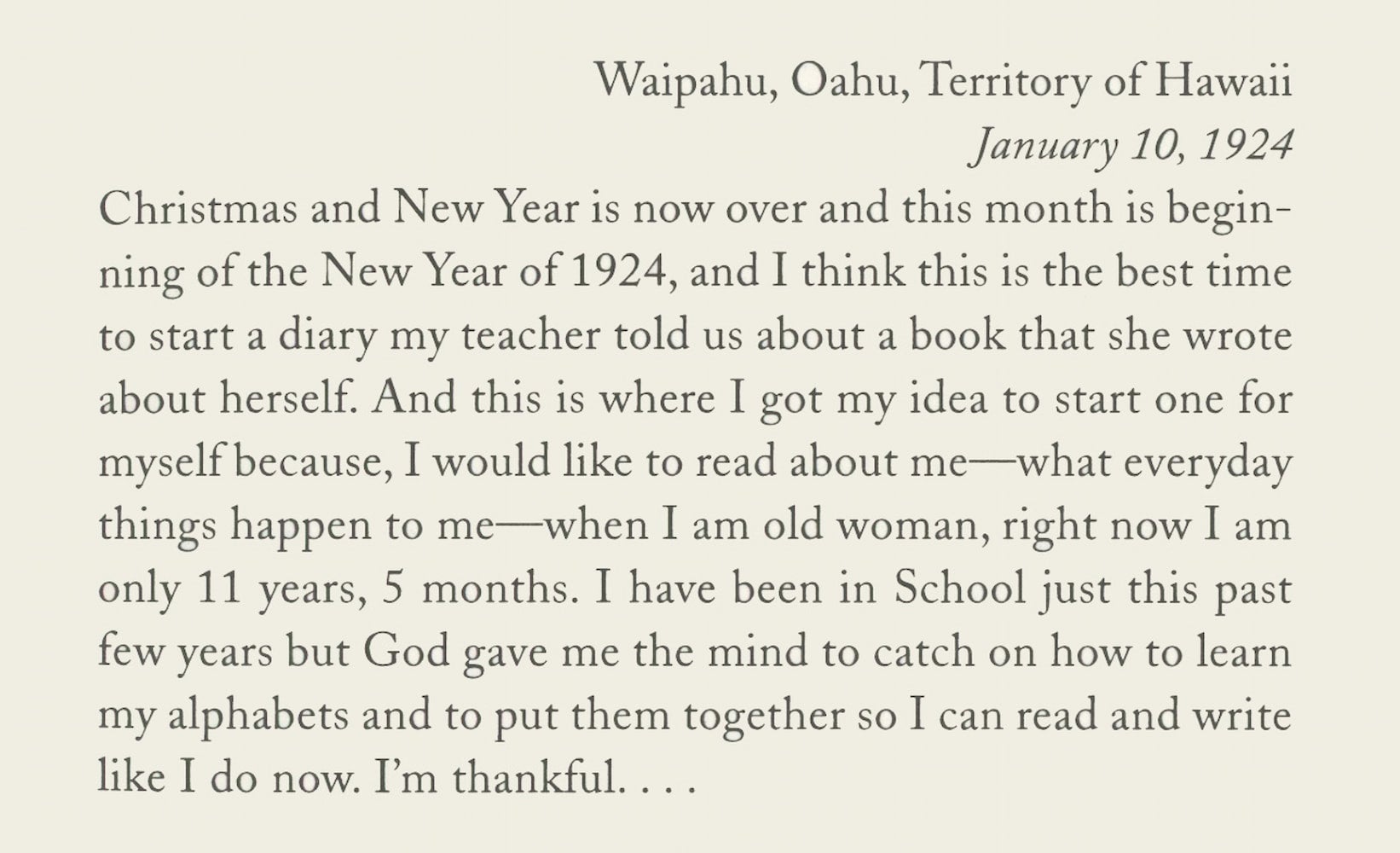
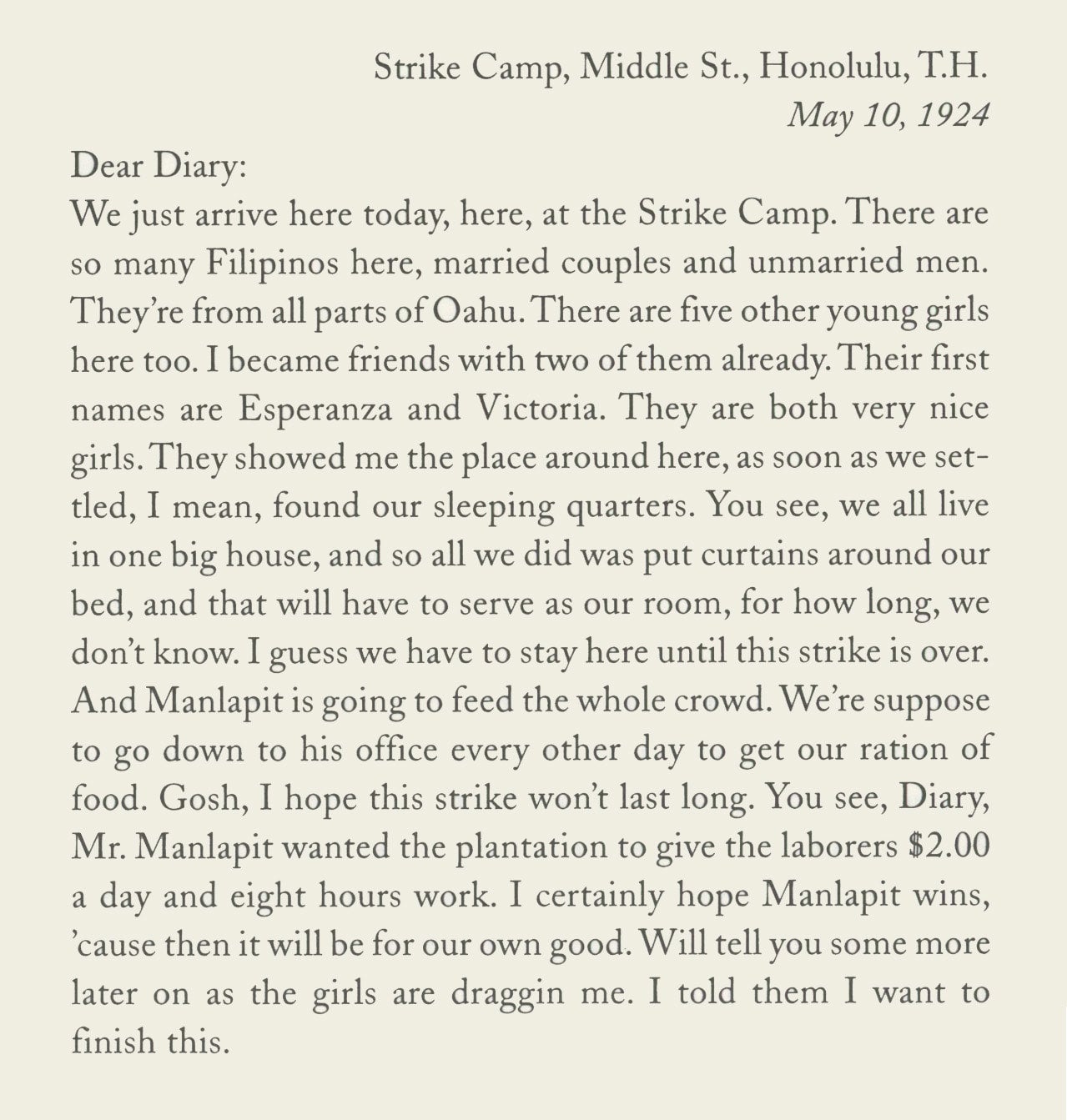
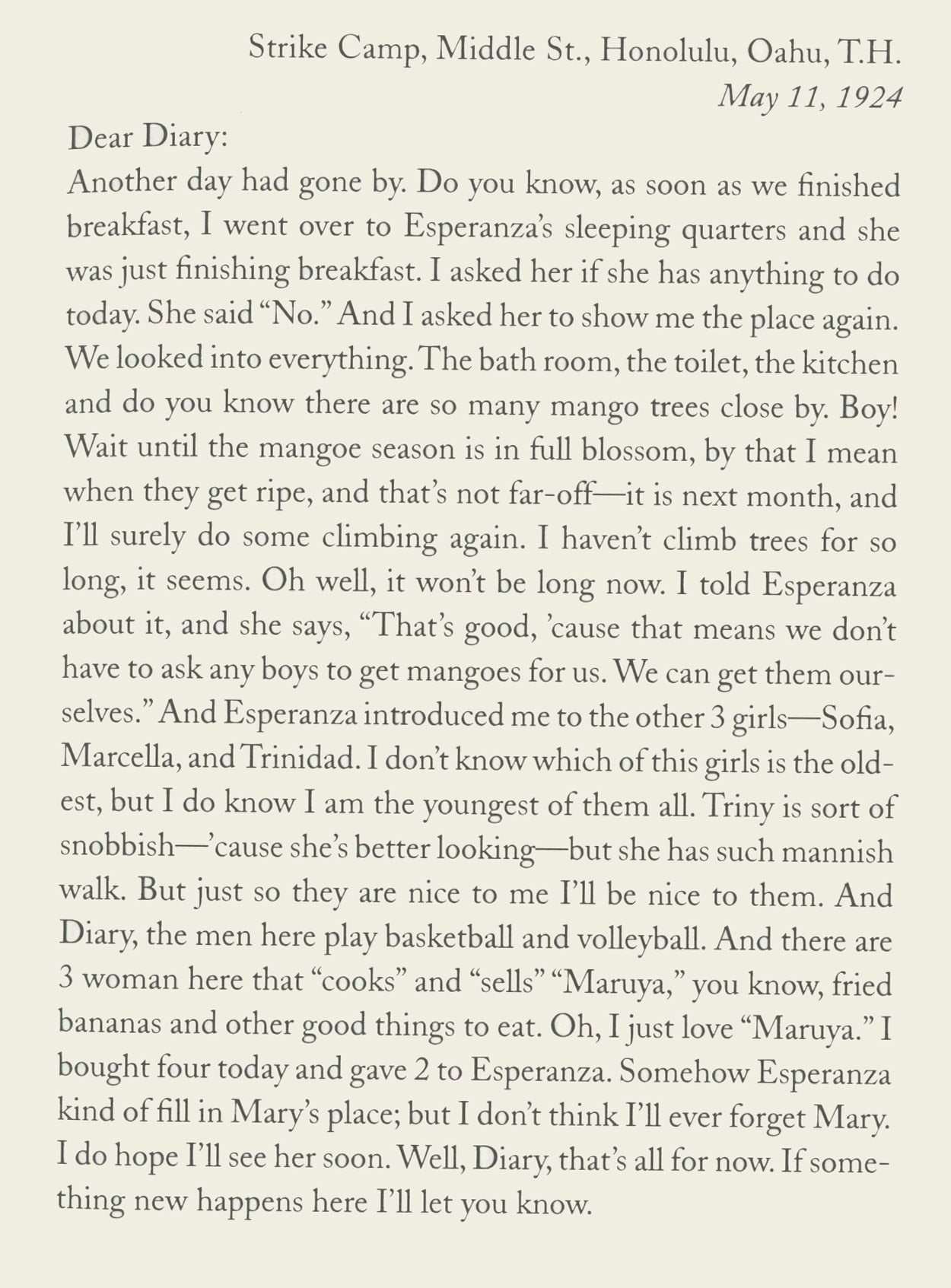
Angeles Monrayo Diary
Read the first entries of Angeles Monrayo, Tomorrow’s Memories: A Diary, 1924–1928 (University of Hawaiʻi Press, 2003), 15-17.
New Strands
Filipino American populations also grew in the second half of the twentieth century. Until the 1940s, Filipino communities in Hawaiʻi and the United States were largely male dominated because plantation owners recruited single men whose wages would be lower than married persons. Many of these workers married in the US, often breaking laws that prohibited marriages between white women and non-white men. This pattern changed with the 1945 War Brides Act, which allowed for the naturalization of foreign women. Filipino Americans who had served in World War II married Filipinas in the Philippines and settled in the US.
The 1965 Immigration and Nationality Act caused another significant increase in the Filipino population in the US. This law expanded immigration, giving preference to certain occupations and family reunification. Congress wanted to give the United States an edge in the global competition between the US and the Soviet Union, and hoped this law would encourage Southern and Eastern Europeans to migrate. An unintended consequence of this broadened immigration policy was an increase of migration from Latin America and Asia, specifically from Mexico and the Philippines. Contemporary life has been deeply shaped by this immigration reform.
As the Filipino population grew in the 1960s, their professions also diversified. Prior to 1965, most scraped their way through working-class jobs in factories, fisheries, farms, and the military. This labor involved long hours, low pay, dangerous working conditions, substandard housing, and unreliable access to health care. After 1965, labor recruiters wanted so-called “professional” expertise that required advanced formal education in health care work and engineering. However, their academic degrees did not guarantee a high salary. In fact, many Filipino migrants experienced a devaluing of their foreign credentials when finding work in the US.
During this time, student activists, including Filipinos, played a major role in rethinking what it meant to be a minority in the United States and to be part of a global majority. This collective term refers to people of Indigenous, African, Asian, or Latin American descent, who constituted approximately 85 percent of the global population at the time. Young people throughout the world saw themselves, and their languages, music, literature, history, fashion, politics, and sexuality, through the lens of the massive shifts across the globe.
Historian Geoffrey Barraclough observed that after World War II, “No less than 40 countries with a population of 800 million—more than a quarter of the globe’s population at the time—revolted against colonialism and won their independence.” 6 Hundreds of millions of people in Asia, Africa, and the Americas envisioned a new world that did not involve their nations used as battlegrounds for world wars and corporations, watering down their cultures and selling them for profit.
In the Philippines, 1965 also marked an important milestone: the presidential election of Ferdinand Marcos. Marcos instituted martial law at the end of his second term in 1972, centralizing the authority of many state functions under his rule. He controlled the legislative, judicial, military, and economic functions in the Philippines, as well as media and communications. Filipinos rose up to challenge this.
In the diaspora, Filipino Americans formed the broad-based National Committee for the Restoration of Civil Liberties in the Philippines, to call for an end to martial law and US aid to the Marcos dictatorship. Other advocacy groups also formed, such as Friends of the Filipino People; and the Union of Democratic Filipinos, or Katipunan ng mga Demokratikong Pilipino (KDP), a self-described revolutionary organization that had chapters throughout the United States and Canada.
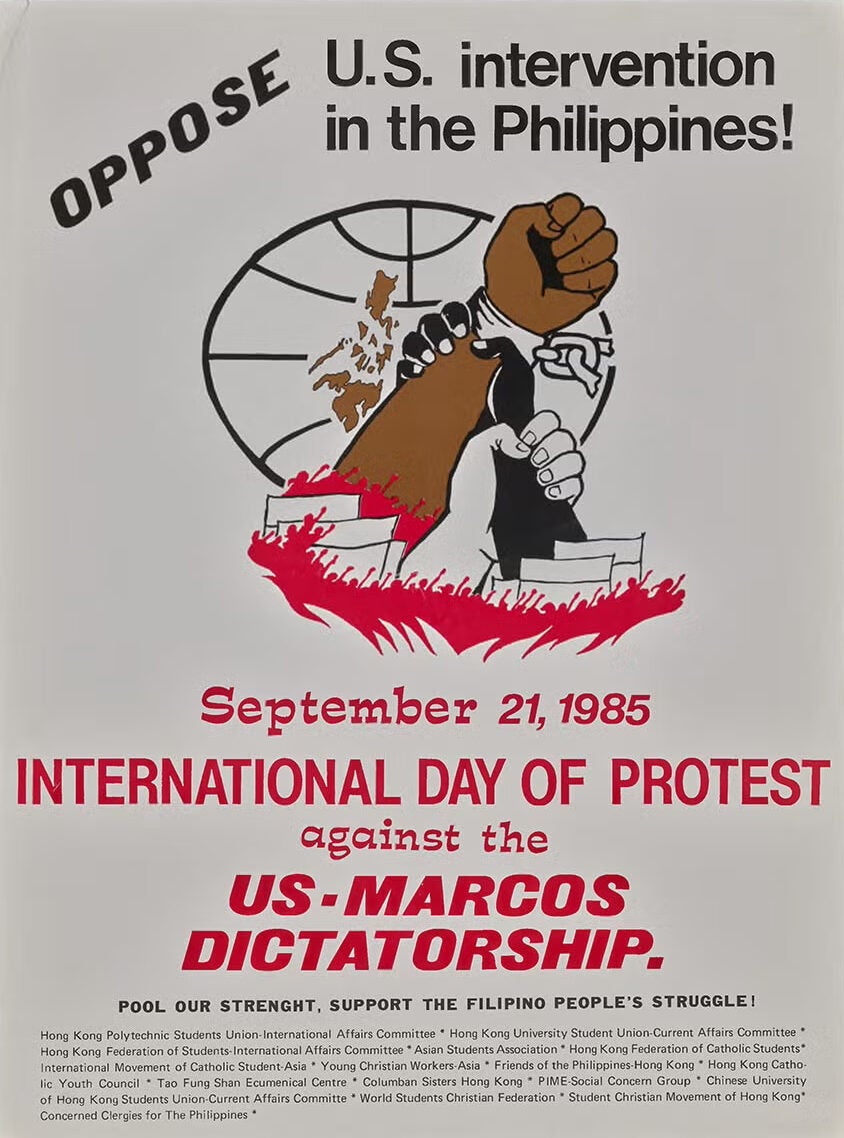
Image 10.01.04 — This 1985 International Day of Protest against the US-Marcos dictatorship was organized by a coalition of several international student groups on the anniversary of Marcos’ declaration of martial law.
Conclusion
These many strands of Filipino American history can seem tangled. We may not always know where to begin, or how to understand when one incident might have an impact on another. The task of historians and curators involves making sense of these tangles and tangents. In the following modules, we will explore some of these strands through museum objects. As we pull one strand, we might be able to see where the evidence—letters, oral histories, artifacts, documents, lyrics, and more—takes us. As we gather these seemingly different and distinct strands together, we will understand larger patterns taking shape in the vibrant weave of Filipino American history.
Listen to
We are the Children
We are the children of the migrant worker
We are the offspring of the concentration camp
Sons and daughters of the railroad builder
Who leave their stamp on America
Audio 10.01.05 — Listen to a sample from Chris Iijima, Nobuko Miyamoyo, and Charlie Chin’s A Grain of Sand: Music for the Struggle by Asians in America (New Paredon Records, 1973), PAR01020. This was an album that expressed the political and cultural values of the Asian American Movement.
Glossary terms in this module
revolution Where it’s used
Instances of social, political, or cultural change.
Endnotes
1 Barrett et al., “In Defense of the X: Centering Queer, Trans, and Non-Binary Pilipina/x/os, Queer Vernacular, and the Politics of Naming,” Alon: Journal for Filipinx American and Diasporic Studies 1, no. 2 (2021): 125–147.
2 Napoleon Lustre, “Conditions (an unrestricted list),” Amerasia Journal 24, no. 2 (1998): 111–114.
3 Carlos Bulosan, “Freedom from Want,” The Saturday Evening Post, March 6, 1943, https://www.saturdayeveningpost.com/2017/12/carlos-bulosans-freedom-want/.
4 Lafcadio Hearn, “Saint Malo: A Lacustrine Village in Louisiana,” Harper’s Weekly, volume 27, number 1371, March 31, 1883, 196–199.
5 Dawn Bohulano Mabalon, “Writing Angeles Monrayo into the Pages of Pinay History,” in Tomorrow’s Memories: A Diary, 1924–1928, ed. Rizaline R. Raymundo (University of Hawai‘i Press, 2003), 248.
6 Geoffrey Barraclough, An Introduction to Contemporary History (C. A. Watts, 1964), 153.